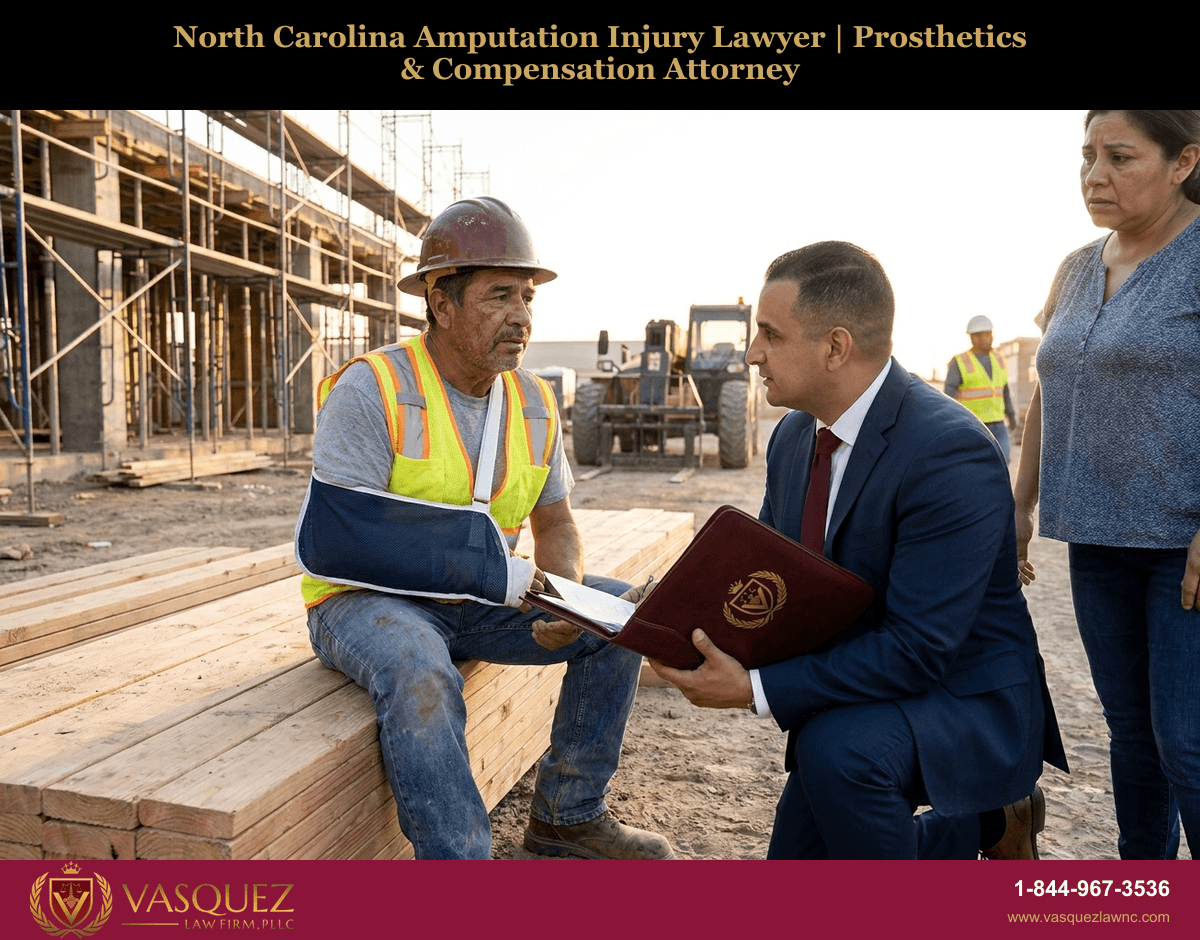
North Carolina Amputation Injury Lawyer | Prosthetics & Compensation Attorney
Fighting for the lifetime of care a limb loss actually requires
Compassionate Legal Support Through a Life-Changing Loss
Losing a limb means a lifetime of adjustment. Our goal is to hold negligent parties accountable and secure the resources your recovery actually requires.
Amputation Injury Claims in North Carolina
An amputation injury is the loss of all or part of a limb - a finger, hand, arm, toe, foot, or leg - due to trauma or, in some cases, a surgical amputation made necessary by a severe injury or untreated medical condition. At Vasquez Law Firm, we help people injured by another party's negligence pursue compensation for an injury that permanently changes how a person works, moves, and cares for themselves.
North Carolina law allows amputation victims to pursue claims under several legal theories depending on how the injury occurred. Workplace amputations - often caused by machinery with inadequate safety guarding, crush injuries, or degloving injuries - are usually handled through the North Carolina Workers' Compensation Act, though a separate claim against a negligent third party, such as an equipment manufacturer or a subcontractor who was not your employer, often remains available. Product liability claims apply when defective machinery, power tools, or equipment lacking proper safety features causes the injury. General personal injury claims apply when a motor vehicle or motorcycle collision, or another party's negligence, results in traumatic limb loss. The statute of limitations for these claims is generally three years from the date of injury under N.C.G.S. § 1-52(16).
The level of amputation - a partial finger or toe, below-knee or below-elbow, above-knee or above-elbow, or the loss of multiple limbs - significantly affects prosthetic needs, functional limitations, and the long-term cost of care, and in turn the value of a claim. Because prosthetic technology and physical rehabilitation needs continue for the rest of a person's life, our attorneys work with prosthetists, physiatrists, vocational experts, and life care planners to build a complete picture of both the costs already incurred and the decades of recurring costs still to come.
Common Causes of Amputation Injuries
Workplace Machinery Accidents
Crush injuries and degloving injuries from equipment with inadequate safety guarding
Motor Vehicle Accidents
Car, truck, and motorcycle collisions causing traumatic limb loss
Defective Products
Power tools and machinery lacking proper safety features
Medical Negligence
A misdiagnosed infection or vascular condition that proper treatment might have prevented from requiring amputation
Compensation in Amputation Injury Cases
Amputation injury compensation in North Carolina covers both economic and non-economic losses. Economic damages typically include emergency and surgical care, initial and ongoing prosthetic devices (which generally need replacement every 3 to 5 years for the rest of a person's life), physical and occupational therapy, home and vehicle modifications, lost income, and diminished future earning capacity, often supported by a vocational expert's assessment of a person's ability to return to their prior occupation. Non-economic damages address phantom limb pain - a well-documented medical phenomenon in which pain or sensation continues to be felt in the amputated limb - along with pain and suffering, loss of independence, and the emotional impact of a permanently changed body and daily life.
Economic Damages
- • Emergency and surgical care
- • Prosthetic devices and lifetime replacement
- • Physical and occupational therapy
- • Home and vehicle modifications
- • Lost income and diminished earning capacity
Non-Economic Damages
- • Phantom limb pain
- • Pain and suffering
- • Loss of independence
- • Loss of enjoyment of life
There is no fixed formula and no outcome can be guaranteed - value depends on the level and completeness of the amputation, the strength of the liability evidence, a properly built life care plan, available insurance coverage, and whether contributory negligence is a factor. We handle amputation injury cases on a contingency fee basis - there is no upfront cost to have us review your case.
Contributory Negligence: What NC Amputation Victims Need to Understand
North Carolina follows the pure contributory negligence rule, one of the strictest in the country. If you are found to have contributed even minimally to causing your own amputation injury, a strict application of that rule can bar recovery entirely, regardless of how much more at fault the other party was. There are limited exceptions, including the "last clear chance" doctrine, which may apply depending on the specific facts. Because insurers frequently scrutinize a victim's own conduct in workplace-safety or equipment-use disputes, it's important to have an attorney review the details before assuming a claim is barred.
The Amputation Injury Legal Process and Realistic Timeline
Realistic Amputation Injury Claims Timeline (Weeks)
| Phase | Minimum (weeks) | Maximum (weeks) |
|---|---|---|
| Emergency & Surgical Care | 1 | 8 |
| Investigation & Expert Evaluation | 8 | 26 |
| Prosthetic Fitting & Rehabilitation | 12 | 52 |
| Demand & Negotiation | 8 | 26 |
| Litigation (if needed) | 52 | 104 |
Ranges shown are typical, not guaranteed - phases can run concurrently in some cases (for example, investigation continues while prosthetic fitting and rehabilitation are ongoing), and litigation only occurs when pre-suit negotiation doesn't resolve the claim.
Time Limits for Amputation Injury Claims
Three-Year Statute of Limitations
In North Carolina, amputation injury claims must generally be filed within three years of the date of injury under N.C.G.S. § 1-52(16). Don't wait - evidence can disappear quickly.
Why Local NC Experience Matters
Amputation injury claims move through a specific North Carolina county's court system, and workplace amputation cases often involve coordination with the North Carolina Industrial Commission alongside any third-party claim. Handling these cases throughout central North Carolina means familiarity with the region's trauma centers, rehabilitation facilities, and prosthetists where amputation patients are typically treated, and firsthand experience with how North Carolina Superior Court judges and defense counsel in these districts approach catastrophic injury claims. Because North Carolina's pure contributory negligence rule is unusual compared to most states, handling these cases day in and day out under North Carolina law means that doctrine informs every stage of how we investigate, negotiate, and, if necessary, litigate a case.
Frequently Asked Questions About Amputation Injury Claims
What is the deadline to file an amputation injury lawsuit in North Carolina?
North Carolina's statute of limitations for personal injury claims, including amputation injuries, is generally three years from the date of injury under N.C.G.S. § 1-52(16). This is different from the two-year deadline that applies to wrongful death claims. Certain circumstances can affect how the deadline is calculated, so it's important to consult an attorney promptly rather than assume the full three years applies to your situation.
What usually causes amputation injuries that lead to a lawsuit?
Common causes include workplace machinery and industrial accidents (crush injuries, degloving injuries from equipment with inadequate guarding), motor vehicle and motorcycle collisions, defective products (power tools, machinery with missing safety features), and, less often, medical malpractice involving a misdiagnosed infection or vascular condition that led to an amputation that proper treatment might have prevented. Each cause involves different liable parties and legal theories.
Can I sue my employer if I lost a limb in a workplace accident in North Carolina?
In most cases, a workplace amputation is covered exclusively by the North Carolina Workers' Compensation Act, which generally bars a separate injury lawsuit against your employer. However, a claim against a third party - such as a defective equipment manufacturer, a subcontractor, or another company at the job site who was not your employer - often remains available alongside your workers' compensation claim, and can recover damages that workers' comp does not cover.
Does the level of amputation affect how much my claim is worth?
Yes. The level of amputation - a partial finger or toe, below-knee or below-elbow, above-knee or above-elbow, or multiple-limb loss - significantly affects prosthetic needs, functional limitations, and lifetime care costs, and in turn the value of a claim. A higher-level amputation generally requires more complex prosthetics, more physical therapy, and a greater vocational impact, though every case depends on its own medical documentation and facts.
How much do prosthetics cost, and is that recoverable?
Modern prosthetics, particularly advanced myoelectric or microprocessor-controlled devices, can cost tens of thousands of dollars, and prosthetic limbs typically need to be replaced every 3 to 5 years due to normal wear, changes in the residual limb, and advancing technology - meaning the true lifetime cost is not a single purchase but a recurring expense for the rest of a person's life. These costs are recoverable as economic damages in a successful claim, and a life care plan is often used to project this recurring cost over a normal life expectancy.
What is phantom limb pain, and does it factor into my claim?
Phantom limb pain is a well-documented medical phenomenon in which a person continues to feel pain or sensation in a limb that has been amputated, and it can be a significant, ongoing source of suffering for many amputees. It is a legitimate component of a pain and suffering claim, and medical documentation from treating physicians or pain specialists helps establish its severity and impact.
Will my own actions affect whether I can recover compensation?
North Carolina follows the pure contributory negligence rule, one of the strictest in the country. If you are found to have contributed even minimally to causing your own amputation injury, a strict application of that rule can bar recovery entirely, regardless of how much more at fault the other party was. There are limited exceptions, including the "last clear chance" doctrine, which may apply depending on the specific facts, so it's important to have an attorney review the details before assuming a claim is barred.
How does an amputation affect my ability to work, and is that compensated?
Losing a limb often requires a significant change in occupation, particularly for physically demanding jobs, and may require vocational rehabilitation or retraining for a new line of work. Lost income and diminished future earning capacity - including the difference between what a person could have earned and what they can realistically earn after the injury - are recoverable economic damages, typically supported by a vocational expert's assessment.
How is the value of an amputation injury settlement calculated?
There is no fixed formula, and no outcome can be guaranteed in advance. Value depends on the level and completeness of the amputation, a life care plan projecting decades of prosthetic replacement and medical costs, lost income and vocational impact, the strength of the liability evidence, available insurance coverage or defendant assets, and whether contributory negligence is a factor.
What if a defective product or piece of equipment caused my amputation?
North Carolina allows product liability claims based on negligence, breach of warranty, and, in some circumstances, strict liability for products deemed unreasonably dangerous. Amputation injuries from defective machinery, power tools, or equipment lacking proper safety guards often involve manufacturers and distributors as potential defendants. These cases typically require engineering experts to establish the defect, and preserving the equipment itself - not repairing or discarding it - is critical evidence.
What if the at-fault party does not have enough insurance to cover a lifetime of prosthetic care?
This is a real concern in catastrophic injury cases, since lifetime prosthetic and medical costs can be substantial. Our attorneys investigate every available source of coverage, including underinsured motorist coverage on your own or a resident relative's auto policy, umbrella policies, commercial coverage if a company vehicle or employee was involved, and any other liable third parties who may carry separate insurance.
Do I need to pay anything upfront to hire an amputation injury attorney?
No. We handle amputation injury cases on a contingency fee basis, meaning our firm advances the costs of investigation, medical record retrieval, and expert retention, and we only get paid if we recover compensation for you. There is no upfront cost to have us review your case.
Let Us Handle the Legal Fight While You Focus on Recovery
A serious amputation injury means a long road of medical treatment and adjustment. You shouldn't have to navigate insurance companies and legal complexities on top of it. We'll handle every aspect of your amputation injury case with compassion and determination.
Get Compassionate Legal HelpLegal Services We Offer
Popular Services
Our Office Locations
Additional Resources
Important Deadlines
3 Years
To file amputation injury claim
ASAP
Evidence preservation critical
No Fee
Unless we recover for you
Amputation Injury Claims in North Carolina: Liability, Damages, and Recovery
What Makes Amputation Claims Different
An amputation permanently changes how a person works, moves, and cares for themselves. Unlike many injuries, prosthetic and rehabilitation needs don't end after initial recovery - prosthetic limbs typically need replacement every 3 to 5 years for the rest of a person's life, which makes careful, forward-looking case valuation essential.
North Carolina Amputation Injury Law
North Carolina law allows amputation victims to pursue claims under several theories: workers' compensation with a possible third-party claim for workplace machinery accidents, product liability for defective equipment, and general personal injury for vehicle collisions. The statute of limitations is generally three years from the date of injury under N.C.G.S. § 1-52(16).
Common Causes of Amputation Injuries
Common causes handled by Vasquez Law Firm include workplace machinery accidents with inadequate safety guarding, motor vehicle and motorcycle collisions, defective power tools and equipment, and, less often, medical negligence involving a misdiagnosed infection or vascular condition.
Compassionate and Determined Representation
Adjusting to life after limb loss is a profound challenge. We approach amputation injury representation with the sensitivity these cases demand while working with prosthetists, physiatrists, and vocational experts as needed. Vasquez Law Firm serves clients throughout North Carolina on a contingency fee basis, with no upfront cost.
Calculating Full Economic Value
A life care plan, prepared by a certified life care planner, is often the single most important document in valuing an amputation claim - it translates a lifetime of recurring prosthetic replacement, therapy, and vocational impact into a present-day figure an insurer or jury can evaluate.
Act Quickly to Preserve Your Rights
North Carolina applies a three-year statute of limitations to amputation injury claims from the date of injury. If a defective product or piece of equipment was involved, preserve it - do not repair or discard it. Call Vasquez Law Firm at 1-844-967-3536 for a compassionate, confidential consultation at no cost.