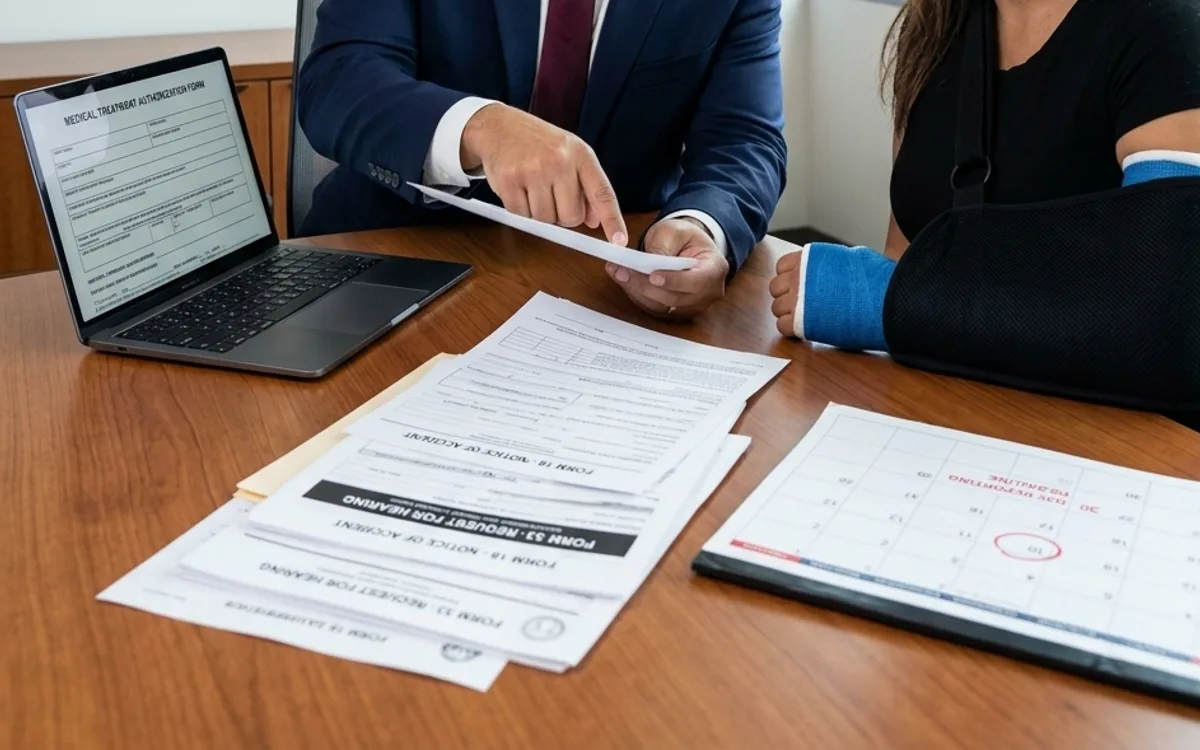
You haven't worked in three weeks. The insurance adjuster keeps asking for 'one more form.' Rent is due, and nobody at the claims office will give you a date you can count on. North Carolina workers' compensation is built to pay partial wages and medical bills without a lawsuit, but it runs on paperwork deadlines, not your bills. Miss one of those deadlines, and the claim can disappear entirely, no matter how real the injury is.
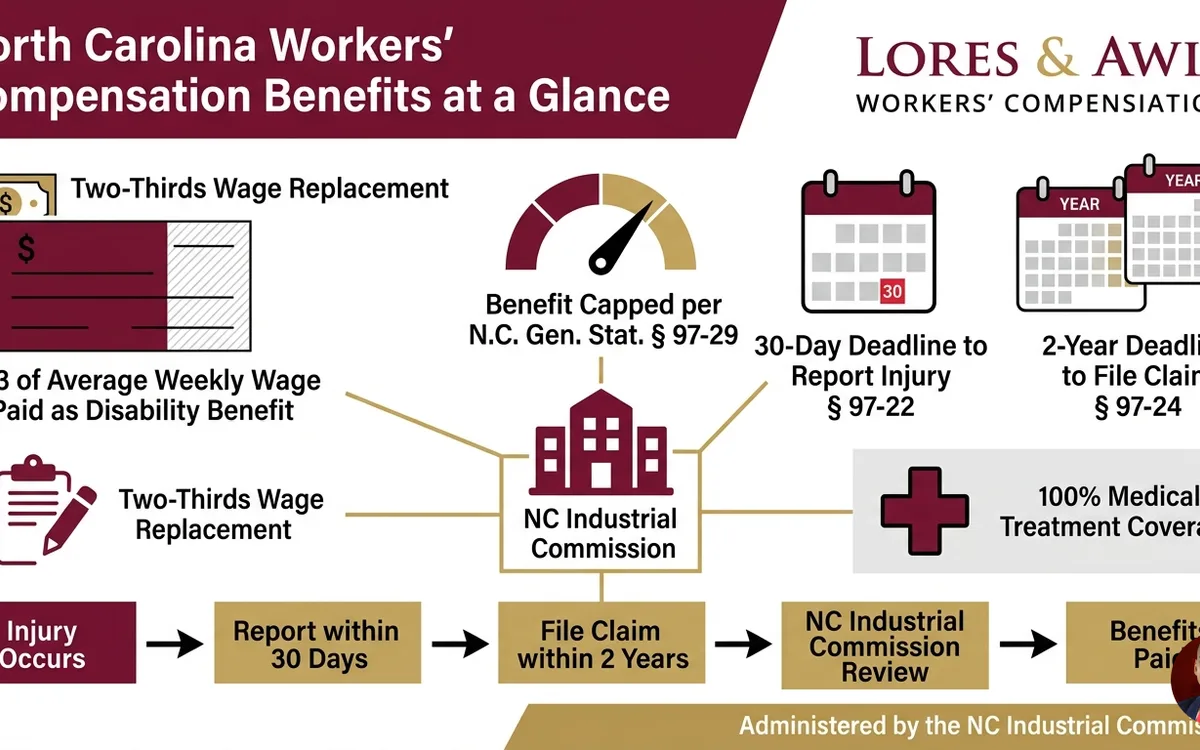
North Carolina workers' compensation pays two-thirds of your average weekly wage (capped per N.C. Gen. Stat. § 97-29) for disability, plus full medical treatment, if you report the injury within 30 days (N.C. Gen. Stat. § 97-22) and file within two years (N.C. Gen. Stat. § 97-24). The NC Industrial Commission administers and resolves all claims.
The Hard Truth
The Hard Truth About NC Workers' Comp Claims
Workers' compensation replaces two-thirds of your average weekly wage, not all of it, under N.C. Gen. Stat. § 97-29. If you made $900 a week, your check drops to roughly $600, capped at the statewide maximum the NC Industrial Commission sets each year.
Carriers contest a meaningful share of claims, especially repetitive-motion and back injuries with no witnessed accident. A denial does not mean your case is weak. It often means the adjuster is testing whether you will actually file a Form 33 and sit through a hearing.
Contested claims commonly take 9 to 12 months from the Form 33 filing to a Deputy Commissioner's decision, per the NC Industrial Commission's published hearing-docket timelines in its most recent Annual Report. Courts have also drawn real limits on what counts as a compensable 'injury by accident'; see Adams v. AVX Corp., 349 N.C. 676 (1998). Some injured workers take a lowball clincher settlement simply because they cannot afford to wait out a contested hearing.
What Happens If You Wait
What Delay Actually Costs You
North Carolina gives you 30 days to notify your employer of an accident, in writing, under N.C. Gen. Stat. § 97-22. Miss that window without a good reason, and the Commission can bar the entire claim, regardless of how serious the injury turns out to be.
You then have two years from the date of injury, or two years from the date a doctor first connects an occupational disease to your job, to file a Form 18 under N.C. Gen. Stat. § 97-24. After that, the claim is gone. There is no revival, no exception for a sympathetic story.
Waiting also costs you leverage on wages already lost. Under N.C. Gen. Stat. § 97-18, a carrier that pays accepted compensation late owes a 10% penalty, but that penalty only exists on a claim that was filed and accepted. Every week you delay seeing a doctor or reporting the injury is a week the carrier can later argue the condition isn't work-related at all.
Step-by-Step Process
How an NC Workers' Comp Claim Moves Through the System
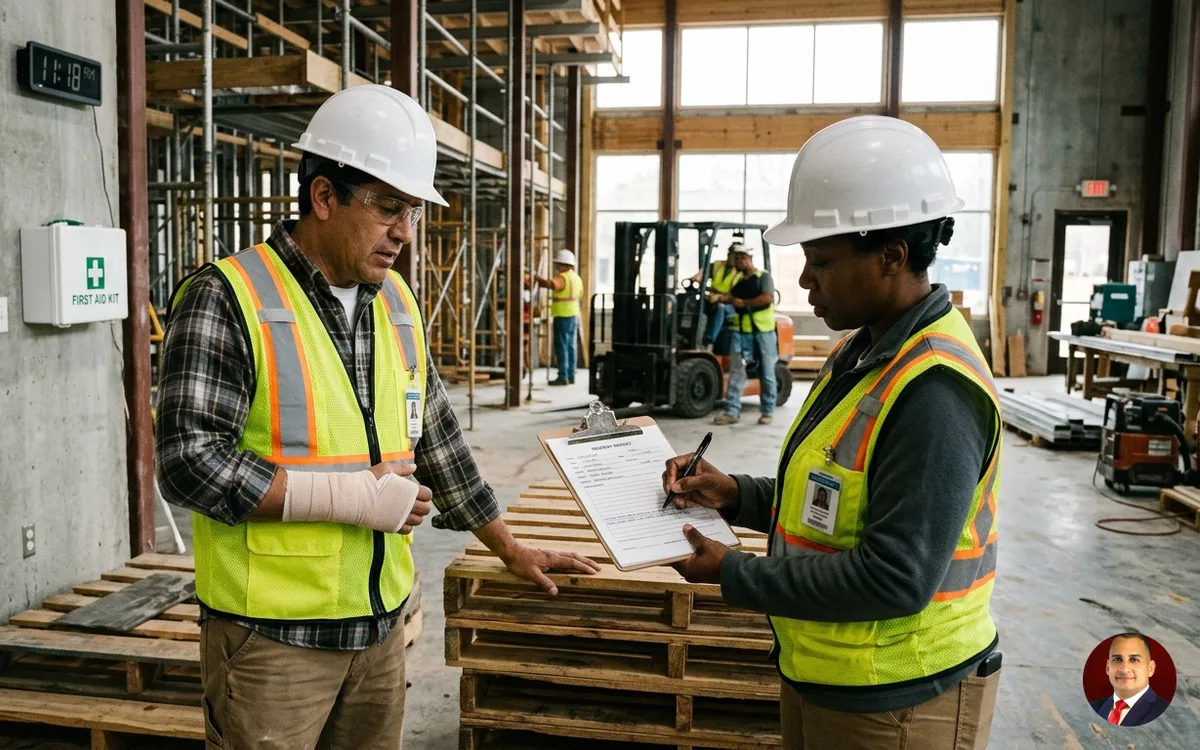
- Report the injury to your employer in writing within 30 days under § 97-22. Keep a copy of the accident report.
- See the physician your employer directs you to, unless it's a true emergency. Under § 97-25, the employer and carrier control the initial choice of doctor; you can petition the Commission for a change if treatment stalls.
- File Form 18, Notice of Accident, with the NC Industrial Commission at the Dobbs Building, 430 N. Salisbury St., Raleigh. This opens the official claim file.
- The carrier accepts (Form 60) or denies (Form 61) the claim, generally within 14 to 30 days of notice.
- If denied, or if you dispute the amount or duration of benefits, file Form 33, Request for Hearing.
- The claim goes to a mandatory mediated settlement conference under Industrial Commission Rule 613 before it can be calendared for a hearing.
- If mediation fails, a Deputy Commissioner holds an evidentiary hearing in Raleigh, Charlotte (Mecklenburg County), or Greensboro (Guilford County), depending on where you live or work.
- Either side can appeal the Deputy Commissioner's decision to the Full Commission within 15 days.
- A Full Commission decision can go further to the NC Court of Appeals under Appellate Rule 3(c).
- Many claims end earlier through a clincher agreement, a lump-sum settlement the Commission must approve before it's final.
If your injury built up from repeated exposure rather than one accident, our page on occupational disease claims covers the different two-year clock that applies. If a negligent third party, not just your employer or a co-worker, caused the injury, North Carolina's exclusivity rule under Shaw v. US Airways, Inc., 365 N.C. 466 (2012) generally blocks a lawsuit against your employer but not a separate claim against that third party; see our page on third-party workplace injury claims.
A Real-World Example
A Composite Example: How a Contested Back Injury Claim Unfolds
This is a composite scenario, not an actual client. A warehouse worker in Guilford County injures her lower back lifting a pallet. She reports it to her supervisor the same day and sees the company's panel physician, who diagnoses a lumbar strain and clears her for light duty. Six weeks later the physician says she's reached maximum medical improvement, but the employer has no light-duty position open.
The carrier files a Form 60 accepting the claim but disputes an MRI finding a herniated disc, arguing it's a pre-existing degenerative condition rather than work-related. Her attorney files a Form 33 and requests an independent medical exam under § 97-27. The case proceeds to Rule 613 mediation at the Commission's Charlotte regional office before it's set for a hearing.
At that point she's waiting on two open questions: whether the herniated disc is part of the compensable injury, and what permanent partial disability rating a treating physician will eventually assign under the § 97-31 schedule. Mediation alone does not resolve either question; both typically require testimony and medical records at a hearing before a Deputy Commissioner.
About William J. Vasquez
William J. Vasquez is licensed to practice in North Carolina and is admitted to the U.S. Courts of Appeals for the Fourth, Fifth, and Eleventh Circuits. He represents injured workers before the North Carolina Industrial Commission, from the initial Form 18 filing through Full Commission appeals.
His practice focuses on contested claims involving disputed average weekly wage calculations, denied medical treatment, and permanent partial disability ratings under the Chapter 97 schedule. Our workers' compensation team handles claims across construction, manufacturing, warehousing, and healthcare employers statewide. See his full attorney profile for bar admissions and case types handled.
Key Terms Explained
Key Terms in an NC Workers' Comp Claim
| Term | What It Is | Deadline | Who Files It |
|---|---|---|---|
| Form 18 (Notice of Accident) | Opens the official claim file with the NC Industrial Commission | Within 2 years of injury, § 97-24 | The injured worker or attorney |
| Form 33 (Request for Hearing) | Asks the Commission to schedule a hearing on a disputed claim | Should follow a denial or dispute promptly; no fixed deadline | The injured worker or attorney |
| Form 60 | Carrier's notice accepting the claim | Generally within 14-30 days of notice | The insurance carrier |
| Form 61 | Carrier's notice denying the claim | Same investigation window as Form 60 | The insurance carrier |
| Average Weekly Wage (AWW) | Wage figure used to calculate the weekly check, generally averaged over the 52 weeks before injury | Calculated under § 97-2(5) | Calculated by the carrier, disputable by the worker |
| Temporary Total Disability (TTD) | Weekly payments while you can't work at all | Two-thirds of AWW under § 97-29 | Paid by the carrier |
| Permanent Partial Disability (PPD) | Scheduled payment for permanent loss of use of a body part | Set weeks per body part under § 97-31 | Paid by the carrier after a rating |
| Clincher Agreement | Lump-sum settlement closing the claim | Negotiated at any stage, subject to Commission approval | Both sides, approved by the Commission |
| Full Commission | Three-commissioner panel reviewing a Deputy Commissioner's decision | Appeal due within 15 days | Either party |
| Rule 613 Mediation | Mandatory settlement conference before most contested hearings | Scheduled after a Form 33 is filed | Ordered by the Commission |
Frequently Asked Questions
Q: How much money will I actually receive each week on NC workers' comp? A: Most injured workers get two-thirds of their average weekly wage, calculated under N.C. Gen. Stat. § 97-2(5) from earnings in the 52 weeks before the injury, subject to the statewide maximum the NC Industrial Commission sets annually under § 97-29. Overtime and a second job can factor into that wage calculation, so the number isn't automatic.
Q: Can my employer fire me while I'm out on workers' comp? A: Yes. North Carolina is an at-will employment state, and workers' comp law alone doesn't protect your job during recovery. You may have a separate retaliation claim if the firing is directly tied to filing the claim, but that's a different legal theory from the comp claim itself.
Q: How long does a contested workers' comp claim take to resolve? A: An accepted, uncontested claim can start paying within weeks of the Form 18 filing. A contested claim that goes through Rule 613 mediation and a hearing before a Deputy Commissioner commonly takes 9 to 12 months from the Form 33 filing to a decision, longer if either side appeals to the Full Commission.
Q: Do I need a lawyer for a workers' comp claim in North Carolina? A: Not for every claim. If the carrier accepts your claim, pays on time, and you agree with the treatment and any disability rating, you may not need one. An attorney matters more once the carrier denies the claim, disputes your average weekly wage, or sends you a clincher offer you don't know how to evaluate.
Q: What happens if my employer doesn't carry workers' comp insurance? A: Employers with three or more employees generally must carry workers' comp insurance under N.C. Gen. Stat. § 97-94, and failing to do so is a misdemeanor. If your employer is illegally uninsured, you can still file a claim, and the Commission can pursue the employer directly for the award.
Q: Can I choose my own doctor, or do I have to see the one my employer sends me to? A: Under § 97-25, the employer and carrier control your initial medical care and choose the treating physician. You can ask the Commission to approve a change of physician if treatment isn't working, but you don't get an automatic choice from day one.
Q: Can undocumented workers file a workers' comp claim in North Carolina? A: Yes. Immigration status does not bar a worker from receiving workers' compensation benefits for a workplace injury under North Carolina law. Your status is a separate issue from your right to medical treatment and disability payments under Chapter 97.
Q: What are workers' comp death benefits for a family member killed on the job? A: Dependents can receive two-thirds of the worker's average weekly wage for up to 500 weeks under N.C. Gen. Stat. § 97-38, plus burial expenses up to the statutory cap set in that section.
Clients describe our workers' compensation team as responsive during a stretch when the insurance company often goes quiet, returning calls about medical authorizations and missed paychecks instead of leaving people guessing. Feedback consistently mentions clear explanations of what each Industrial Commission filing means for their benefits. We don't publish star ratings or outcome statistics. What we can tell you is that clients value being walked through a Form 33 hearing before they have to walk into one.
Before You Call
Gather what you have: the accident report, any denial letter or Form 61, your last few pay stubs, and the name of the doctor you've seen. Having these ready makes a first conversation about your claim faster and more useful, whether that conversation is with us or with the Industrial Commission's public information line at (919) 807-2500.
Our workers' compensation team reviews NC Industrial Commission claims at every stage, from a first Form 18 filing to a denied claim headed for a Form 33 hearing. We work on a contingency basis for workers' comp matters, meaning you owe attorney's fees only if we recover benefits for you, and any fee is subject to Commission approval under N.C. Gen. Stat. § 97-90. Schedule a consultation to review your claim, your average weekly wage calculation, or a clincher settlement offer before you sign anything.
- /practice-areas/workers-compensation
- /practice-areas/workers-compensation/occupational-disease-claims
- /practice-areas/workers-compensation/third-party-claims
- /practice-areas/workers-compensation/denied-claims-appeals
- /attorneys/william-j-vasquez