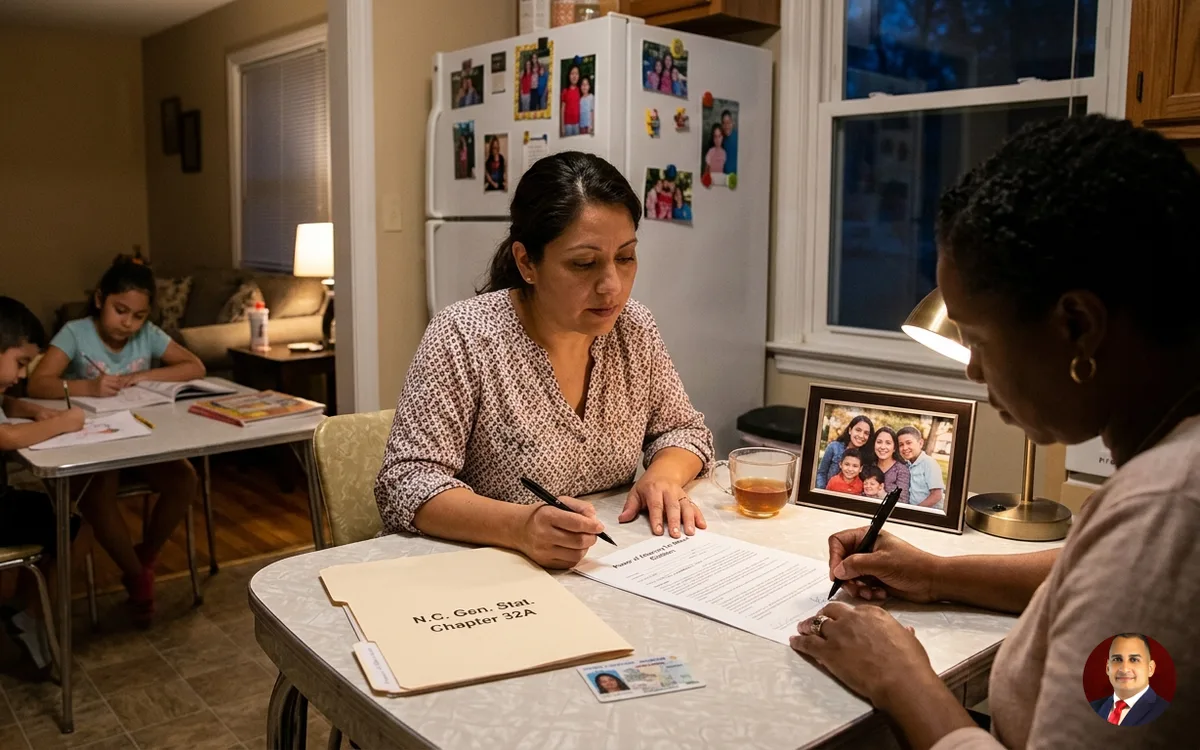
Your phone rings and it is not your mother. A neighbor says ICE agents just took a family member from a parking lot on South Boulevard, or from a cell at Mecklenburg County Jail Central after a routine traffic stop. Immigrant rights organizations tracking enforcement activity in 2025 have reported a rise in arrests of mothers and primary caregivers, a pattern government data does not break out by gender in the same detail advocacy groups do. Whatever the full national picture turns out to be, the fear in front of you right now is not abstract. Somewhere in Charlotte, a child is asking where their mom or dad went.
This page does not try to settle whether that trend holds up nationally. It answers what you actually need answered tonight: who can pick up your kids from school tomorrow, what a Charlotte Immigration Court judge can and cannot decide about your custody arrangement, and how North Carolina family law and federal immigration law run on two separate clocks you now have to track at the same time.
There are concrete steps available to you today, before you hire any attorney, that protect your children's immediate care and preserve your options in both court systems.
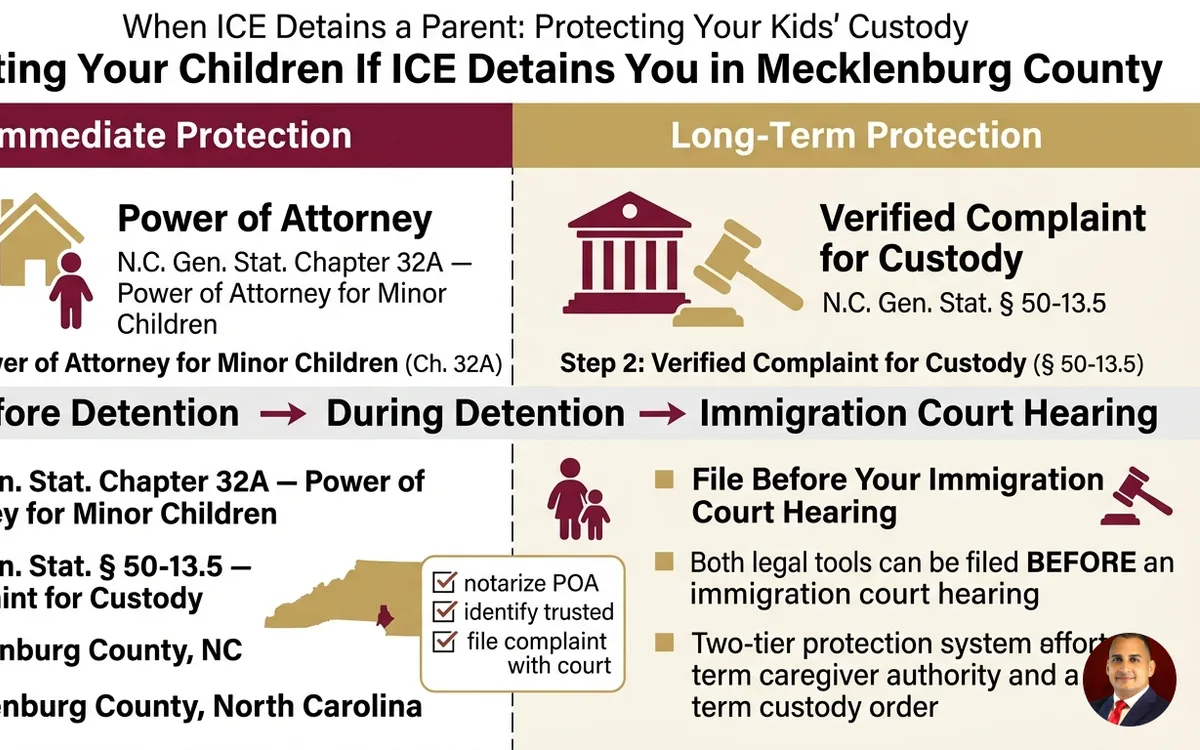
If ICE detains a parent in Mecklenburg County, a Power of Attorney for Minor Children under N.C. Gen. Stat. Chapter 32A lets a trusted adult care for your kids immediately, while a Verified Complaint for Custody under § 50-13.5 secures longer-term legal authority. Both can be filed before any immigration court hearing.
The Hard Truth
Charlotte Immigration Court will not move quickly, and no filing guarantees a particular result. The national immigration court backlog passed 3.7 million pending cases by late 2024, according to TRAC Immigration's court-level tracking (trac.syr.edu/immigration), and a case filed today commonly waits two to five years for a merits hearing before an immigration judge, not because of anything specific to your situation but because the system itself is backed up.
Detention changes the timeline. Mecklenburg County Jail Central has, at various points, operated under a 287(g) Jail Enforcement Model agreement with ICE; whether that agreement is currently active can change, so confirm current status directly with the Mecklenburg County Sheriff's Office. A parent held there, or transferred to Alamance County Detention Center, faces bond and custody decisions on a far shorter clock than the merits-hearing backlog suggests.
Relief from removal, cancellation of removal under 8 U.S.C. § 1229b, asylum, or a waiver, is only available to someone who meets specific statutory requirements. An immigration judge cannot grant relief simply because separating a parent from young children is painful. Filing the right paperwork in family court or immigration court does not guarantee an outcome. It gives you a documented, legally recognized plan if the worst-case timeline happens.
What Happens If You Wait
Every day without a signed Power of Attorney for Minor Children under North Carolina Chapter 32A is a day a school, pediatrician, or landlord can legally refuse to deal with whoever is actually caring for your kids. Chapter 32A does not require a court hearing to execute this document, but it is not automatic either. Someone has to sign it, and a parent cannot sign it from inside a detention facility without having planned ahead.
If no relative steps forward within days, Mecklenburg County Department of Social Services can open a child welfare referral under N.C. Gen. Stat. § 7B-302 (https://www.ncleg.gov/EnactedLegislation/Statutes/HTML/BySection/Chapter_7B/GS_7B-302.html). Once DSS is involved, moving your children from state custody back into a family member's care becomes its own legal process, with its own hearings, layered on top of the immigration case.
The immigration-side clock is shorter and less forgiving. If an immigration judge orders removal, the deadline to file a Notice of Appeal, Form EOIR-26, with the Board of Immigration Appeals is 30 calendar days under 8 C.F.R. § 1003.38(b) (https://www.ecfr.gov/current/title-8/chapter-I/subchapter-B/part-1003/subpart-A/section-1003.38). Miss that date while sorting out childcare from inside a detention facility, and the removal order becomes final, whether or not a stronger case ever got presented.
Step-by-Step Process
Locating a Detained Family Member
Start with the ICE Online Detainee Locator System (https://locator.ice.gov/odls/) using the person's full legal name, country of birth, and date of birth, or their Alien Registration Number (A-number) if you have it. If the person was stopped in Mecklenburg County, ask Mecklenburg County Jail Central directly whether an ICE hold or 287(g) screening is listed on the booking record. The Charlotte ICE Field Office can also confirm a transfer to Alamance County Detention Center or another facility.
Within the First 24 to 48 Hours
- Identify one adult the detained parent trusts to take physical custody of the children immediately, a relative, godparent, or close family friend.
- If the detained parent can be reached by phone or jail visitation, arrange for a notary to visit the facility so the parent can sign a Power of Attorney for Minor Children under Chapter 32A (https://www.ncleg.gov/Laws/GeneralStatuteSections/Chapter32A). Most facilities allow this with advance scheduling through the visitation office.
- If the parent cannot be reached in time, the caregiver can petition family court directly instead of waiting on a signed POA.
Days 2 Through 10: Family Court Track (Mecklenburg County Courthouse, 26th Judicial District)
- File a Verified Complaint for Custody under N.C. Gen. Stat. § 50-13.5 (https://www.ncleg.gov/EnactedLegislation/Statutes/HTML/BySection/Chapter_50/GS_50-13.5.html). If the facts show immediate danger or risk the child will be moved out of the court's reach, ask for an emergency ex parte order the same day, before the other parent or caregiver is notified.
- Understand the standard a judge applies: under Pulliam v. Smith, 348 N.C. 616 (1998) (https://www.courtlistener.com/?q=Pulliam%20v.%20Smith%20348%20N.C.%20616), a natural parent cannot be deprived of custody in favor of a relative without a specific showing of unfitness or conduct inconsistent with the parent's constitutionally protected status. A grandparent or aunt who is simply willing and able is not automatically enough; the petition has to address this standard directly.
Weeks 1 Through 4: Immigration Court Track (Charlotte Immigration Court, EOIR, Clanton Road)
- Once retained, an attorney files Form EOIR-28, Notice of Entry of Appearance, following the filing and service requirements in EOIR Immigration Court Practice Manual, Chapter 3 (https://www.justice.gov/eoir/reference-materials/ic/chapter-3).
- If the parent remains detained, request a bond hearing (/immigration/bond-hearings-charlotte) before the immigration judge; whether bond is available, and at what amount, depends on immigration history and any criminal record, not on parental status alone.
- If childcare logistics are not resolved by the scheduled hearing date, file a written motion for a continuance explaining specifically why more time is needed. Continuances are granted at the immigration judge's discretion under the same Practice Manual chapter; a judge is not required to grant one.
If a Child May Qualify for Special Immigrant Juvenile Status
- A child under 21 who has been abused, abandoned, or neglected by one or both parents may qualify for Special Immigrant Juvenile Status (/immigration/special-immigrant-juvenile-status). This starts with a North Carolina district court custody or guardianship order containing specific findings, not a federal filing, consistent with USCIS Policy Manual, Volume 6, Part J (https://www.uscis.gov/policy-manual/volume-6-part-j). Only after that state court order exists can Form I-360 be filed with USCIS.
If Criminal History Is Part of the Case
- For cancellation of removal filings under 8 U.S.C. § 1229b, certified copies of North Carolina criminal records come from the Clerk of Superior Court under N.C. Gen. Stat. § 15A-151.5 (https://www.ncleg.gov/EnactedLegislation/Statutes/HTML/BySection/Chapter_15A/GS_15A-151.5.html). Processing time varies by county and should be requested as early as possible, since immigration court filing deadlines do not pause for records requests.
A Real-World Example
A Composite Example: Two Tracks at Once
Consider a composite scenario built from patterns our team sees, not a specific client. A mother is pulled over for a broken taillight in east Charlotte and is held at Mecklenburg County Jail Central after an ICE detainer is lodged. Her two children, ages 6 and 9, are at school when it happens.
Her sister locates her within hours using the ICE Online Detainee Locator System and confirms placement through the jail's booking line. Because the sister and the mother had already talked through this possibility, a notary visits the facility within two days and the mother signs a Power of Attorney for Minor Children under Chapter 32A, giving the sister authority to enroll the kids in school, consent to medical care, and make day-to-day decisions.
The sister also files a Verified Complaint for Custody at the Mecklenburg County Courthouse within the first week, since a POA is temporary and does not resolve long-term custody if the mother remains detained for months. The petition has to address the Pulliam standard directly: the sister is not claiming the mother is unfit, only asking the court to authorize a temporary custodial arrangement while the mother's immigration case proceeds.
On the immigration side, an attorney enters an appearance at Charlotte Immigration Court, requests a bond hearing, and files a motion for a continuance of the initial master calendar hearing to allow time to gather the mother's cancellation-of-removal documentation, including certified North Carolina court records under § 15A-151.5. At the point this composite scenario ends, the bond motion and the custody petition are both still pending before their respective courts, each running on its own schedule, each requiring separate filings and separate follow-up.
William J. Vasquez is licensed by the North Carolina State Bar and is admitted to practice before the federal immigration courts, which fall under the Executive Office for Immigration Review and accept appearances from any attorney licensed in good standing in a single U.S. state, per 8 C.F.R. § 1292.1 (https://www.ecfr.gov/current/title-8/chapter-I/subchapter-B/part-1292/section-1292.1). He has represented clients in removal proceedings before Charlotte Immigration Court.
Our firm regularly coordinates immigration court filings with North Carolina custody petitions for the same family. That means tracking two separate court systems, two separate clerks, and two sets of deadlines that do not run on the same calendar, work that requires knowing both EOIR filing rules and Mecklenburg County family court procedure.
Read William J. Vasquez's full background on his attorney bio page (/attorneys/william-vasquez).
Key Terms Explained
Notice to Appear (NTA): The charging document that starts removal proceedings in immigration court under 8 U.S.C. § 1229a (https://www.law.cornell.edu/uscode/text/8/1229a).
EOIR: The Executive Office for Immigration Review, the Department of Justice agency that runs immigration courts, including Charlotte Immigration Court on Clanton Road.
BIA: The Board of Immigration Appeals, the administrative body that reviews immigration judge decisions on appeal. Under 8 C.F.R. § 1292.1, any attorney licensed in a single U.S. state can appear before it nationwide.
Cancellation of removal: A form of relief under 8 U.S.C. § 1229b that allows an immigration judge to cancel a removal order for someone who meets specific statutory requirements, including continuous physical presence and good moral character. It is not automatic and not available to everyone.
Special Immigrant Juvenile Status (SIJS): An immigration classification for a child under 21 who has a state court order finding abuse, abandonment, or neglect by one or both parents, described in USCIS Policy Manual, Volume 6, Part J (https://www.uscis.gov/policy-manual/volume-6-part-j).
Power of Attorney for Minor Children: A North Carolina document under Chapter 32A letting a parent delegate caregiving authority, including school enrollment and medical consent, to another adult without a court order. It is temporary and does not transfer legal custody.
287(g) Jail Enforcement Model: An agreement that lets local jail staff screen for immigration status and notify ICE during booking. Whether a given county's agreement is currently active changes over time.
Flores Settlement Agreement: The result of Flores v. Reno, 507 U.S. 292 (1993) (https://www.aclu.org/other/flores-v-meese-stipulated-settlement-agreement), setting national standards for how long and under what conditions the government may hold minors in immigration custody.
Continuance: A postponement of a scheduled immigration court hearing, granted at the immigration judge's discretion, not automatically.
Bond hearing: A separate immigration court proceeding where a judge decides whether a detained noncitizen can be released while the removal case continues, and on what financial terms.
Frequently Asked Questions
Q: What happens to my kids if ICE detains me in Charlotte? A: A trusted adult can take physical care of them right away under a Power of Attorney for Minor Children (N.C. Gen. Stat. Chapter 32A), and that same person, or a different relative, can file for temporary custody at the Mecklenburg County Courthouse if detention lasts longer than a few days.
Q: How is a Power of Attorney different from a custody order? A: A POA is a signed document, no judge required, that lets someone handle school, medical, and daily-care decisions, but it is temporary and can be revoked. A custody order from Mecklenburg County Courthouse carries ongoing legal force and addresses who has legal and physical custody long term.
Q: Can North Carolina family court give custody to a relative while my removal case is pending? A: Yes, but under Pulliam v. Smith, 348 N.C. 616 (1998), the court generally cannot take custody from a fit natural parent without a specific showing of unfitness or conduct inconsistent with the parent's protected status. Being detained alone is not automatically that showing.
Q: How do I find a family member ICE has detained in the Charlotte area? A: Use the ICE Online Detainee Locator System (locator.ice.gov) with the person's full legal name, date of birth, and country of birth, or call the Charlotte ICE Field Office. Mecklenburg County Jail Central or Alamance County Detention Center can also confirm whether someone is currently held there.
Q: Can I request a continuance in Charlotte Immigration Court if I don't have childcare arranged? A: You can file a written motion explaining the specific reason you need more time, but the immigration judge decides whether to grant it under the EOIR Immigration Court Practice Manual, Chapter 3. It is not automatic.
Q: What is Special Immigrant Juvenile Status, and does my child qualify? A: It is a classification for a child under 21 with a North Carolina court order finding abuse, abandonment, or neglect by a parent, as described in USCIS Policy Manual, Volume 6, Part J. The state court order has to exist before USCIS will accept the federal petition.
Q: What does a consultation cost, and how long does the combined custody-and-immigration process take? A: Consultation terms are discussed directly when you schedule one, since they depend on what filings are already needed. Timeline-wise, a custody order can often be in place within weeks, while a removal case commonly runs two to five years to a merits hearing per TRAC Immigration's backlog data, so the two processes rarely finish on the same schedule.
Q: What actually happens if I never set up a Power of Attorney? A: Without one, a school or hospital can refuse to act on a caregiver's instructions, and if no arrangement is in place within days, Mecklenburg County DSS can open a referral under N.C. Gen. Stat. § 7B-302, which adds its own hearings on top of everything else you are already managing.
Clients working through a detained family member's case describe the same thing: they want someone who explains what is actually happening in plain language, returns calls, and tells them honestly when an outcome is uncertain. That is the standard our team holds itself to in combined removal-defense and custody matters. Read client feedback on our Google Business Profile and Avvo listing before deciding whether to schedule a consultation.
None of this requires hiring a lawyer tonight. Locate your family member, talk to the caregiver you trust, and gather whatever documents you already have, identification, prior court orders, the A-number if you know it. When you are ready to talk through the Mecklenburg County custody filing and the Charlotte Immigration Court filing together, with someone who tracks both calendars, that conversation is available.
If ICE has detained you or a family member in the Charlotte area, schedule a consultation (/contact) to go over the custody paperwork and the immigration court filings side by side. We handle removal defense before Charlotte Immigration Court and coordinate it with North Carolina custody and guardianship filings for the same family, so you are not managing two separate legal problems with two separate strangers.

- Special Immigrant Juvenile Status (SIJS) Eligibility
- Bond Hearings at Charlotte Immigration Court
- North Carolina Custody Modification
- Schedule a Consultation
- William J. Vasquez, Attorney Bio