Last updated: October 15, 2026.
If you came here after seeing the headline that the Supreme Court is reviewing Trump-era immigration policy, you are probably trying to figure out one thing: does this change what happens to me, or to my family, in Mecklenburg County? Your reason for asking could be any number of things. Your child might have been born after January 2025 and you're unsure about their citizenship paperwork. You might have a hearing coming up at Charlotte Immigration Court and no idea whether it will even go forward. Someone you love might have been stopped by the Mecklenburg County Sheriff's Office, and now you're worried about a 287(g) detainer.
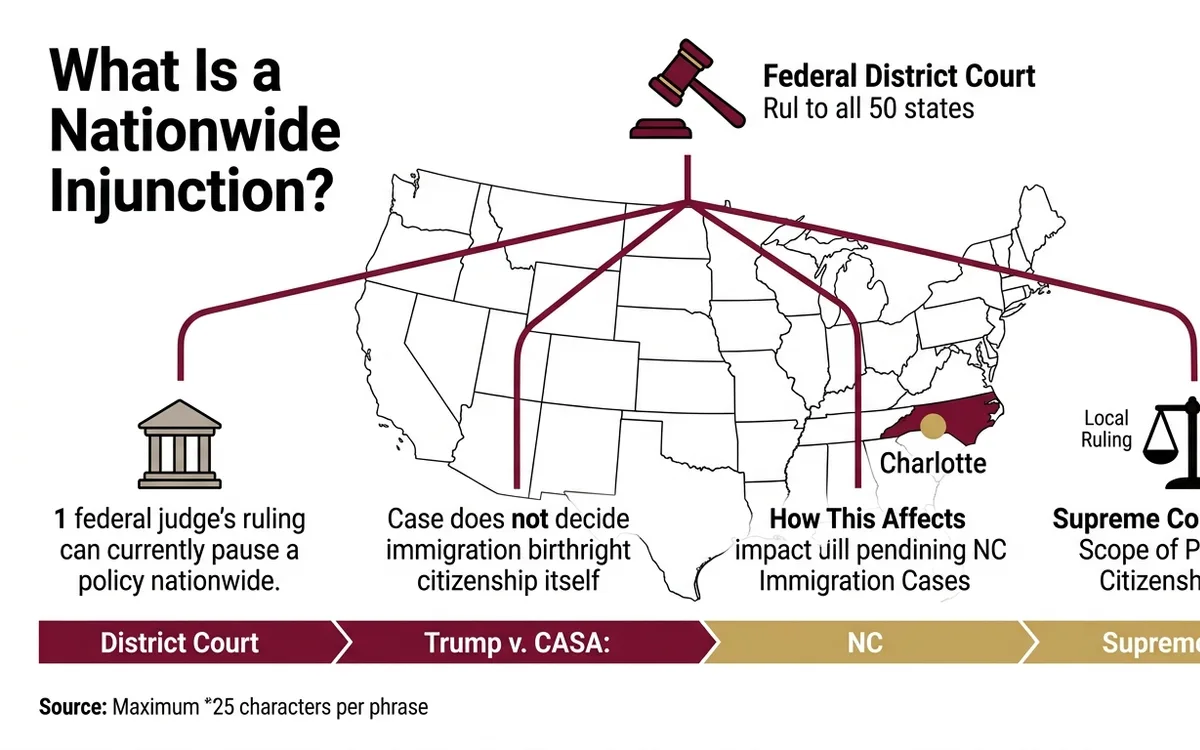
The ruling itself is narrower than the headlines suggest. It addresses one question: how much power a single federal judge has to block a nationwide policy. What it means for you depends on where your case sits right now, not on the headline alone.
The Supreme Court is reviewing how far federal courts can go in blocking President Trump's birthright citizenship executive order nationwide. The case, Trump v. CASA, does not decide citizenship itself. It decides whether one judge can block a policy for the whole country, which affects every pending immigration case, including ones in Charlotte.
The Hard Truth
What the Supreme Court Actually Decided
The Supreme Court did not rule on whether President Trump's executive order on birthright citizenship is constitutional. In Trump v. CASA, Inc., Docket No. 24A884, decided June 27, 2025 (per the Court's published opinion, available at supremecourt.gov), the Court ruled 6-3 that federal district courts generally lack authority to issue nationwide, or universal, injunctions reaching people who are not parties to the lawsuit before them.
That means Executive Order 14160, which would deny automatic citizenship to some children born in the United States after January 20, 2025, is still blocked for the plaintiffs who sued and for people who join an approved class action. If you are not part of one of those lawsuits, the order's legal status in your specific case is not settled. Anyone telling you this ruling guarantees your child's citizenship, or guarantees the order will never take effect, is not being straight with you.
Nationwide injunctions were rare before the last two decades; according to the scholarship cited in the Court's own opinion, federal courts issued more universal injunctions during 2017-2021 than in the prior two centuries combined. This ruling reaches beyond birthright citizenship. It applies to any nationwide injunction sought in other pending immigration litigation, including challenges to Temporary Protected Status terminations and parole program rescissions working through other federal circuits.
What Happens If You Wait
What Happens if You Wait
Doing nothing has a cost, even while the bigger legal question is unresolved. North Carolina's immigration courts, including Charlotte, carried a pending caseload of more than 60,000 cases as of 2024 (per TRAC Immigration, Syracuse University, trac.syr.edu). A case sitting in that backlog does not pause because a different case is in front of the Supreme Court. Your hearing date arrives on the court's schedule, not on the news cycle.
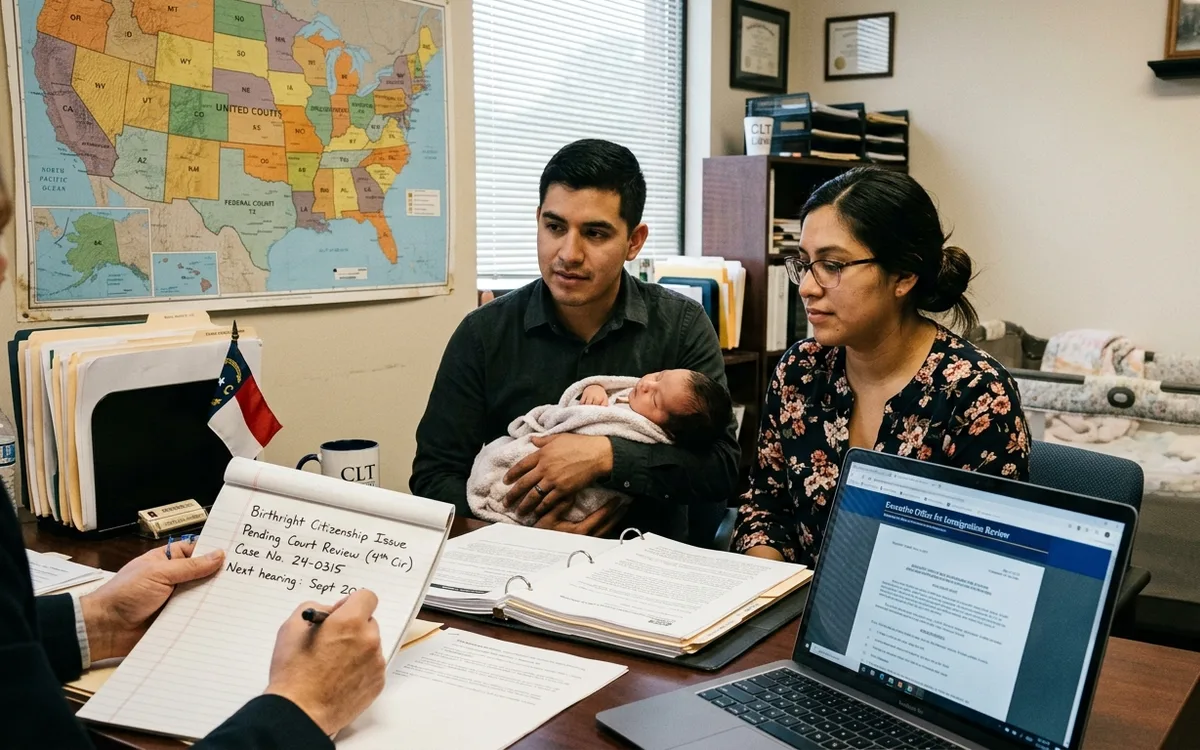
If your child was born after January 20, 2025, and you have not confirmed whether you fall inside a certified class, you may be relying on protection that does not actually cover you. Class membership is not automatic. It typically requires your case, or one like it, to be part of the litigation record.
More than 500,000 people nationwide held active DACA status as of the most recent USCIS reporting period (per USCIS DACA population data, uscis.gov). USCIS still recommends filing a renewal 120 to 150 days before it expires; see our DACA renewal guide. None of that changed on June 27, 2025, and letting a renewal lapse while waiting for bigger news creates a separate, avoidable problem.
North Carolina's appellate deadlines do not pause either. Under the North Carolina Rules of Appellate Procedure, Rule 4, a notice of appeal in a state criminal matter generally must be filed within 14 days of judgment, a deadline that matters when a conviction carries immigration consequences under Padilla v. Kentucky, 559 U.S. 356 (2010). Waiting to address a plea that could trigger removal does not stop that clock.
Step-by-Step Process
What Should You Do While You Wait
Confirm what you are actually dealing with. If you have a notice from USCIS Charlotte Field Office, EOIR (Charlotte Immigration Court), or a letter referencing a 287(g) detainer from the Mecklenburg County Sheriff's Office, read the document type and deadline before assuming it relates to this Supreme Court case at all.
Check your hearing or interview date. Charlotte Immigration Court schedules can be confirmed through the EOIR automated case information line (1-800-898-7180) or the online case status tool at acis.eoir.justice.gov, using your alien registration number. For USCIS Charlotte Field Office appointments specifically, see our field office guide.
If a hearing is approaching and your case could be affected by the injunction litigation, your attorney can file a motion to continue explaining the pending legal question and asking the immigration judge to hold the case open. The judge decides whether to grant it, and approval isn't guaranteed. See our Charlotte Immigration Court guide for how continuances work procedurally.
If your child was born after January 20, 2025, gather the birth certificate, your immigration documents, and any Social Security Administration correspondence now, whether or not you end up needing them for a class-action filing.
If a family member was stopped in Mecklenburg County and a 287(g) detainer was issued, ask the detention facility directly whether the hold is based on the executive order litigation or a separate removal charge. Our 287(g) and criminal-immigration overlap guide explains how these holds actually function locally.
If you are weighing whether a North Carolina criminal case could affect your immigration status, talk to a lawyer before entering a plea. Under Padilla v. Kentucky, your criminal defense attorney must advise you of immigration consequences, but that advice works best before a plea is entered, not after.
A Real-World Example
Case Example: A Composite Scenario
Consider a composite example, not a real client. A mother in Mecklenburg County gave birth in February 2025. She is undocumented; the child's father has a pending asylum application in Charlotte Immigration Court. She hears about the Supreme Court case and worries her baby will not get a Social Security number.
Confirming the document trail comes before anything else: the hospital birth certificate, any Social Security Administration denial letter if one was issued, and the father's asylum receipt notice (Form I-589 acknowledgment). From there, the question becomes whether the family's circumstances connect to an existing certified class, something that shifts as the litigation moves through the district courts on remand.
Calendar management matters just as much. The father's next Charlotte Immigration Court hearing date still has to be tracked, and if a continuance is needed, it has to be requested in writing rather than assumed. Our removal defense team tracks filings like this as a matter of routine.
What this family can expect is a waiting period measured in months, not days, while the class-certification question works through the courts. There is no shortcut that skips that process, and no attorney can promise a specific result on the citizenship question itself, because that question has not been decided yet.
William J. Vasquez is licensed by the North Carolina State Bar and admitted to practice before the U.S. Court of Appeals for the Fourth, Fifth, and Eleventh Circuits, which allows him to handle federal immigration appeals arising from Charlotte Immigration Court. Immigration proceedings before USCIS, EOIR, and the Board of Immigration Appeals are federal matters; under 8 C.F.R. § 1292.1, any attorney licensed and in good standing in a single U.S. state may represent clients before the Board of Immigration Appeals nationwide. He has spent years handling removal defense, family-based petitions, and DACA filings for clients across Mecklenburg County and the greater Charlotte area.
Our team, which includes additional attorneys beyond Mr. Vasquez, tracks developments in cases like Trump v. CASA as they move through the federal courts, so the advice we give about continuances, class membership, and filing deadlines reflects where the litigation actually stands. Read more on his attorney profile page. This page was last reviewed by our immigration team on October 15, 2026.
Key Terms Explained
Key Terms Defined
Nationwide (universal) injunction: A court order that blocks a federal policy for everyone it would affect, not just the people who sued. Trump v. CASA, Inc. limited when federal district courts can issue this kind of order.
Class action / class certification: A procedure where a court allows one lawsuit to represent a defined group of people with the same legal claim, so a ruling can cover the whole group instead of only the named plaintiffs. Courts decide whether to certify a class under Federal Rule of Civil Procedure 23.
287(g) agreement: A contract between U.S. Immigration and Customs Enforcement and a local law enforcement agency, such as the Mecklenburg County Sheriff's Office, authorizing designated local officers to perform certain immigration enforcement functions inside the jail, under 8 U.S.C. § 1357(g). More than 150 law enforcement agencies nationwide currently participate in 287(g) agreements, per ICE's published program data at ice.gov.
Birthright citizenship: Automatic U.S. citizenship for most people born on U.S. soil, recognized under the Fourteenth Amendment. Executive Order 14160 would narrow this for children of parents without lawful permanent status or citizenship; its constitutionality has not been decided by the Supreme Court.
Notice to Appear (NTA): The charging document that starts removal proceedings in immigration court, specifying the allegations and the legal basis for removal.
Padilla advisal: The requirement, from Padilla v. Kentucky, 559 U.S. 356 (2010), that a criminal defense attorney tell a noncitizen client about the immigration consequences of a guilty plea before the plea is entered.
Frequently Asked Questions
Frequently Asked Questions
Q: Did the Supreme Court decide whether my child born in the United States is a citizen? A: No. The Court's June 27, 2025 ruling in Trump v. CASA, Inc. addressed how far a single judge's injunction can reach, not whether Executive Order 14160 is constitutional. That underlying question is still being litigated in the lower federal courts.
Q: Does this ruling change how Charlotte Immigration Court handles my removal case? A: Not automatically. Immigration judges in Charlotte decide continuance requests case by case. If you believe the injunction litigation affects your case, ask your attorney to file a written motion explaining the connection rather than assuming the court already knows.
Q: Does this affect the Mecklenburg County Sheriff's Office 287(g) agreement? A: No. The 287(g) program operates under separate statutory authority, 8 U.S.C. § 1357(g), and a separate memorandum of agreement between ICE and the Sheriff's Office. The ruling on injunction scope does not change that agreement.
Q: I have DACA. Should I still renew on the normal schedule? A: Yes. USCIS's guidance to file a renewal 120 to 150 days before expiration has not changed because of this case. Letting a renewal lapse creates a separate problem that this litigation will not fix.
Q: What if my North Carolina criminal case could affect my immigration status? A: Talk to an attorney before you enter a plea. Under Padilla v. Kentucky, your criminal defense lawyer must advise you about immigration consequences, and under the North Carolina Rules of Appellate Procedure, Rule 4, the window to appeal a criminal judgment is generally 14 days, so delay can close off options.
Clients come to our Charlotte office with cases at every stage, from a first USCIS notice to a pending appeal. Our reviews reflect what people experience working with our team: direct answers about what a filing actually requires, realistic timelines, and straight talk about what the law does and does not currently allow. We do not quote outcome statistics, because immigration case results depend on facts, law, and a judge's or officer's decision, not on how any firm markets itself.
The legal question in Trump v. CASA will keep moving through the lower courts for months. What matters for you right now is whether your specific hearing date, filing deadline, or detainer status is affected, and that is a fact-specific question, not a headline-specific one.
If you have a hearing at Charlotte Immigration Court, a pending application at USCIS Charlotte Field Office, a DACA renewal coming due, or a family member affected by a Mecklenburg County 287(g) detainer, schedule a consultation with our immigration team to review your specific documents and deadlines. Call our Charlotte office or request a consultation through our immigration services page to get a clear read on where your case actually stands.