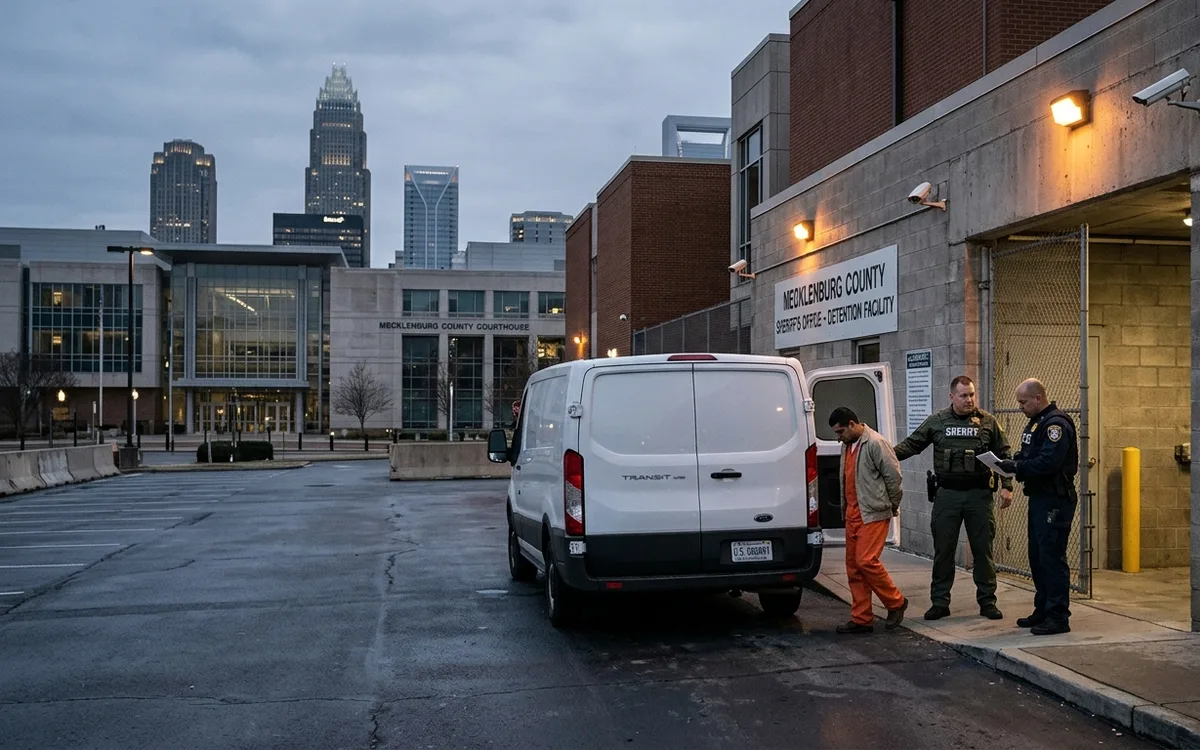
## When ICE and a Fatal Hit-and-Run Charge Collide in Mecklenburg County A 15-year-old girl died on a Charlotte street. The driver did not stop. Days later, federal agents, not just North Carolina State Highway Patrol, took him into custody as part of a Charlotte-area enforcement operation ICE has publicly referred to as Operation Charlotte's Web (see [ICE Newsroom](https://www.ice.gov/newsroom)). If you are reading this because ICE just took someone you love, or because you buried a child and do not know what a felony indictment or an immigration detainer actually means for your case, the uncertainty itself is exhausting. Two systems are now running on separate clocks: a Mecklenburg County felony prosecution, and a federal immigration case that does not answer to the state court at all. Neither process waits for the other to finish. A judge in Mecklenburg County Superior Court can set bond on the criminal charge and the person can still sit in ICE custody the same day. This page walks through what happens next, in the order it actually happens, in the courts and offices that will handle it.
When ICE arrests someone already charged with felony hit-and-run in Mecklenburg County, the criminal case proceeds separately in Superior Court while an ICE detainer under 8 C.F.R. § 287.7 can hold the person past their release date. Removal proceedings open at Charlotte Immigration Court, often before the criminal charge is resolved, under two unrelated timelines.
The Hard Truth
## The Hard Truth About These Two Cases A felony hit and run causing death under [N.C. Gen. Stat. § 20-166(a)](https://www.ncleg.gov/EnactedLegislation/Statutes/HTML/BySection/Chapter_20/GS_20-166.html) is a Class F felony in North Carolina, carrying a presumptive range of roughly 10 to 41 months depending on the defendant's prior record level under the state's structured sentencing grid, [N.C. Gen. Stat. § 15A-1340.17](https://www.ncleg.gov/EnactedLegislation/Statutes/HTML/BySection/Chapter_15A/GS_15A-1340.17.html). A conviction at that level, combined with a sentence of a year or more, generally qualifies as an aggravated felony under federal immigration law, which forecloses most forms of relief from removal. Winning the state case does not end the immigration case. An ICE detainer under [8 C.F.R. § 287.7](https://www.ecfr.gov/current/title-8/chapter-I/subchapter-B/part-287/section-287.7) does not depend on a conviction. If Mecklenburg County dismisses or reduces the charge, ICE can still hold the person on a prior removal order, an existing final order, or an independent finding of removability, and the state court has no authority to stop that. For families of the person who died, the civil side carries its own hard fact: a wrongful death judgment against an undocumented driver is often difficult to collect. Many defendants in this position carry no auto insurance and few attachable assets, and a civil judgment is only worth what can actually be recovered from the person who owes it.
What Happens If You Wait
## What Waiting Costs You in Each System North Carolina law gives a victim's family two years from the date of death to file a wrongful death claim, under [N.C. Gen. Stat. § 1-53(4)](https://www.ncleg.gov/EnactedLegislation/Statutes/HTML/BySection/Chapter_1/GS_1-53.html). Miss that date and the claim is barred permanently, regardless of how clear the liability is or what happens in the criminal case. On the immigration side, missing a scheduled master calendar hearing at Charlotte Immigration Court generally results in an order of removal issued in absentia, under INA § 240(b)(5), without the person present to contest it. Reopening a case after that kind of order is difficult and is not guaranteed. On the criminal side, a defendant who fails to appear in Mecklenburg County District or Superior Court faces a separate failure-to-appear charge and forfeiture of any bond posted, on top of the underlying felony. Evidence does not wait either: North Carolina State Highway Patrol crash reconstruction data, 911 call recordings, and nearby business surveillance footage are not preserved indefinitely, and delay in requesting them through counsel can mean they are gone before trial.
Step-by-Step Process
## The Procedural Sequence, Step by Step 1. **Crash investigation.** North Carolina State Highway Patrol, Troop G, District 4, or Charlotte-Mecklenburg Police Department investigates the scene and prepares a crash reconstruction report. A magistrate at Mecklenburg County Jail Central, 801 E. 4th St., issues the arrest warrant once probable cause is established. 2. **Booking and the 287(g) check.** At booking, Mecklenburg County Sheriff's Office runs an immigration status check under its 287(g) Jail Enforcement Model agreement with ICE, one of more than 100 agreements ICE currently lists nationwide on its 287(g) participating-agencies page. If the check flags a prior order or unlawful status, the Sheriff's Office lodges an ICE detainer under 8 C.F.R. § 287.7, which can hold the person up to 48 hours past the time they would otherwise be released, excluding weekends and holidays. 3. **First appearance.** North Carolina law requires a first appearance before a district court judge within 96 hours of a felony arrest, under [N.C. Gen. Stat. § 15A-601(c)](https://www.ncleg.gov/EnactedLegislation/Statutes/HTML/BySection/Chapter_15A/GS_15A-601.html). A state bond amount can be set here even though the ICE detainer remains in place underneath it. 4. **Transfer to ICE custody.** If the detainer holds, ICE Enforcement and Removal Operations, Charlotte Sub-Office at Tyvola Centre, takes custody once the state releases the person, regardless of whether bond was posted on the criminal charge. 5. **Notice to Appear and docketing.** ICE issues a Notice to Appear, and the case is docketed at Charlotte Immigration Court, 5701 Executive Center Dr. A custody redetermination hearing before the immigration judge can be requested separately from the criminal bond proceeding. 6. **Master calendar hearing.** This first immigration court hearing is short, often 10 to 20 minutes. The judge confirms identity, takes pleadings on the Notice to Appear, and sets a schedule for any application for relief. 7. **Parallel criminal prosecution.** The felony charge proceeds independently through the Mecklenburg County District Attorney's Office, 26th Prosecutorial District, with filings tracked through the state's eCourts system. Felony cases in Mecklenburg County Superior Court commonly run 12 to 24 months from indictment to trial, per the NC Administrative Office of the Courts' published caseload data. 8. **Civil filing window.** Separately, the decedent's estate can file a wrongful death action in Mecklenburg County Superior Court at any point within the two-year statute of limitations, independent of how the criminal or immigration cases resolve.
A Real-World Example
## A Composite Scenario: How the Two Tracks Actually Move The following is a composite illustration, not a real client or case. Call him 'Mr. R.' Mr. R. is involved in a crash on a Charlotte street that results in a pedestrian's death. NC State Highway Patrol responds, reconstructs the crash scene over the following days, and a magistrate issues a warrant for felony hit and run resulting in death. At booking at Jail Central, the Mecklenburg County Sheriff's Office runs its standard 287(g) check and finds an existing final removal order from several years earlier. The Sheriff's Office lodges a detainer. Mr. R.'s criminal defense attorney appears with him at his first appearance within the 96-hour window, where the district court judge sets a secured bond on the state charge. Because the detainer is already lodged, ICE takes custody once the state process releases him, and he is transferred to the ICE Enforcement and Removal Operations Charlotte Sub-Office. A Notice to Appear is issued, and his case is set for a master calendar hearing at Charlotte Immigration Court roughly six weeks out. His immigration attorney requests a custody redetermination hearing separately, while his criminal defense attorney begins preparing for arraignment on the felony charge in Mecklenburg County Superior Court. Both cases continue to move on their own schedules. The immigration judge will eventually decide what relief, if any, Mr. R. may be eligible to apply for given his record and circumstances; the Superior Court will separately resolve the felony charge on its own timeline. Neither outcome is decided by the other proceeding, and neither is decided at this stage.
## About the Attorney Handling Cases Like This William J. Vasquez is licensed by the North Carolina State Bar and admitted to practice before the U.S. Court of Appeals for the Fourth Circuit, the circuit that covers North Carolina and would hear any petition for review arising from a Charlotte Immigration Court removal order. His practice focuses on the overlap between criminal charges and immigration consequences, including detainer disputes, bond and custody redetermination hearings, and removal defense matters originating in Mecklenburg County. He has represented clients at Charlotte Immigration Court and in Mecklenburg County criminal courts on matters involving felony charges with immigration consequences, including cases where a 287(g) detainer was lodged at booking. Our team also includes attorneys who handle the civil wrongful death side of cases like this one, working alongside criminal and immigration counsel when a single incident produces all three kinds of proceedings. A consultation does not require you to have already decided which track you need help with.
Key Terms Explained
## Key Terms Used on This Page **ICE detainer**: A written request from Immigration and Customs Enforcement asking a jail to hold someone up to 48 hours past their scheduled release so ICE can take custody, authorized under [8 C.F.R. § 287.7](https://www.ecfr.gov/current/title-8/chapter-I/subchapter-B/part-287/section-287.7). **287(g) Jail Enforcement Model**: An agreement between ICE and a local sheriff's office, such as Mecklenburg County's, that trains deputies to screen arrestees' immigration status inside the jail and lodge detainers on ICE's behalf. **Notice to Appear (NTA)**: The charging document that starts removal proceedings in immigration court, listing the allegations and the legal grounds ICE believes make the person removable. **Master calendar hearing**: The first, short hearing in immigration court where the judge confirms identity, takes pleadings on the Notice to Appear, and schedules next steps. It is not the trial. **Custody redetermination hearing**: A separate immigration court hearing where a detained person can ask an immigration judge to set or lower a bond, distinct from any bond set in the criminal case. **Felony hit and run resulting in death**: An offense under [N.C. Gen. Stat. § 20-166(a)](https://www.ncleg.gov/EnactedLegislation/Statutes/HTML/BySection/Chapter_20/GS_20-166.html), a Class F felony when the crash results in death and the driver fails to stop and render aid. **Wrongful death claim**: A civil lawsuit brought by a decedent's personal representative under [N.C. Gen. Stat. § 28A-18-2](https://www.ncleg.gov/EnactedLegislation/Statutes/HTML/BySection/Chapter_28A/GS_28A-18-2.html), separate from any criminal charge against the same person. **Proximate cause**: The legal requirement, addressed by the North Carolina Supreme Court in [State v. Walston, 367 N.C. 721 (2014)](https://www.courtlistener.com/), that a defendant's conduct must be a direct and foreseeable cause of the death for a felony death-by-vehicle conviction to stand.
Frequently Asked Questions
Q: Does Mecklenburg County Sheriff's Office honor ICE detainers? A: Yes. The Mecklenburg County Sheriff's Office operates under a 287(g) Jail Enforcement Model agreement with ICE, and North Carolina's House Bill 10 (2024 session) separately requires sheriffs statewide to attempt to verify immigration status and honor detainer requests for specified offenses. Q: Can ICE hold someone even after their NC criminal charges are dismissed? A: Yes. An ICE detainer under 8 C.F.R. § 287.7 is independent of the state case. If ICE has an existing removal order or an independent finding of removability, dismissal or reduction of the state charge does not end ICE custody. Q: What is the difference between felony hit and run and felony death by vehicle in North Carolina? A: Felony hit and run under N.C. Gen. Stat. § 20-166(a) punishes the failure to stop and render aid after a crash involving death or serious injury. Felony death by vehicle, charged separately, punishes causing the death through impaired or reckless driving itself; the two charges can be brought together from a single crash. Q: Can a victim's family sue an undocumented driver in North Carolina even while that driver is in ICE custody? A: Yes. A wrongful death action can be filed in Mecklenburg County Superior Court regardless of the defendant's immigration status or custody location, though serving the defendant and coordinating with their immigration and criminal counsel typically takes longer when the person is held at a detention facility. Q: How long does a removal case take after a Mecklenburg County felony charge? A: It depends on whether the person is detained and what relief, if any, they are eligible to apply for. Detained dockets at Charlotte Immigration Court generally move faster than non-detained dockets, which can run several years, but a felony conviction can also narrow or eliminate eligibility for relief, which shortens the case in a different way.
Clients contacting our firm about cases like this one are often managing a criminal charge, an immigration detainer, and a grieving family all at once. Reviews from clients and community members on Google and Avvo describe our attorneys' communication during that kind of overlapping, high-stress process, particularly when a case moves across Mecklenburg County criminal court, Charlotte Immigration Court, and civil court at the same time. We do not publish case outcomes or success statistics; North Carolina's rules on attorney communications (NC RPC 7.1) do not permit that kind of claim, and case results vary by the specific facts of each matter.
Reading about Operation Charlotte's Web because it touches your own family's situation is different from reading it as news. If someone you love is currently held at Mecklenburg County Jail Central with an ICE detainer, or you are the family of someone killed in a hit-and-run and are not sure what your legal options are, the next step is figuring out which of these three tracks, criminal, civil, or immigration, actually applies to your situation first.
Our firm handles the criminal-immigration overlap directly: ICE detainer disputes, custody redetermination hearings at Charlotte Immigration Court, and removal defense arising from Mecklenburg County felony charges, alongside wrongful death claims for families affected by a fatal crash. Call our office or request a consultation to go over which track applies to your situation and what the realistic next filing deadline is, whether that is a bond motion, a master calendar hearing, or the two-year window to file a wrongful death claim under N.C. Gen. Stat. § 1-53(4).
- Removal Defense Services - /practice-areas/immigration/removal-defense
- Understanding ICE Detainers and 287(g) Agreements - /resources/ice-detainers-287g
- Wrongful Death Claims in North Carolina - /practice-areas/personal-injury/wrongful-death
- Criminal Defense in Mecklenburg County - /practice-areas/criminal-defense
- Schedule a Consultation - /contact