A deputy pulls you aside after a routine traffic stop. Hours later, you're told ICE has been notified and a hold has been placed on the file. Until recently, whether that happened depended on which North Carolina county you were sitting in. It no longer does.
House Bill 10, now codified as N.C. Gen. Stat. § 162-62, ended that variation. Every sheriff's office and county jail in North Carolina must now cooperate with U.S. Immigration and Customs Enforcement in specific, legally defined ways. If someone you love was arrested this week in Mecklenburg, Wake, or any of North Carolina's 100 counties, the clock is already running on decisions that affect their custody, their bond, and their immigration case.
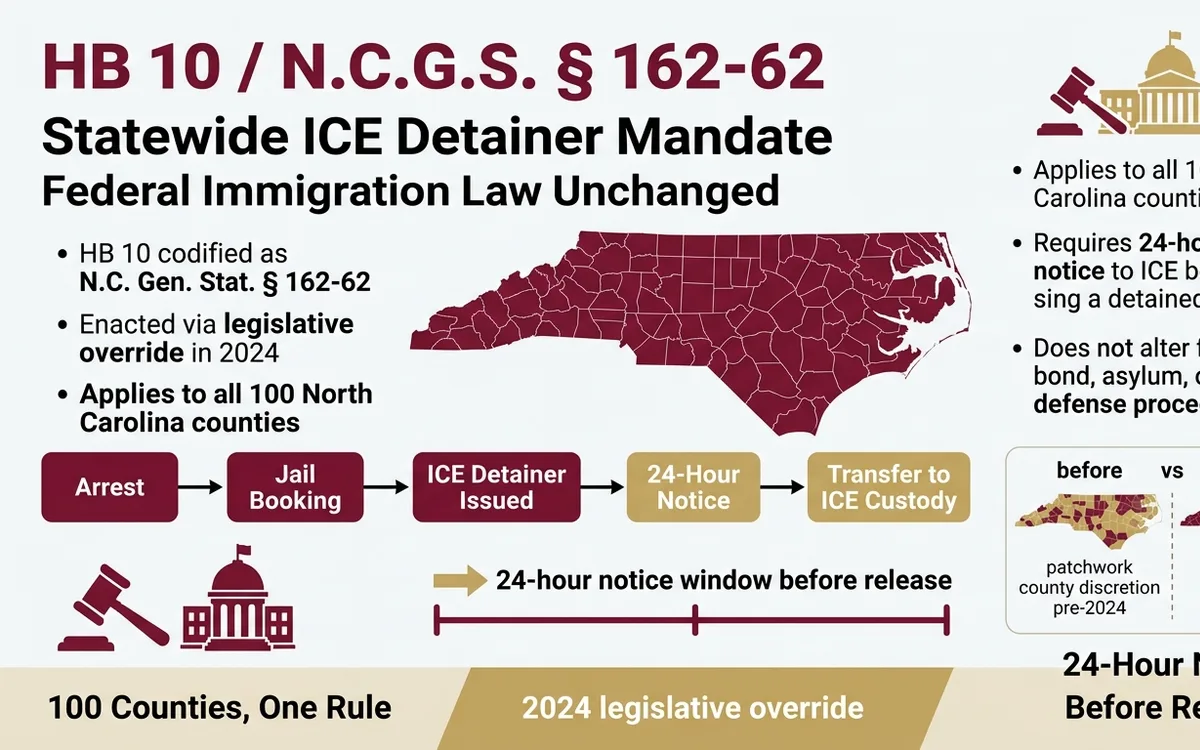
North Carolina's House Bill 10, codified at N.C. Gen. Stat. § 162-62, requires every county jail and sheriff to honor ICE detainers and give U.S. Immigration and Customs Enforcement 24-hour notice before releasing a detained noncitizen. Enacted by legislative override in 2024 (ncleg.gov), it ends county-by-county discretion statewide. It does not change federal bond, asylum, or removal-defense law.
The Hard Truth
The Window Is Shorter Than You Think
Honoring the law does not make a detainer disappear, and calling a lawyer the same day does not undo a 24-hour notification window that has already started. Under N.C. Gen. Stat. § 162-62(b), a jail must notify ICE at least 24 hours before releasing someone ICE has flagged for pickup. If ICE issues a detainer on Form I-247A, the jail can hold that person up to 48 hours beyond when they would otherwise be released, per standard ICE detainer practice. That window is often gone before a family finds an immigration attorney, let alone retains one.
Bond in immigration court is a separate process from state criminal bond, decided by an immigration judge at the Charlotte Immigration Court or another EOIR court, not by the magistrate who set criminal bail. A sheriff's cooperation with ICE under the new law does not, by itself, determine whether an immigration judge grants bond. It does determine whether someone has already been transferred to ICE custody by the time that bond motion gets filed.
What Happens If You Wait
What Delay Actually Costs
Every hour matters once a detainer is lodged. If the 24-hour notice period under § 162-62(b) passes without a motion for state bond or without immigration counsel contacting ICE's local field office, the person in custody is typically transferred to an ICE facility, often outside the county and sometimes outside North Carolina. Once that transfer happens, locating where someone is being held gets harder, and so does finding a lawyer who can appear at the first immigration hearing.
Missing a master calendar hearing date because mail went to the wrong address, or because a family did not understand how immigration bond hearings work, can result in an in absentia removal order. Under INA § 240(b)(5), an immigration judge can order someone deported without them present if they were properly notified and did not appear. That order is difficult to reopen later. Delay is not neutral here. It has a cost measured in custody location, hearing dates, and sometimes a removal order that already exists by the time a family calls a lawyer.
Step-by-Step Process
What Happens After an Arrest Under HB 10
Step 1: Booking and fingerprint submission
When a county jail books someone, fingerprints run through the FBI's database, which can flag immigration history to ICE automatically, regardless of the charge.
Step 2: ICE review and detainer decision
ICE reviews the flag and may issue a detainer on Form I-247A, asking the jail to hold the person up to 48 hours past the scheduled release date.
Step 3: 24-hour pre-release notification
Under N.C. Gen. Stat. § 162-62(b), the jail must notify ICE at least 24 hours before release once a detainer or notification request is lodged, rather than acting at its own discretion as some sheriffs did before 2024.
Step 4: First appearance before a magistrate or judge
Within 48 hours of arrest, or the next business day for certain charges, the person has a first appearance under North Carolina criminal procedure, where state bail is set separately from any ICE hold.
Step 5: Transfer to ICE custody, if the detainer stands
If no state release happens before the detainer window closes, ICE typically takes custody directly from the jail.
Step 6: Immigration bond motion
A separate request for immigration bond can be filed with the immigration judge at the Charlotte Immigration Court or the EOIR court with jurisdiction over the facility holding the person.
Step 7: Master calendar hearing and removal defense
The immigration judge schedules a master calendar hearing, a short procedural hearing where the judge confirms identity, takes pleadings, and sets deadlines for any applications for relief, including asylum, cancellation of removal, or other removal defense options.
A Real-World Example
A Composite Example: What the First 48 Hours Look Like
Consider a composite scenario based on the pattern our team sees across North Carolina. 'Marco,' a construction worker in Mecklenburg County, is stopped for a broken taillight. The officer finds an open warrant unrelated to immigration status and books him into the Mecklenburg County Jail, which operates under a 287(g) Jail Enforcement Model agreement with ICE.
Fingerprints flag Marco's prior immigration record. ICE lodges a detainer, and jail staff log the required 24-hour notice under § 162-62(b). Marco's family contacts an immigration attorney the next morning. The attorney's first calls confirm whether ICE has already transferred Marco and, if not, whether a state bond motion and a separate immigration bond motion should both be filed.
The attorney requests Marco's A-number, checks the ICE Online Detainee Locator, and calendars the deadline for a master calendar hearing notice once Marco is transferred. No outcome is described here, because none can be promised. What can be described is the sequence: confirm custody, assess bond eligibility, identify what relief from removal Marco may qualify for, and prepare for the first hearing date.
William J. Vasquez is licensed by the North Carolina State Bar and admitted to practice before the U.S. Court of Appeals for the Fourth Circuit, the circuit whose decision in Santos v. Frederick County Board of Commissioners, 884 F.3d 404 (4th Cir. 2018), still shapes how detainer holds are challenged in North Carolina federal courts. His practice is focused on removal defense, detainer challenges, and bond proceedings arising from county jail custody across North Carolina, including matters originating in Mecklenburg, Wake, and Henderson counties. He has represented clients in proceedings before the Charlotte Immigration Court and before USCIS's Charlotte Field Office. Our team tracks each county's 287(g) status and the Uniform Bond Policy issued by the North Carolina Conference of Superior Court Judges, because the procedural posture of a case often depends on where a client was booked.
Key Terms Explained
Key Terms Defined
House Bill 10 / N.C. Gen. Stat. § 162-62: The North Carolina statute, enacted by legislative override in 2024, requiring every county sheriff and jail to honor ICE detainers and give 24-hour pre-release notice to ICE. Full text is available at ncleg.gov.
ICE detainer (Form I-247A): A written request from ICE asking a jail to hold someone up to 48 hours beyond their scheduled release so ICE can take custody. It is a request, not a judicial warrant.
287(g) agreement: A contract between ICE and a local sheriff's office under Immigration and Nationality Act § 287(g), authorizing specific deputies to perform limited immigration functions. The Jail Enforcement Model lets trained officers screen people already booked; the Warrant Service Officer model lets officers serve ICE administrative warrants inside the jail; the Task Force Model, reinstated by ICE in 2025, authorizes broader field enforcement. ICE publishes the current list of participating counties at ice.gov/287g.
First appearance: The initial hearing before a magistrate or district court judge, usually within 48 hours of arrest, where state bail conditions are set. It does not address any ICE detainer.
Master calendar hearing: A short procedural hearing before an immigration judge, 5 to 15 minutes, where the judge confirms identity, takes pleadings, and sets deadlines. It is not a trial.
In absentia removal order: A deportation order issued under INA § 240(b)(5) when someone who was properly notified fails to appear for an immigration hearing.
A-number: The unique nine-digit number USCIS and ICE assign to a noncitizen's immigration file, used to locate someone in custody through the ICE Online Detainee Locator.
EOIR: The Executive Office for Immigration Review, the Department of Justice agency that runs immigration courts, including the Charlotte Immigration Court. Information is available at justice.gov/eoir.
Frequently Asked Questions
Q: Does North Carolina's new ICE cooperation law apply to someone arrested in Mecklenburg County without legal status? A: Yes. N.C. Gen. Stat. § 162-62 applies statewide, including Mecklenburg County, and requires the jail to honor ICE detainers and give 24-hour pre-release notice regardless of the underlying charge.
Q: Can a North Carolina sheriff still refuse an ICE detainer after the 2024 law change? A: No. Before the override, some sheriffs used discretion to decline detainer requests. Section 162-62 now requires compliance statewide, though a sheriff can still decline a request that fails to meet ICE's own documentation standards on Form I-247A.
Q: What happens if ICE places a detainer after someone has already been released under the notice rule? A: If the 24-hour notice period passes and the person is released before ICE arrives, ICE may still attempt to locate and arrest them separately, but the jail is not required to re-detain someone it has already released.
Q: What is the difference between a criminal warrant and an ICE detainer? A: A criminal warrant is issued by a judge or magistrate based on probable cause of a crime and is enforceable as a judicial order. An ICE detainer, filed on Form I-247A, is an administrative request from ICE without the same judicial authorization, which is part of why Santos v. Frederick County limits how long a detainer alone can justify holding someone.
Q: Does this law affect someone with a pending asylum application, TPS, or a valid visa? A: The notification and detainer-cooperation rules in § 162-62 apply regardless of pending status. A pending asylum case, Temporary Protected Status, or a visa does not exempt someone from the jail's notification obligation, though it is directly relevant to the bond and removal-defense arguments an attorney can raise once ICE takes custody.
Families searching for help after an arrest often look for reviews before they call. Ours reflect a consistent pattern across courthouses in Mecklenburg, Wake, Guilford, and other North Carolina counties: clients describe direct communication during a stressful custody situation and clear explanations of what each hearing date means. We do not publish outcome statistics or success rates, because no two detainer or bond cases involve the same facts, and because past results are not a reliable predictor of what happens in a new case.
If someone in your family is currently in a North Carolina jail with an ICE hold, the next hours matter more than the next weeks. Before deciding on a next step, it helps to know exactly where that person is being held and whether a detainer has actually been lodged, not just rumored.
Call our office to schedule a consultation focused on North Carolina detainer and bond matters. We review the booking record, confirm custody status, and map out the immigration bond and removal-defense options available for your specific county and facility. Schedule a consultation with our immigration team or call our office directly to speak with someone today.