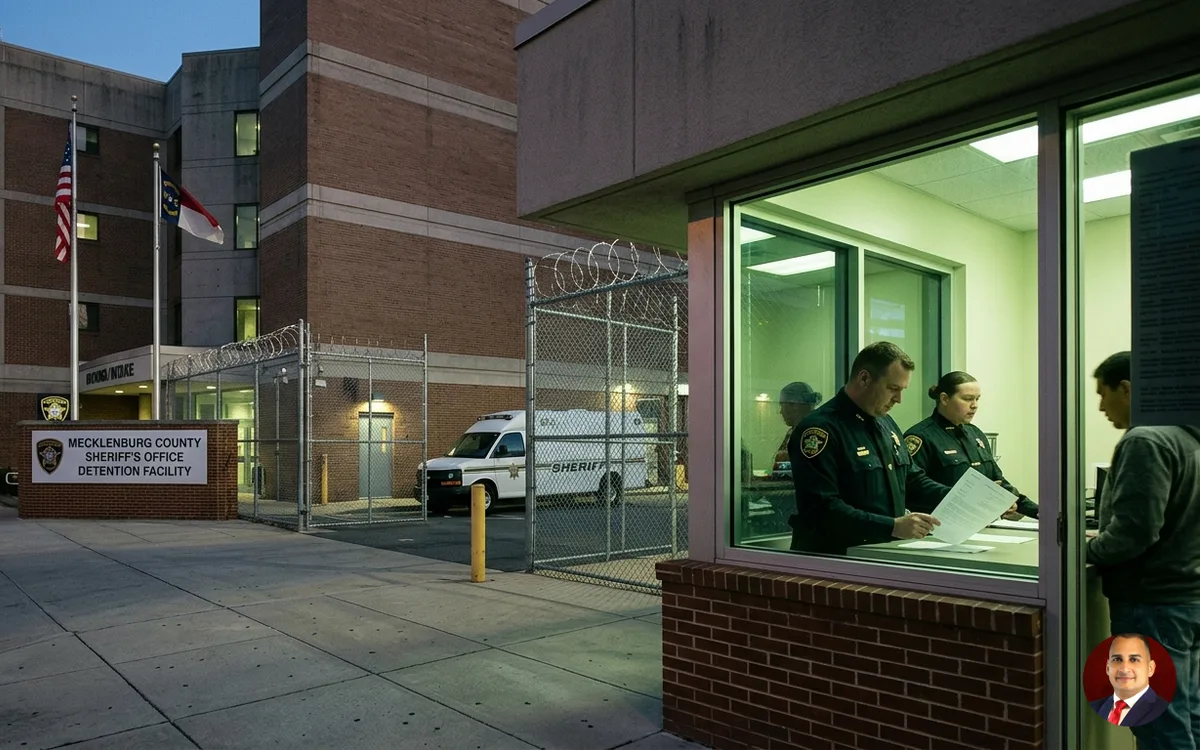
A phone call from Mecklenburg County Jail. A kidnapping charge. A rape allegation involving a minor. Now a hold from Immigration and Customs Enforcement sits on top of the state case, and no one has explained what that means for the next six months. If someone in your family was booked into Mecklenburg County Jail on these charges and ICE placed a detainer, you are dealing with two separate legal systems. The criminal case, in Mecklenburg County Superior Court, decides guilt and sentence. The immigration case, in Charlotte Immigration Court, decides whether your family member can stay in the United States at all. They run on different clocks and answer to different people. This page explains how a detainer works, what North Carolina law requires of the Mecklenburg County Sheriff's Office, and what happens at each stage of both cases. It does not minimize the seriousness of the underlying charges. It explains the process so your family can make informed decisions with counsel, not guesses.
When ICE lodges a detainer after a Mecklenburg County arrest for kidnapping or rape of a minor, the jail can hold the person up to 48 hours past release eligibility under 8 C.F.R. § 287.7 so ICE can take custody. A state judge may still set bond, but the detainer usually keeps the person held.
The Hard Truth
Start with the hardest fact: if the underlying conviction is first-degree statutory rape of a child under N.C. Gen. Stat. § 14-27.29, immigration law classifies that as an aggravated felony under 8 U.S.C. § 1101(a)(43). An aggravated felony conviction triggers mandatory detention under 8 U.S.C. § 1226(c), meaning no immigration judge can set bond once that conviction is final, regardless of family ties, employment, or time in the country. Mecklenburg County has operated a 287(g) Jail Enforcement Model agreement with ICE since 2006, one of the first in the country (U.S. Immigration and Customs Enforcement, 287(g) Program). Jail staff, not just federal agents, run fingerprints and immigration status checks on every person booked, and detainers often get lodged within hours of intake, before a family has retained counsel. A state bond on the kidnapping charge does not control the detainer. A Mecklenburg County magistrate or Superior Court judge can set conditions of release under N.C. Gen. Stat. § 15A-534(d1), but if ICE has lodged a detainer, the jail can hold the person up to 48 hours past that release time so ICE can take custody (8 C.F.R. § 287.7). Posting bond on the state charge, by itself, does not get someone out of custody. These are two of the most severe charge categories in North Carolina criminal law, and removal defense options narrow sharply after a conviction. The honest starting point is that pretrial custody and post-conviction immigration consequences both work against the defendant here, and no attorney can promise a different result in advance.
What Happens If You Wait
Waiting to retain counsel costs real time in both cases. Under Padilla v. Kentucky, 559 U.S. 356 (2010), a criminal defense attorney must advise a noncitizen client of the immigration consequences of a guilty plea before that plea is entered. If no immigration-aware attorney is present at arraignment, that advisement can be rushed or skipped, and undoing a plea afterward is far harder than getting it right the first time. The transfer window is short. Once the Mecklenburg County Sheriff's Office finishes its 287(g) hold, ICE Enforcement and Removal Operations (ERO) Charlotte Field Office can take physical custody and move the person to a detention facility outside Mecklenburg County, sometimes within days. Once that transfer happens, in-person attorney visits get harder to arrange, and family members lose the ability to act on any state bond that might still apply. Evidence problems start their own clock. North Carolina Rule of Evidence 412, the rape shield rule, requires specific pretrial motions and notice deadlines before certain evidence about a complaining witness can be offered at trial. Missing those deadlines can mean that evidence never reaches a jury, regardless of its relevance. On the immigration side, a custody redetermination hearing, a bond hearing before an immigration judge, has to be requested, and it is only available if mandatory detention under 8 U.S.C. § 1226(c) does not yet apply. Delay in requesting it means more time in ICE detention, often in a facility hours from Charlotte.
Step-by-Step Process
## Step 1: Booking and the 287(g) Check A person arrested on state kidnapping or rape charges is booked into the Mecklenburg County Jail. Under the Sheriff's Office's 287(g) Jail Enforcement Model agreement, jail staff cross-check fingerprints against federal immigration databases during booking, not after conviction. ## Step 2: The Detainer (Form I-247A) If the database shows the person may be removable, ICE lodges a detainer, Form I-247A, asking the jail to notify ICE before release and to hold the person up to 48 hours past that release time (8 C.F.R. § 287.7). N.C. Gen. Stat. § 162-62, enacted in 2024, requires North Carolina sheriffs, including Mecklenburg County, to receive and act on these detainers for certain offense categories. It does not, by itself, set bond or decide guilt. ## Step 3: First Appearance and Bond Within 72 hours, or the next session of court, whichever is sooner, per N.C. Gen. Stat. § 15A-511, the person appears before a magistrate or district court judge. Bond on the state charge is set under N.C. Gen. Stat. § 15A-534(d1), which lets the judge weigh flight risk, including immigration status, community ties, and charge severity. Posting bond here addresses the state case only. [Learn more about immigration bond hearings](/practice-areas/immigration/bond-hearings-and-detention). ## Step 4: The 48-Hour Hold and Transfer If ICE has lodged a detainer, the jail can hold the person up to 48 hours past state release eligibility. In practice, ICE ERO Charlotte Field Office typically takes custody before that window closes. Our [overview of 287(g) counties in North Carolina](/practice-areas/immigration/287g-counties) explains which sheriffs currently participate. ## Step 5: Notice to Appear and Charlotte Immigration Court ICE issues a Notice to Appear, the charging document for removal proceedings, and the case is calendared at Charlotte Immigration Court, 6130 Tyvola Centre Drive, Charlotte. This is a civil proceeding before the Executive Office for Immigration Review (EOIR), separate from the criminal docket in Mecklenburg County Superior Court. ## Step 6: Parallel Tracks From here, two cases move at once. The criminal case proceeds through Mecklenburg County Superior Court (26th Judicial District), with pretrial motions, including any Rule 412 rape-shield motions, discovery, and eventually trial or plea. The immigration case proceeds through master calendar hearings and, if contested, an individual merits hearing. A conviction or plea in the criminal case can change what relief, if any, is legally available in the immigration case. See our [removal defense practice page](/practice-areas/immigration/removal-defense). ## Step 7: Appeals A removal order can be appealed to the Board of Immigration Appeals (BIA), an administrative body. Under 8 C.F.R. § 1292.1, any attorney licensed in good standing in a single U.S. state may represent a client before the BIA nationwide, with no circuit-specific admission required. Beyond the BIA, a further appeal goes to the federal circuit court covering the case, which does require that specific circuit's bar admission. [Read more about BIA appeals](/practice-areas/immigration/bia-appeals). This sequence reflects North Carolina procedure and federal immigration law as of June 2025. Deadlines and the specific statutes cited above can change; confirm current requirements with the Mecklenburg County Clerk of Superior Court and the Charlotte Immigration Court before relying on any specific date.
A Real-World Example
The following is a composite scenario built from the kinds of cases our team sees in Mecklenburg County. It is not a real client, and no outcome should be read into it. Mr. R., a Mexican national in his thirties, has lived in Charlotte for eleven years. He is arrested on a kidnapping charge and a charge under N.C. Gen. Stat. § 14-27.29 after an allegation involving a minor. He is booked into the Mecklenburg County Jail, and the 287(g) check flags his immigration status within hours of booking. ICE lodges a Form I-247A detainer before his first court appearance. At first appearance, a district court judge sets bond on the state charges under N.C. Gen. Stat. § 15A-534(d1), citing the severity of the charges and flight risk. His family can post that bond, but the ICE detainer means the jail holds him an additional 48 hours past that release point. ICE ERO Charlotte takes custody before the window closes, and he is transferred to a federal immigration detention facility. His criminal defense attorney, coordinating with immigration counsel, requests a custody redetermination hearing before an immigration judge to argue he is not yet subject to mandatory detention under 8 U.S.C. § 1226(c), since the criminal case has not produced a conviction. Separately, in Superior Court, his defense team files pretrial motions, including a Rule 412 motion addressing what evidence about the complaining witness may be offered at trial, and begins reviewing discovery. As of this writing, both the Mecklenburg County Superior Court case and the Charlotte Immigration Court case remain open. What happens at trial will determine what, if any, immigration relief remains available to him. That is the actual shape of a case like this: two systems, moving at the same time, with no shortcut through either one.
William J. Vasquez is licensed by the North Carolina State Bar and admitted to practice before the U.S. Courts of Appeals for the Fourth, Fifth, and Eleventh Circuits. His practice includes removal defense before the Charlotte Immigration Court and criminal matters in North Carolina Superior and District Courts, including cases where a state charge and an ICE detainer proceed at the same time. He does not hold a Florida Bar license and does not represent clients in Florida state court. His federal immigration-bar standing allows him to appear before EOIR and the Board of Immigration Appeals nationwide, consistent with 8 C.F.R. § 1292.1. Our team also includes attorneys who focus on North Carolina criminal defense, including sex-offense and violent-felony charges in Mecklenburg County Superior Court. We do not publish case outcomes or success rates for these matters. A result in any case depends on the facts actually proven, the charges filed, and decisions made by a judge, jury, or immigration judge, none of which an attorney controls in advance.
Key Terms Explained
ICE detainer (Form I-247A): A written request from Immigration and Customs Enforcement asking a jail to notify ICE before releasing someone and to hold that person up to 48 hours past their release date so ICE can take custody (8 C.F.R. § 287.7). 287(g) Jail Enforcement Model: An agreement between ICE and a local sheriff's office, like Mecklenburg County's, that lets jail staff perform certain immigration status checks and processing functions inside the jail during booking. Aggravated felony: A category of offenses defined at 8 U.S.C. § 1101(a)(43) that, after a qualifying conviction, triggers mandatory immigration detention and sharply limits eligibility for most forms of relief from removal. The term is defined by federal immigration law and does not always match how North Carolina classifies the same offense. Mandatory detention: Under 8 U.S.C. § 1226(c), a rule requiring ICE to detain certain noncitizens, including those with aggravated felony convictions, without the possibility of a bond hearing before an immigration judge. Notice to Appear (NTA): The document that begins removal proceedings in immigration court, listing the government's allegations and the legal basis for removability. Custody redetermination hearing: A bond hearing before an immigration judge, available only when mandatory detention under 8 U.S.C. § 1226(c) does not apply. Rule 412 (rape shield rule): A North Carolina Rule of Evidence that limits when evidence about a complaining witness's prior sexual behavior can be introduced at trial, and requires specific pretrial notice before such evidence is offered. Padilla advisement: The requirement, from Padilla v. Kentucky, 559 U.S. 356 (2010), that a criminal defense attorney tell a noncitizen client about the immigration consequences of a guilty plea before the plea is entered. EOIR: The Executive Office for Immigration Review, the Department of Justice agency that runs immigration courts, including Charlotte Immigration Court, and the Board of Immigration Appeals.
Frequently Asked Questions
Q: Can a Mexican national get bond if ICE places a detainer after a kidnapping arrest in Mecklenburg County? A: A state judge can still set bond on the criminal charge under N.C. Gen. Stat. § 15A-534(d1). The ICE detainer is separate; it lets the jail hold the person up to 48 hours past release so ICE can take custody, so posting the state bond alone usually does not result in release. Q: Does N.C. Gen. Stat. § 162-62 require Mecklenburg County to honor an ICE detainer? A: Yes, for the offense categories it covers. N.C. Gen. Stat. § 162-62, enacted in 2024, requires North Carolina sheriffs to receive ICE detainers and notify ICE before release. It governs what the Sheriff's Office does with the detainer; it does not set bond on the state charge. Q: What happens to the immigration case if the kidnapping or rape charge is dismissed? A: Dismissal of the state charge can change the immigration analysis, but ICE can still pursue removal on other grounds in some circumstances. An immigration judge at Charlotte Immigration Court decides whether removal proceedings continue, not the state court. Q: How long does a case like this typically take to resolve? A: The criminal case in Mecklenburg County Superior Court can take several months to more than a year depending on the trial docket. The immigration case often takes longer; EOIR's national backlog exceeded 3.7 million pending cases as of 2024 (TRAC Immigration, Syracuse University), and a case with parallel criminal proceedings is often continued until the criminal case concludes. Q: What does a consultation cost, and what should a family bring to it? A: Call to ask about consultation fees directly, since they vary by case type and attorney. Bring the arrest warrant or charge sheet, the detainer form if the family has a copy, the name and location of the jail, and the person's full legal name and date of birth. Q: What can a family member do today, before hiring an attorney? A: Confirm custody status and location through the Mecklenburg County Sheriff's Office inmate search or by calling the jail directly. Do not discuss the facts of the case by phone with the person in custody, since jail calls are recorded and can be used in either case. Write down the exact charges and booking date, since both matter for the detainer timeline and the bond hearing. Q: Can the case be appealed if the immigration judge orders removal? A: Yes. A removal order can be appealed to the Board of Immigration Appeals, and under 8 C.F.R. § 1292.1 any attorney licensed in a single U.S. state can represent a client before the BIA nationwide. A further appeal to a federal circuit court requires admission to that specific circuit.
Families contacting our firm about a detainer or a parallel criminal and immigration case consistently describe the same starting point: confusion about which system controls what happens next. We do not publish star ratings or success statistics for criminal or immigration matters, consistent with North Carolina's rules on attorney advertising. What we can tell you is that our attorneys regularly appear in Mecklenburg County Superior Court and before the Charlotte Immigration Court, and that coordinating those two cases is a recurring part of the work.
None of this changes by waiting. The 287(g) check happens at booking, the detainer clock runs on ICE's schedule, and the criminal docket moves on the Superior Court's schedule, not the family's. The next decision, whether to request a custody redetermination hearing, what to file before the first Superior Court date, needs to be made by someone who has read the actual charge sheet and detainer.
If ICE has lodged a detainer on a family member booked into the Mecklenburg County Jail, call our office to schedule a consultation covering both the North Carolina criminal charge and the immigration detainer. Bring the charge sheet, the detainer paperwork if you have it, and the jail's booking number. Our attorneys handle removal defense before the Charlotte Immigration Court and criminal defense in Mecklenburg County Superior Court, and can explain, case by case, how the two proceedings affect each other.
- North Carolina Criminal Defense (/practice-areas/criminal-defense)
- Immigration Bond Hearings and Detention (/practice-areas/immigration/bond-hearings-and-detention)
- 287(g) Counties in North Carolina (/practice-areas/immigration/287g-counties)
- BIA Appeals (/practice-areas/immigration/bia-appeals)
- Removal Defense (/practice-areas/immigration/removal-defense)