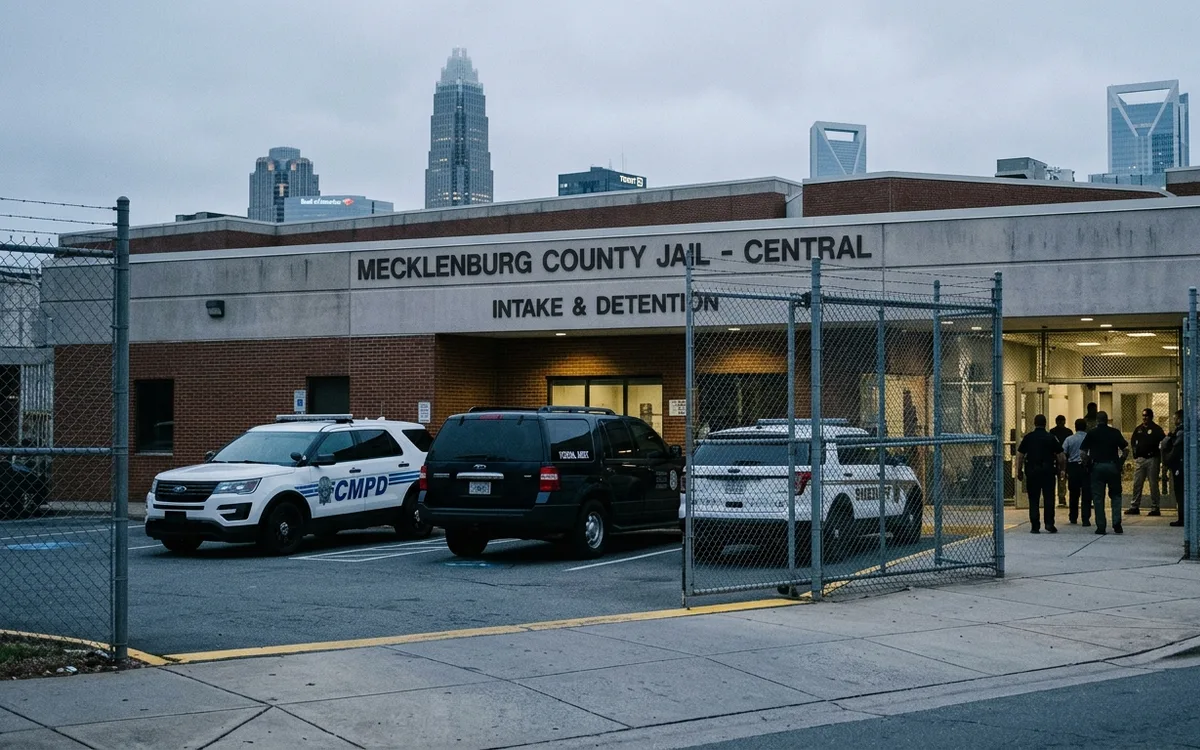
Someone you love didn't come home last night. Maybe you heard it was a joint operation, ICE agents working alongside Charlotte-Mecklenburg Police and the Mecklenburg County Sheriff's Office, and now nobody will tell you where he is or what happens next. You are not panicking for no reason. A multi-agency arrest moves a person through two separate systems at once, criminal and immigration, on two different clocks, and missing either one can cost him his case. Start with where he is, not with what the news reported.
If ICE and local police arrested a family member in a Charlotte multi-agency operation, the person is first held at Mecklenburg County Jail Central under the 287(g) agreement, then must appear before a magistrate within 96 hours (N.C. Gen. Stat. § 15A-511) before any separate immigration bond process begins at Charlotte Immigration Court.
The Hard Truth
Not every case gets a bond hearing. If the charge falls under 8 U.S.C. § 1226(c) (https://www.law.cornell.edu/uscode/text/8/1226), including most aggravated felonies, certain controlled substance offenses, and specified firearms or moral-turpitude crimes, federal law requires ICE to hold the person without a bond redetermination hearing, regardless of how strong his equities are. The Charlotte Immigration Court's docket is also backed up; EOIR publishes quarterly caseload data for every immigration court, including Charlotte, at justice.gov/eoir/statistics, and the pending caseload there has run in the thousands in recent reporting periods. Checking the current report before you set expectations matters more than optimism.
What Happens If You Wait
The criminal clock moves first and moves fast. Mecklenburg County must bring the person before a magistrate within 96 hours of arrest under N.C. Gen. Stat. § 15A-511 (https://www.ncleg.gov/EnactedLegislation/Statutes/HTML/BySection/Chapter_15A/GS_15A-511.html), and whatever happens at that hearing, bail set, charges read, counsel appointed, becomes part of the record ICE and an immigration judge will both look at later. If no one requests a bond redetermination hearing at Charlotte Immigration Court promptly once ICE assumes custody, the person can sit in detention for weeks with no hearing scheduled. Every day without a lawyer reviewing the charging documents is a day closer to a final removal order, and under Santos v. Frederick County Board of Commissioners, 725 F.3d 451 (4th Cir. 2015, opinion archived at ca4.uscourts.gov), a detainer itself does not guarantee due process protections unless someone affirmatively raises them.
Step-by-Step Process
## How Long Can ICE Hold Someone After a Charlotte Multi-Agency Arrest? Under the Mecklenburg County Sheriff's Office's 287(g) Jail Enforcement Model agreement with ICE, a person booked into Mecklenburg County Jail Central (801 E. Fourth Street, Charlotte) who is flagged as a noncitizen can be screened for an immigration detainer before he is ever released on the criminal charge. N.C. Gen. Stat. § 162-62 (https://www.ncleg.gov/EnactedLegislation/Statutes/HTML/BySection/Chapter_162/GS_162-62.html), enacted under House Bill 10 in 2024, requires the sheriff to honor a validly issued ICE detainer rather than release someone solely because the criminal charge resolved. ## What Is the 7-Step Process After a Joint Operation Arrest? 1. **Booking at Jail Central.** Local charges are entered, and the 287(g)-trained deputy checks immigration status against DHS databases. 2. **First appearance within 96 hours.** A magistrate addresses the criminal charge under N.C. Gen. Stat. § 15A-511; this is not an immigration hearing and does not touch the detainer. 3. **ICE detainer lodged.** If one is filed, the sheriff holds the person up to 48 hours beyond when he would otherwise be released, per the detainer form itself. 4. **Transfer to ICE custody.** ICE picks the person up and transports him to a detention facility; location changes can be tracked through ICE's online detainee locator at locator.ice.gov. 5. **Custody determination.** ICE decides whether the charge triggers mandatory detention under 8 U.S.C. § 1226(c) or whether a bond is possible. 6. **Bond hearing request, if eligible.** Counsel files a motion for bond redetermination with the Charlotte Immigration Court (5701 Executive Center Drive, Suite 414, Charlotte). 7. **Master calendar hearing.** The immigration judge sets the removal case on a docket; this hearing is short, often 10 to 20 minutes, and addresses pleadings and scheduling, not the merits. ## Where Do I Find Someone After a Charlotte ICE Operation? Use ICE's Online Detainee Locator System (locator.ice.gov) with the person's full name, country of birth, and date of birth, or call the ICE Charlotte ERO field office directly. ICE's Enforcement and Removal Operations field office publishes arrest totals, prior conviction history, and named partner agencies for each announced operation at ice.gov/news/releases; check the release tied to the specific date of this operation for the agency-reported numbers rather than relying on secondhand reporting. For help with the immigration side of a detainer or bond motion, see our [immigration bond hearings page](/practice-areas/immigration/bond-hearings) and our [detention representation services](/practice-areas/immigration/detention-representation). If the criminal charge itself needs separate counsel, our [criminal defense practice](/practice-areas/criminal-defense) handles the Mecklenburg County Courthouse side of these cases.
A Real-World Example
Consider a composite, not a real client: a man is stopped by CMPD during a joint task-force operation, booked at Jail Central on a state charge, and flagged under the 287(g) agreement. His family cannot reach him for most of the first day because he is still in local booking, not yet in ICE custody. At the 96-hour mark, a magistrate addresses the state charge and sets conditions; the detainer is unaffected by that hearing. Two days later, ICE transfers him to a detention facility outside Mecklenburg County, and his file is docketed at Charlotte Immigration Court. Because his prior record includes a charge listed under 8 U.S.C. § 1226(c), his attorney evaluates whether a bond hearing is available at all before filing anything, since filing a bond motion on a mandatory-detention case wastes the one motion slot the court allows and tips off the government to the argument early. The family's first calls go to the ICE detainee locator and the Charlotte Immigration Court's automated case status line, not to a bond amount, because at that stage there is nothing yet to negotiate.
William J. Vasquez is admitted to the North Carolina State Bar and to the Fourth Circuit Court of Appeals, the circuit that covers North Carolina and hears petitions for review from Charlotte Immigration Court decisions. He has spent more than 15 years handling detainer challenges, bond redetermination motions, and master calendar proceedings arising out of joint ICE and local law enforcement operations in the Charlotte area. Full credentials and case focus areas are listed on his [attorney bio page](/attorneys/william-j-vasquez).
Key Terms Explained
287(g) Jail Enforcement Model: an agreement between ICE and a local sheriff's office, here Mecklenburg County, that trains deputies to screen jail inmates for immigration status and issue detainers while the person is still in local custody. ICE detainer: a written request asking a jail to hold someone up to 48 hours past their release date so ICE can take custody; it is a request, not a judicial warrant. Mandatory detention (8 U.S.C. § 1226(c)): a federal rule requiring ICE to hold certain noncitizens with specified criminal histories without the option of a bond hearing. First appearance: the initial hearing before a magistrate on the criminal charge, required within 96 hours under N.C. Gen. Stat. § 15A-511; it addresses only the state charge, not immigration status. EOIR (Executive Office for Immigration Review): the Department of Justice agency that runs the immigration courts, including Charlotte Immigration Court. Master calendar hearing: a short, preliminary immigration court hearing where the judge takes pleadings and sets a schedule; it is not the trial on removal. Criminal alien: an enforcement term ICE uses for a noncitizen with a criminal conviction or pending charge; it is not itself a legal status and does not determine detention eligibility on its own, the specific charge does.
Frequently Asked Questions
Q: Does the Mecklenburg County Sheriff's Office have to honor an ICE detainer? A: Yes. Under N.C. Gen. Stat. § 162-62, enacted via House Bill 10 in 2024, North Carolina sheriffs are required to honor a properly issued ICE detainer rather than releasing someone once the local charge is resolved. Q: Can local Charlotte police legally participate in an ICE operation? A: CMPD officers can assist with logistics such as traffic control or perimeter security during a joint operation, but only deputies trained and certified under the Mecklenburg County Sheriff's Office's 287(g) agreement are authorized to perform immigration screening and detainer functions themselves. Q: How do I check the status of someone's immigration case after a Charlotte sweep? A: Use the EOIR automated case information line or the Charlotte Immigration Court's case status lookup with the person's alien registration number, available through the Department of Justice's EOIR website, and separately check ICE's online detainee locator for custody location. Q: Is a bond hearing guaranteed after an ICE arrest? A: No. If the underlying charge falls under 8 U.S.C. § 1226(c)'s mandatory detention categories, the immigration judge generally cannot hold a bond redetermination hearing at all, regardless of family ties or employment history.
Clients who have come to our firm after a Charlotte-area ICE arrest describe the same starting point: confusion about which court has their family member and no clear next step. Feedback consistently points to direct answers about where the case stands and what filing comes next, not promises about how a judge will rule. We do not quote outcome statistics for immigration matters because case results depend on facts specific to each person's record and charge.
Every hour matters more in the first four days than at almost any later point, because the criminal first appearance and the ICE custody decision both happen on that timeline. Before you decide anything else, confirm where the person is being held and whether a detainer has actually been lodged.
If a family member was arrested in a recent Charlotte-area ICE operation, schedule a consultation with our team to review the charge, the detainer, and whether a bond hearing is possible before the next filing deadline passes. Visit our [immigration bond hearings page](/practice-areas/immigration/bond-hearings) or [contact our office directly](/contact) to get a specific next step for his case, not a general explanation of the law.
- Immigration Bond Hearings
- Detention Representation
- Criminal Defense in Mecklenburg County
- Schedule a Consultation
- Attorney William J. Vasquez