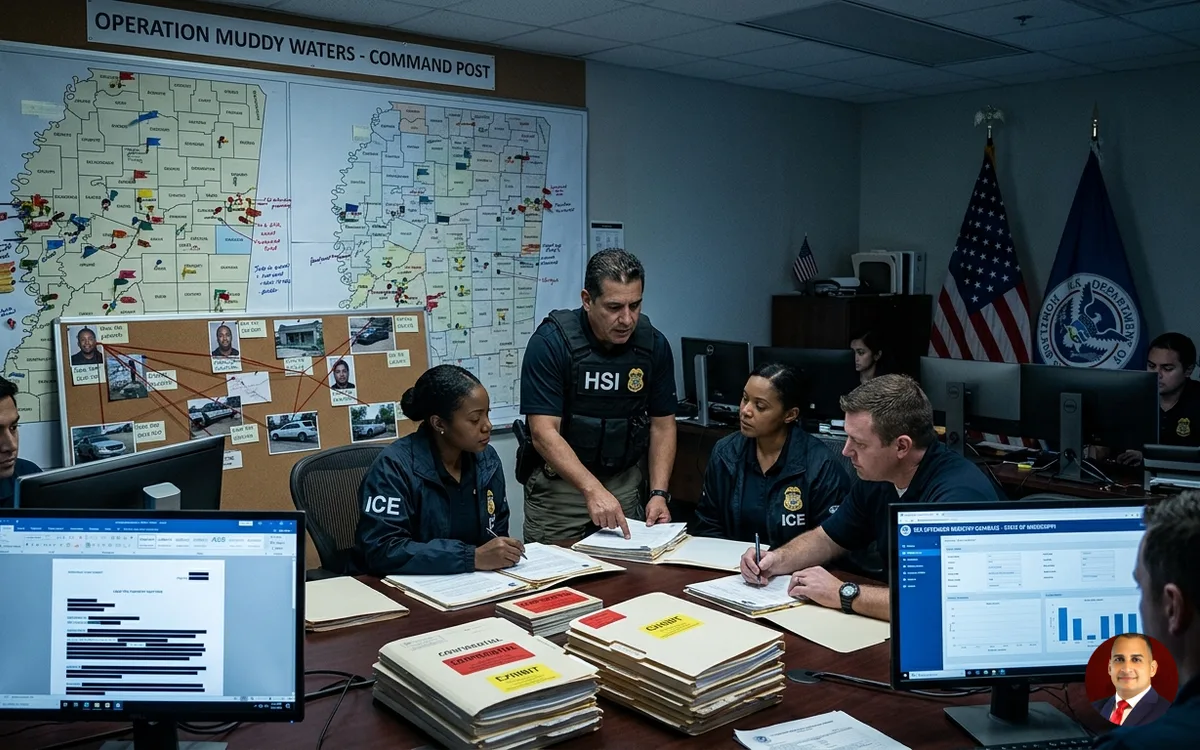
Your phone rings with a Mississippi area code, and the voice on the other end tells you a relative was just arrested in something called Operation Muddy Waters. Or maybe you live in Charlotte or Raleigh and you've started wondering whether the ICE Homeland Security Investigations unit that ran that sweep also watches North Carolina. Either way, you're trying to figure out what happens next, and most of what you'll find online is written for Mississippi, not for the state where you actually live. North Carolina has its own registration statute, its own sheriff's offices that enforce it, and its own deadlines that start running the moment a conviction or an address change occurs. Getting the next step wrong, even by a few days, carries criminal exposure of its own.
Operation Muddy Waters is an ICE Homeland Security Investigations enforcement action that led to 70 arrests across Mississippi in March 2025 for child exploitation and sex offender registry violations, per HSI's press release. North Carolina residents face separate exposure: NC Gen. Stat. § 14-208.7 requires in-person registration with the county sheriff within 3 business days of release or address change.
The Hard Truth
A federal child exploitation charge is not a case you talk your way out of at the first court date. HSI builds these investigations over months, often with undercover accounts, subpoenaed internet service provider records, and forensic device extraction completed before anyone is arrested. By the time an indictment is unsealed in the Eastern, Middle, or Western District of North Carolina, the government has usually already reviewed the evidence a defense attorney is seeing for the first time at arraignment. Federal sentencing guidelines for these offenses carry mandatory minimums in many cases, and pretrial detention is the norm, not the exception, under 18 U.S.C. § 3142(e)'s rebuttable presumption for certain child exploitation charges. If you are a lawful permanent resident, a conviction under most of these statutes is also an aggravated felony under federal immigration law, which triggers mandatory deportation with no judicial discretion to cancel it.
What Happens If You Wait
North Carolina's registration deadline does not pause while you decide whether to hire a lawyer. Under N.C. Gen. Stat. § 14-208.7, a person required to register must appear in person at the sheriff's office in the county where they reside within 3 business days of release from custody or a change of address. Missing that window is itself a separate felony under N.C. Gen. Stat. § 14-208.11, Failure to Register as a Sex Offender, punishable independent of whatever the underlying conviction was. Someone who moves to North Carolina after an out-of-state or federal conviction and assumes the home state's registration satisfies North Carolina law is frequently wrong, and that assumption has put people in front of a second set of felony charges within weeks of relocating.
Step-by-Step Process
Step 1: HSI opens an investigation, often based on a cybertip from the National Center for Missing & Exploited Children, an ISP referral, or an undercover online operation. This stage can run for months before anyone is contacted. Step 2: Agents execute a search warrant or make contact, sometimes before an arrest. Anything said at this stage becomes part of the record; you have the right to decline to answer questions until you've spoken with counsel. Step 3: Federal charges are filed, typically in the U.S. District Court for the Eastern, Middle, or Western District of North Carolina depending on where the conduct occurred, and the defendant is arraigned before a magistrate judge. Step 4: A detention hearing follows, usually within days. For charges carrying the 18 U.S.C. § 3142(e) presumption, the defense bears the burden of showing conditions that would reasonably assure appearance and community safety. Step 5: Pretrial litigation, plea negotiation, or trial proceeds under the federal sentencing guidelines applicable to the specific statute charged. Step 6: If a conviction results, the sentencing court determines any SORNA registration obligation under the Adam Walsh Child Protection and Safety Act of 2006, and North Carolina's own reportable-offense list under N.C. Gen. Stat. § 14-208.6 determines state registration duration. Step 7: Within 3 business days of release, the person must register in person with the county sheriff under N.C. Gen. Stat. § 14-208.7. The NC State Bureau of Investigation's Sex Offender and Public Protection Registration Program then maintains the record statewide. Step 8: The sentencing or registering authority determines whether satellite-based monitoring applies under N.C. Gen. Stat. § 14-208.40, subject to the individualized assessment required by State v. Bowditch, 364 N.C. 335 (2010), which struck down automatic lifetime SBM without a hearing.
A Real-World Example
Consider a composite case: a North Carolina resident, call him Daniel, learns his adult son was arrested in another state during a multi-agency operation similar in scope to Operation Muddy Waters. The son's case proceeds in that state's federal district court, but Daniel's family lives in Mecklenburg County, and the son plans to return there after any period of incarceration. Daniel's first calls are to the Mecklenburg County Sheriff's Office Sex Offender Registration Unit to understand what North Carolina will require regardless of what happens in the out-of-state case. The unit explains that a reportable conviction anywhere triggers North Carolina's own registration duty under N.C. Gen. Stat. § 14-208.7 the moment the son establishes residency here, independent of the original state's procedures. Over the following months, Daniel's family works through the federal sentencing timeline, the separate SORNA classification process, and the question of whether satellite-based monitoring will be assessed once the son registers in North Carolina. Each stage has its own paperwork, its own deadline, and its own agency, and no single phone call resolves all of them at once.
William J. Vasquez is admitted to the North Carolina State Bar and to the U.S. District Courts for the Eastern, Middle, and Western Districts of North Carolina, where federal child exploitation and sex offense cases originating from HSI Charlotte referrals are prosecuted. His practice includes federal criminal defense and NC sex offender registry compliance matters, including registration disputes and satellite-based monitoring hearings under State v. Bowditch. Full credentials and case history are available on his attorney profile at /attorneys/william-j-vasquez.
Key Terms Explained
HSI (Homeland Security Investigations): the investigative arm of ICE responsible for federal criminal investigations, including child exploitation cases. SORNA: the Sex Offender Registration and Notification Act, Title I of the Adam Walsh Child Protection and Safety Act of 2006, which sets the federal baseline for registration requirements nationwide. Reportable conviction: an offense listed under N.C. Gen. Stat. § 14-208.6 that triggers North Carolina's registration duty, regardless of where the conviction occurred. Satellite-based monitoring (SBM): continuous GPS tracking imposed under N.C. Gen. Stat. § 14-208.40 on certain registrants, subject to an individualized hearing required by State v. Bowditch, 364 N.C. 335 (2010). Failure to register: a separate felony under N.C. Gen. Stat. § 14-208.11 for missing the registration or address-update deadline, charged independent of the underlying offense. Aggravated felony (immigration): a federal immigration law category that includes most child exploitation convictions and carries mandatory deportation with no discretionary waiver.
Frequently Asked Questions
Q: What was Operation Muddy Waters? A: Operation Muddy Waters was a coordinated ICE Homeland Security Investigations enforcement action announced in March 2025 that resulted in 70 arrests across Mississippi for child exploitation offenses and sex offender registration compliance violations, according to HSI's press release. Q: Does Operation Muddy Waters affect people living in North Carolina? A: Not directly, since the operation targeted Mississippi, but anyone with a reportable conviction from that operation who later moves to or already resides in North Carolina must still register here under N.C. Gen. Stat. § 14-208.7, independent of their home state's process. Q: What should I do if HSI agents show up at my home in North Carolina? A: You are not required to answer questions or consent to a search without a warrant; state that you want to speak with an attorney before any further conversation, and write down the agents' names and badge numbers once they leave. Q: How much does federal criminal defense for a case like this cost? A: Fees vary by case complexity, stage of investigation, and whether the matter proceeds to trial; because these cases often involve forensic review of seized devices, costs are typically discussed and set during an initial consultation rather than quoted generically. Q: How long does it take to resolve a federal child exploitation case? A: These cases commonly take 12 to 24 months from indictment to resolution in federal court, longer if forensic evidence requires independent review or if the case proceeds to trial. Q: What happens if someone ignores a registration deadline in North Carolina? A: Missing the 3-business-day window under N.C. Gen. Stat. § 14-208.7 exposes the person to a separate felony charge under N.C. Gen. Stat. § 14-208.11, Failure to Register, regardless of the status of any underlying case. Q: Can satellite-based monitoring be appealed in North Carolina? A: Yes; under State v. Bowditch, 364 N.C. 335 (2010), the state cannot impose lifetime SBM automatically without an individualized hearing on whether monitoring is reasonable, and registrants can challenge that determination. Q: What immigration consequences follow a sex offense conviction for a green card holder in North Carolina? A: Most child exploitation and many sex offense convictions qualify as aggravated felonies under federal immigration law, which triggers mandatory removal proceedings with no cancellation-of-removal eligibility, regardless of how long the person has held a green card. Q: How do I check whether someone is on the NC sex offender registry? A: The NC State Bureau of Investigation maintains a public, searchable Sex Offender and Public Protection Registration Program database, and county sheriff's offices such as the Wake County Sheriff's Office Sex Offender Registry Compliance Unit can confirm local registration status directly. Q: What evidence does HSI typically have before making contact? A: By the time of contact, HSI has usually already obtained internet service provider subscriber records, device identifiers, and in many cases a forensic preview of seized or cloud-stored material pursuant to a search warrant, meaning the investigation is often further along than the contacted individual realizes.
Clients contacting our firm after a federal referral or an HSI inquiry consistently describe the same starting point: confusion about which court has jurisdiction and which deadline applies first. Feedback from past clients and referring attorneys reflects a practice built on direct communication about realistic timelines and plain explanations of registry obligations, not promises about outcomes we cannot make in a federal criminal matter.
If you're facing a registration deadline this week, or a family member was just named in a multi-state operation, the next right step is understanding exactly which North Carolina statute applies to your situation before the clock runs further. Our federal criminal defense practice and our sex offender registry compliance work operate side by side for exactly this reason.
Call our office to schedule a consultation with William J. Vasquez about a federal child exploitation charge, an HSI contact, or a North Carolina sex offender registration deadline. Visit /practice-areas/federal-criminal-defense or /practice-areas/sex-offender-registry-compliance for more on how these matters are handled, or go directly to /contact to set a time to talk through your deadline before it passes.
- /practice-areas/federal-criminal-defense
- /practice-areas/sex-offender-registry-compliance
- /attorneys/william-j-vasquez
- /contact
- /practice-areas/immigration-consequences-of-criminal-convictions