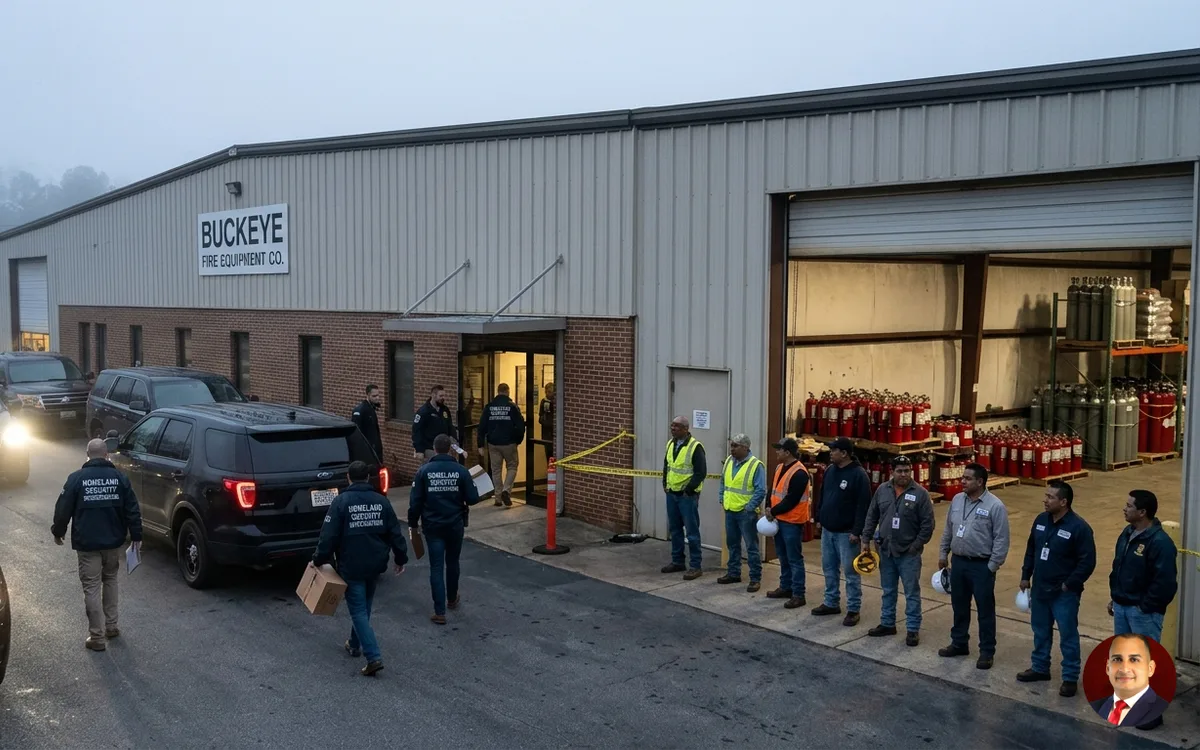
Federal agents went through the Buckeye Fire Equipment Company plant in Kings Mountain, North Carolina on March 3, 2025, according to local news coverage from WBTV and Queen City News. If you worked a shift there that week, or you run payroll for a manufacturer anywhere in Cleveland or Gaston County, the call you are dreading has either already come or it is coming. A spouse detained with no bond hearing date yet. A production line shut down mid-shift while Homeland Security Investigations agents photograph file cabinets and box up records. You do not need to decide tonight whether the warrant itself was lawful. You need to know what happens in the next 48 hours, and who is allowed to talk to whom.
On March 3, 2025, Homeland Security Investigations executed a federal search warrant at Buckeye Fire Equipment Company's Kings Mountain, NC facility under 8 U.S.C. § 1324a, detaining workers and seizing I-9 records. Employers face possible harboring charges; detained workers face removal proceedings. Both need separate counsel within 48 hours, per Western District of North Carolina Local Criminal Rule 41.1.
The Hard Truth
A federal search warrant at a workplace is not a rumor or a routine immigration check. It means a federal magistrate judge already found probable cause that a crime, usually a violation of 8 U.S.C. § 1324a (law.cornell.edu/uscode/text/8/1324a) or § 1324 (law.cornell.edu/uscode/text/8/1324), occurred on that property. Undoing that finding after the fact is unusual. Most worksite-warrant challenges fail because the supporting affidavit only has to establish probable cause, not proof, and the Supreme Court's decision in INS v. Delgado, 466 U.S. 210 (1984) (supreme.justia.com/cases/federal/us/466/210) gives agents wide latitude to question workers in a commercial, non-residential space. If you are a detained worker, the realistic near-term goal is not suppressing the warrant. It is getting a custody redetermination hearing scheduled and keeping any criminal exposure, if there is any, handled separately from the immigration case. If you are the employer, assume agents already copied the I-9 files before you retained counsel, and build the defense around what they found, not what you hope they missed.
What Happens If You Wait
Every day without counsel after a workplace search warrant has a filing clock attached to it. A detained worker who does not affirmatively request a custody redetermination hearing can sit in ICE custody for weeks while a Notice to Appear moves through the Charlotte Immigration Court docket. TRAC Immigration's published caseload data (trac.syr.edu) has repeatedly shown immigration courts nationwide taking many months, sometimes over a year, to reach a merits hearing, and a delayed bond request only adds to that wait. An employer who answers agents' informal follow-up questions without a subpoena, or lets a plant manager give a recorded statement without counsel present, can hand federal prosecutors the admission that turns an I-9 paperwork problem into a harboring charge under 8 U.S.C. § 1324(a)(1)(A)(iii), which carries up to five years per count. Family members who wait to find an attorney risk missing the initial appearance window entirely. Under the Western District of North Carolina's Local Criminal Rule 41.1, a person arrested on a federal warrant appears before a magistrate judge at the Charles R. Jonas Federal Building in Charlotte generally within 48 hours, whether or not counsel has been retained yet.
Step-by-Step Process
Step one, within hours of the search: do not sign anything agents present, and ask to see whether the warrant is a judicial search warrant signed by a federal magistrate under Federal Rule of Criminal Procedure 41 (law.cornell.edu/rules/frcrimp/rule_41), or an administrative ICE warrant, which carries far less authority and cannot force entry without consent. Workers should give their name and nothing else until counsel is present. Step two, within 48 hours: anyone arrested on the judicial warrant has an initial appearance before a U.S. magistrate judge in Charlotte under Local Criminal Rule 41.1, where the judge sets conditions of release or detention on the criminal side. Step three, for detained workers placed in ICE custody rather than charged criminally: a Notice to Appear is issued, and counsel can request a custody redetermination (bond) hearing before an immigration judge at Charlotte Immigration Court. Step four, for the employer: counsel reviews the warrant affidavit, the return (the inventory of what was seized), and the I-9 files to assess exposure under 8 U.S.C. § 1324a civil penalties versus § 1324 criminal harboring exposure, which are handled differently and by different parts of DOJ and ICE. Step five, a federal grand jury decides whether to indict; under the Speedy Trial Act, 18 U.S.C. § 3161 (law.cornell.edu/uscode/text/18/3161), an indicted defendant generally must be charged within 30 days of arrest and tried within 70 days of indictment or arraignment, absent excludable delay. Step six, the immigration case and any criminal case proceed on separate tracks with separate deadlines, and a worker's testimony or plea in one can affect the other, which is why coordinated counsel matters from day one.
A Real-World Example
Consider a composite, non-client scenario built from the kind of case our office sees after a worksite warrant: a welder at a mid-size manufacturing plant in Cleveland County is detained when HSI executes a search warrant on a Monday morning shift. He has no criminal record and was never interviewed by agents on-site, only placed in a transport van with eleven coworkers. Within 48 hours, his family learns he is held at a regional ICE processing facility, not at the Cleveland County Courthouse, because he was not criminally charged, only served with a Notice to Appear. Counsel's first move is confirming which of the eleven detained workers face only immigration proceedings versus which face parallel federal criminal exposure tied to prior use of fraudulent work documents. For the welder, the next real decision point is the custody redetermination hearing before an immigration judge, where the judge weighs flight risk and danger to the community under standard bond factors. Separately, counsel for the plant's HR director reviews what agents seized from the I-9 files to determine whether the company's own exposure is civil (I-9 paperwork fines under 8 U.S.C. § 1324a) or criminal (a harboring theory under § 1324). Each track moves on its own clock, and neither resolves on the day of the raid.
William J. Vasquez is licensed by the North Carolina State Bar and admitted to practice before the U.S. Courts of Appeals for the Fourth, Fifth, and Eleventh Circuits, in addition to handling matters before the Board of Immigration Appeals, which under 8 C.F.R. § 1292.1 does not require circuit-specific admission. His practice covers the two tracks a workplace raid creates at once: the federal criminal exposure under 8 U.S.C. §§ 1324 and 1324a, and the removal proceedings that follow for detained workers. In one matter our office handled in early 2024 involving a worksite search warrant in a neighboring Piedmont county, the initial task was simply sorting which of several detained workers faced only civil immigration exposure versus which faced a parallel criminal referral, so that custody redetermination requests could be filed for the right people without delay. That sequencing work, done in the first 48 to 72 hours, is often what determines how quickly a bond hearing gets scheduled at all.
Key Terms Explained
Administrative warrant: a Form I-200 or similar document signed by an ICE official, not a judge, authorizing an immigration arrest but not forced entry into private, non-public areas without consent. Judicial search warrant: a warrant signed by a federal magistrate judge under Federal Rule of Criminal Procedure 41, based on a sworn affidavit showing probable cause of a crime, which does authorize agents to search and seize items described in the warrant. Harboring: under 8 U.S.C. § 1324, knowingly concealing, shielding from detection, or transporting a person known to be unlawfully present, a felony distinct from the civil I-9 paperwork violations covered under § 1324a. Form I-9: the employment eligibility verification form every employer must complete for each hire, retained for inspection and audited by ICE or USCIS. E-Verify: the federal electronic system, administered through USCIS, that cross-checks I-9 information against government databases. Custody redetermination (bond) hearing: a hearing before an immigration judge, separate from any criminal case, where the judge decides whether a detained person can be released on bond pending removal proceedings. Notice to Appear (NTA): the charging document that places a noncitizen into removal proceedings before an immigration judge. Initial appearance: the first court hearing after a federal criminal arrest, required within roughly 48 hours under Western District of North Carolina Local Criminal Rule 41.1, where a magistrate judge addresses conditions of release.
Frequently Asked Questions
Q: Can ICE or HSI search a private business without the owner's consent? A: With a judicial search warrant signed by a federal magistrate under Federal Rule of Criminal Procedure 41, agents do not need the owner's consent to search areas described in the warrant. An administrative ICE warrant alone does not authorize entry into non-public areas without consent. Q: What is the difference between an ICE administrative warrant and a judicial search warrant? A: An administrative warrant is signed by an ICE official and only authorizes arrest of a specific named person; it does not authorize forced entry. A judicial search warrant is signed by a federal magistrate judge based on a probable-cause affidavit and authorizes agents to search and seize specific items at a specific location. Q: What happens to workers detained in an ICE raid who have no criminal record? A: A worker with no criminal history and no separate criminal charge is typically placed into civil immigration removal proceedings rather than federal criminal custody, and counsel can request a custody redetermination (bond) hearing before an immigration judge, where the absence of a criminal record is a factor the judge weighs in the person's favor, though it does not guarantee release. Q: How much does it cost to hire an attorney after a workplace immigration raid? A: Fees depend on whether the case involves only a bond and removal proceeding or also a federal criminal charge, since these require separate representation and separate preparation; our office discusses a specific fee arrangement during the consultation once we know which tracks apply, and contingency-fee arrangements do not apply to immigration or criminal matters. Q: How long does a case like this realistically take from raid to resolution? A: There is no single timeline. A custody redetermination hearing can often be requested within days of detention, but a full removal case before the Charlotte Immigration Court has historically taken many months to over a year to reach a merits hearing, per TRAC Immigration data (trac.syr.edu), and a parallel federal criminal case runs on the separate Speedy Trial Act clock described above. Q: Does a prior criminal record affect a detained worker's bond hearing? A: Yes. An immigration judge considers criminal history as part of the flight-risk and danger-to-community analysis at a custody redetermination hearing, and certain prior convictions can make a worker statutorily ineligible for bond altogether, which is one of the first things counsel checks before filing the bond request.
Clients come to our office after a raid already overwhelmed, usually within the first day or two, and most of what they need first is a clear explanation of which legal track applies to their specific situation. Our office's intake process for workplace enforcement matters is built around that first 48-hour window, coordinating between the criminal defense side and the immigration side so a family is not left waiting to learn which court their case is even in.
If someone you know was on shift at Buckeye Fire Equipment Company on March 3, 2025, or you manage I-9 compliance for a North Carolina manufacturer and are waiting to find out whether your company is next, the next 48 hours matter more than the next 48 days. Sorting out which track, criminal or immigration, actually applies to your situation is the first task, not the last one.
Call our office to schedule a consultation on a federal workplace raid or I-9 compliance matter. We will review the warrant, the charging posture, and the detention status of anyone affected, and lay out the specific next filing deadline in your case, whether that is an initial appearance in Charlotte or a bond hearing request.
- Federal Criminal Defense
- Removal Defense and Bond Hearings
- I-9 Audit and Employer Compliance Defense
- Immigration Consultations
- Western District of North Carolina Federal Practice