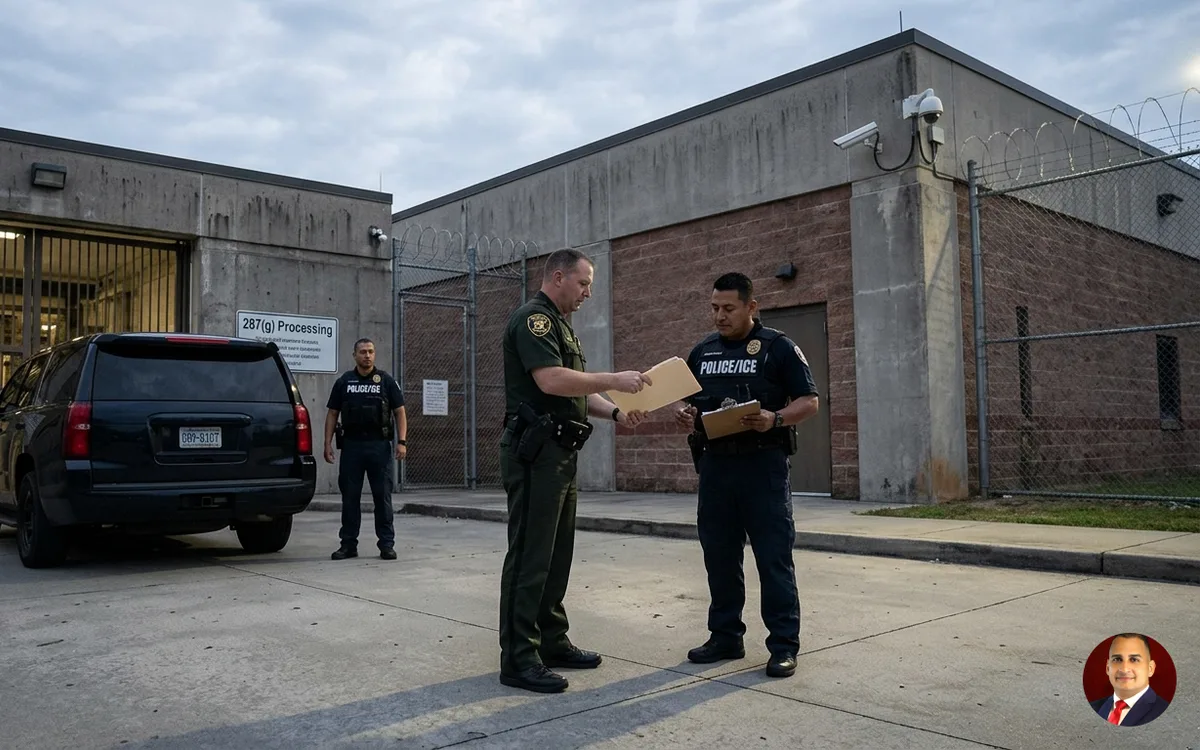
You saw the ICE press release. A Massachusetts man, arrested on sex-crime and extortion charges, taken into federal custody by ICE's Boston Field Office. Now you're searching because someone you know, in North Carolina, is in a similar spot: a pending charge, a jail cell, and a fear that immigration status is about to become the bigger problem. That fear is not irrational. In North Carolina, a criminal arrest and an immigration arrest can happen within the same 48 hours, through a county jail program most families have never heard of until it touches their own case. What happens next depends on the county, the specific charge, and decisions made in the first few days after booking, not after any conviction.
ICE's Boston Field Office arrest of a Massachusetts man on sex-crime and extortion charges shows how a pending state charge can trigger federal immigration detention before any conviction. In North Carolina, the same mechanism runs through 287(g) jail agreements: an ICE detainer is lodged at booking, starting a separate removal case in Charlotte Immigration Court.
The Hard Truth
### Mandatory Detention Means No Bond Hearing A sex-offense or extortion conviction, not merely a charge, can place someone in mandatory detention under [8 U.S.C. § 1226(c)](https://www.law.cornell.edu/uscode/text/8/1226), a federal statute that removes the immigration judge's discretion to set bond at all. This applies to lawful permanent residents, not only undocumented immigrants, once the conviction qualifies as an aggravated felony or a crime involving moral turpitude under the INA. First-degree forcible sexual offense under [N.C. Gen. Stat. § 14-27.21](https://www.ncleg.gov/EnactedLegislation/Statutes/HTML/BySection/Chapter_14/GS_14-27.21.html) and extortion under [N.C. Gen. Stat. § 14-118.4](https://www.ncleg.gov/EnactedLegislation/Statutes/HTML/BySection/Chapter_14/GS_14-118.4.html) both carry this risk once a conviction becomes final. The case described in ICE's Boston news release followed this pattern: a state criminal charge led directly into federal custody, independent of where the Massachusetts prosecution stood. In North Carolina, an open charge alone does not trigger mandatory detention. It is the conviction, and specifically how it's classified under federal immigration law, that closes the door on a bond hearing. That distinction is exactly where an immigration-aware plea negotiation, consistent with the duty set out in [Padilla v. Kentucky, 559 U.S. 356 (2010)](https://www.law.cornell.edu/supct/html/08-651.ZS.html), matters most, and where many cases go wrong before an immigration attorney is ever consulted. Our [criminal-immigration defense](/practice-areas/criminal-immigration-defense) work focuses on that overlap. ICE's own numbers show the scale of this. ICE's Fiscal Year 2023 Annual Report recorded roughly 170,590 total arrests, with about two-thirds involving a prior conviction or a pending criminal charge ([ICE.gov, FY2023 ICE Annual Report](https://www.ice.gov/features/ERO-2023)). A criminal record, even an unresolved one, is the single biggest driver of who ICE arrests.
What Happens If You Wait
### What Waiting Costs You Every day between arrest and getting a lawyer involved narrows the options. A Notice to Appear (NTA) issued by ICE starts the removal case, and missing the first scheduled hearing can result in an in absentia removal order entered without the person present, under [8 U.S.C. § 1229a(b)(5)](https://www.law.cornell.edu/uscode/text/8/1229a). On the criminal side, defense counsel in a North Carolina court who fails to advise on immigration consequences before a guilty plea falls short of the duty described in Padilla v. Kentucky. That duty only helps if it's raised before the plea is entered, not after. A plea taken in Mecklenburg County District Court without that advisal can lock in deportability permanently, with no way to undo it once judgment is final. If a conviction becomes final while § 1226(c) mandatory detention applies, any chance at a bond hearing disappears for the rest of the case. A detained docket at the Charlotte Immigration Court can run from several months to roughly two years before a merits hearing, based on EOIR's published nationwide caseload data, which showed a backlog of over 3.7 million pending cases as of 2024 ([TRAC Immigration, Syracuse University](https://trac.syr.edu/immigration/reports/)). A missed appeal to the Board of Immigration Appeals, due within 30 days of the judge's decision under [8 C.F.R. § 1003.38(b)](https://www.ecfr.gov/current/title-8/chapter-V/subchapter-A/part-1003/subpart-A/section-1003.38), ends the case outright. None of these deadlines pause while someone looks for representation. Our [Immigration Bond Hearings](/practice-areas/immigration-bond-hearings) page explains what's still possible once a detainer is lodged.
Step-by-Step Process
### Step 1: Booking and the 287(g) Check (Hours 0-6) Mecklenburg County Sheriff's Office has operated a 287(g) jail model agreement with ICE since 2006 and remains an active participating agency as of 2025 ([ICE.gov, 287(g) Program](https://www.ice.gov/identify-and-arrest/287g)). Trained detention officers check immigration status against DHS databases during booking at the Mecklenburg County Jail Central Processing Unit. A database match lets ICE lodge a detainer under [8 C.F.R. § 287.7](https://www.ecfr.gov/current/title-8/chapter-I/subchapter-B/part-287/section-287.7) before the person ever sees a magistrate. ### Step 2: Initial Appearance and State Bond (Hours 6-48) A magistrate or district court judge sets conditions of pretrial release under [N.C. Gen. Stat. § 15A-534](https://www.ncleg.gov/EnactedLegislation/Statutes/HTML/BySection/Chapter_15A/GS_15A-534.html), weighing flight risk and danger to the community. Posting a state bond does not end the matter if a detainer is also on file. Under 8 C.F.R. § 287.7(d), the jail can hold someone up to 48 hours past their otherwise-scheduled release so ICE can take custody. ### Step 3: Transfer to ICE Custody If ICE takes custody, the person typically moves to a contract detention facility while the criminal case continues separately in NC District or Superior Court, often with the defendant appearing by video for criminal hearings. The two cases run on separate tracks, separate courts, and separate deadlines, unless one legal team is coordinating both. ### Step 4: Notice to Appear and the Charlotte Immigration Court ICE issues a Notice to Appear (NTA), the charging document that starts the removal case, filed with the Charlotte Immigration Court. The first hearing, a master calendar hearing, is a short procedural session, typically 5 to 15 minutes, where the judge confirms identity, reviews the NTA's factual allegations, and sets a schedule. ### Step 5: Bond Redetermination, If Available If § 1226(c) mandatory detention doesn't apply, meaning there's no qualifying final conviction yet, the detainee can request a bond redetermination hearing before an immigration judge. If it does apply, the only remaining paths are a habeas petition filed in the U.S. District Court for the Western District of North Carolina or resolution of the underlying criminal case. See [Immigration Bond Hearings](/practice-areas/immigration-bond-hearings) for how that process works when it's available. ### Step 6: Merits Hearing and Appeal If removal relief is contested, the case proceeds to a merits hearing, where the judge decides whether relief such as cancellation of removal or asylum can be granted under the applicable legal standard. A decision can be appealed to the Board of Immigration Appeals within 30 days under 8 C.F.R. § 1003.38(b), and from there, in limited circumstances, to the U.S. Court of Appeals for the Fourth Circuit, which reviews petitions from the Charlotte Immigration Court.
A Real-World Example
### A Composite Example: Arrest to Master Calendar Hearing This is a composite built from the kind of case pattern this firm sees in Mecklenburg County, not a real client. Call him Mr. R, a lawful permanent resident for nine years, arrested on an extortion charge under N.C. Gen. Stat. § 14-118.4 following a dispute with a former business partner. At booking, 287(g)-trained officers flag his immigration history and ICE lodges a detainer. A magistrate sets a state bond under N.C. Gen. Stat. § 15A-534. His family posts it within a day. ICE still takes custody at the 48-hour mark under 8 C.F.R. § 287.7(d), because the detainer does not depend on the state bond decision. Because the extortion charge hasn't yet resulted in a conviction, § 1226(c) mandatory detention doesn't yet apply, so his immigration attorney requests a bond redetermination hearing. At the same time, his criminal defense attorney negotiates with the Mecklenburg County District Attorney's office, mindful of the Padilla duty to advise him on immigration consequences before he agrees to any plea. The criminal case and the immigration case move forward on separate clocks, coordinated but not combined, toward a master calendar hearing in Charlotte Immigration Court and a pretrial date in Mecklenburg County District Court.
William J. Vasquez is admitted to the North Carolina State Bar and to the U.S. Court of Appeals for the Fourth Circuit, the circuit that reviews petitions for review arising out of the Charlotte Immigration Court. Appearances before the Board of Immigration Appeals itself don't require circuit-specific admission; under 8 C.F.R. § 1292.1, any attorney licensed in a single state bar may represent clients before the BIA nationwide. His practice focuses on the overlap between North Carolina criminal courts and EOIR immigration proceedings, including cases that begin with a 287(g) detainer at a county jail like Mecklenburg County's. He coordinates with criminal defense counsel on Padilla advisals before a plea is entered, not after, since that timing is what makes the advisal useful. Read more on his [attorney profile page](/attorneys/william-j-vasquez). The firm does not publish case outcome statistics; removal proceedings and criminal cases both turn on facts specific to the person's record, charge, and immigration history.
Key Terms Explained
287(g) program: An agreement between ICE and a local sheriff's office, like Mecklenburg County's, authorizing jail staff to check an arrestee's immigration status during booking ([ICE.gov, 287(g)](https://www.ice.gov/identify-and-arrest/287g)). ICE detainer: A written request under 8 C.F.R. § 287.7 asking a jail to hold someone up to 48 hours past their release date so ICE can take custody. It is a request, not a judicial order. Mandatory detention: Under 8 U.S.C. § 1226(c), a category of noncitizens, generally those with certain criminal convictions, for whom an immigration judge has no authority to set bond. Notice to Appear (NTA): The document ICE files with the immigration court that starts removal proceedings and lists the factual and legal basis for removal. EOIR: The Executive Office for Immigration Review, the Department of Justice agency that runs the immigration courts, including the Charlotte Immigration Court. Master calendar hearing: A short initial hearing, usually 5 to 15 minutes, where the judge confirms identity, addresses the NTA's allegations, and schedules the case. It is not a trial. Bond redetermination hearing: A hearing before an immigration judge to request release on bond, available only when mandatory detention under 8 U.S.C. § 1226(c) does not apply. Aggravated felony: A defined category under INA § 101(a)(43) that, despite its name, includes some offenses that are misdemeanors under state law; a conviction in this category generally forecloses most forms of relief from removal. Padilla advisal: The constitutional requirement from Padilla v. Kentucky that criminal defense counsel advise a noncitizen client about the immigration consequences of a guilty plea before the plea is entered. In absentia order: A removal order entered when a respondent fails to appear for a scheduled immigration hearing, issued under 8 U.S.C. § 1229a(b)(5).
Frequently Asked Questions
Q: Does a pending sex-crime or extortion charge in North Carolina automatically trigger an ICE detainer? A: Not automatically. A detainer depends on whether the arresting jail participates in 287(g), like Mecklenburg County, and whether the database check at booking returns an immigration match. A charge alone, without a 287(g) check flagging status, doesn't by itself generate a detainer. Q: Can a green card holder be deported after a North Carolina extortion conviction? A: Yes, if the conviction is classified as an aggravated felony or a crime involving moral turpitude under the INA, lawful permanent resident status does not prevent removal proceedings or, once convicted, mandatory detention under 8 U.S.C. § 1226(c). Q: What does it mean that Mecklenburg County participates in the 287(g) program? A: It means jail staff at the Mecklenburg County Jail are trained and authorized by ICE to check an arrestee's immigration status during booking and to lodge detainers directly, rather than waiting for ICE agents to independently identify the person later. Q: Is the Boston ICE arrest connected to how North Carolina handles similar cases? A: Not directly. The Boston arrest involved Massachusetts state charges and ICE's Boston Field Office. North Carolina cases go through different state courts and county jail agreements, but the underlying federal mechanism, a criminal charge feeding into a separate immigration case, works the same way nationwide. Q: Can ICE still take someone into custody after they post a state bond in North Carolina? A: Yes. Posting bond resolves the state criminal case's release conditions under N.C. Gen. Stat. § 15A-534, but it does not cancel a separate ICE detainer. Under 8 C.F.R. § 287.7(d), the jail can hold the person up to 48 additional hours for ICE regardless of the state bond.
Clients who come to this firm after an arrest involving both criminal charges and immigration status consistently describe the same thing: someone finally explained how the two cases connect. Feedback on platforms including Google reflects clear communication during a fast-moving process, not promises about results, because none exist in removal defense or criminal defense. The firm has handled cases spanning the criminal-immigration overlap across Mecklenburg County and the greater Charlotte area for years. Outcomes in both the criminal case and the immigration case depend on the person's record, the specific charge, and their immigration history, not on a statistic this page could honestly offer.
None of this changes because the news story was set in Boston instead of Charlotte. The mechanism, a criminal charge feeding into a separate federal immigration case, works the same way anywhere a county jail runs a 287(g) program. If someone you know was just booked into the Mecklenburg County Jail, or any county jail in North Carolina, the clock described above is already running.
Schedule a consultation with our immigration team to review the detainer, the underlying charge, and the current bond posture together, before the criminal case and the immigration case drift further apart. Our attorneys handle the overlap between North Carolina criminal courts and Charlotte Immigration Court proceedings, including bond redetermination requests and coordination with criminal defense counsel on Padilla advisals. Ask about our [Immigration Bond Hearings](/practice-areas/immigration-bond-hearings) and [Aggravated Felony Removal Defense](/practice-areas/aggravated-felony-removal-defense) services when you call.
- Immigration Bond Hearings
- Aggravated Felony Removal Defense
- Criminal Immigration Defense
- Attorney Profile: William J. Vasquez
- Charlotte Immigration Court Case Guide
- 287(g) Program and Your Rights in Mecklenburg County