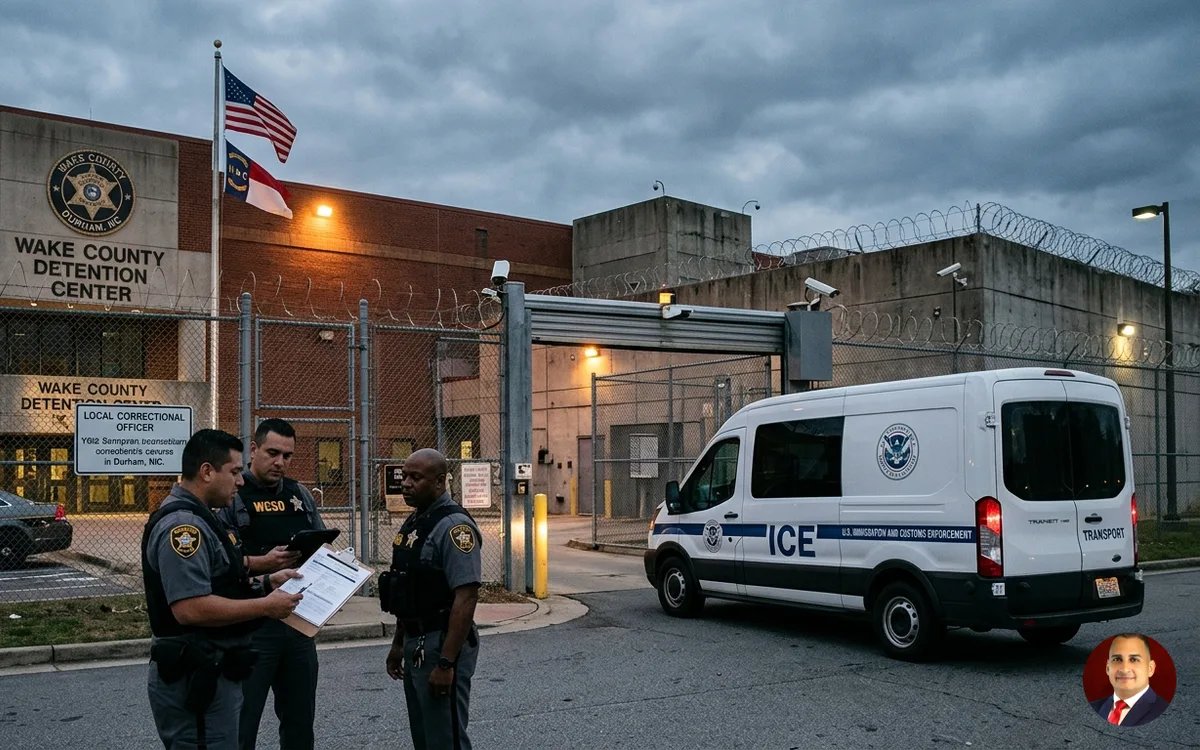
Last updated: June 2025. You saw the headline. Maybe it named someone you love, or maybe it just felt close enough to make your stomach drop: ICE wants a North Carolina jail to hand over a detained immigrant facing a child sex offense charge. Now you are trying to find out what happens next, and nobody at the jail will tell you anything useful. A detainer is not an arrest warrant, and a criminal charge is not a conviction. Both distinctions matter here, and so does the fact that North Carolina law changed in 2024 in ways that make this situation harder to simply wait out. You need to understand the next 48 hours, the next court date, and what a felony charge like this means for someone without U.S. citizenship, before anyone decides what to do next.
When U.S. Immigration and Customs Enforcement (ICE) lodges a Form I-247A detainer against someone held in a North Carolina jail, N.C. Gen. Stat. § 162-62 (enacted by Session Law 2024-11, known as HB 10) requires the sheriff to hold that person up to 48 hours past their scheduled release, excluding weekends and state holidays, so ICE can take custody.
The Hard Truth
## The Hard Truth About a Child Sex Offense Charge and Immigration Status Under INA § 101(a)(43)(A), 8 U.S.C. § 1101(a)(43)(A) (law.cornell.edu/uscode), a conviction for sexual abuse of a minor, and several comparable North Carolina offenses involving a minor victim, is classified as an 'aggravated felony.' That classification triggers mandatory detention under INA § 236(c), 8 U.S.C. § 1226(c). That means no immigration bond, not from an immigration judge and not from ICE, once the conviction is final. It also eliminates most forms of relief, including cancellation of removal under INA § 240A(a) and most waivers. None of that changes what happens in the state criminal case first. The North Carolina charge still has to be proven beyond a reasonable doubt, the rules of evidence still apply, and a dismissal, acquittal, or plea to a lesser, non-qualifying offense changes the entire immigration analysis. A family member hoping the immigration piece will resolve itself, or that a plea deal that looks acceptable from a sentencing standpoint will not also be an aggravated felony for immigration purposes, is making a decision on incomplete information. Those are two separate legal questions, decided by two different systems, and a plea entered without analyzing both can close off relief permanently.
What Happens If You Wait
## What Waiting Costs You Every day this sits is a day with fewer options, not more. - The HB 10 hold window, N.C. Gen. Stat. § 162-62 (ncleg.gov), runs on ICE's schedule, not yours: up to 48 hours past the person's scheduled release date, excluding weekends and state holidays. Missing the chance to address conditions of release before that clock starts does not pause it. - In a 287(g) jurisdiction, such as Mecklenburg County Sheriff's Office or Henderson County Sheriff's Office (ICE's current partner list is at ice.gov/identify-and-arrest/287g), jail staff are cross-trained to process ICE paperwork as part of intake. A detainer can be in place within hours of booking, before anyone has retained a lawyer. - A first appearance before a magistrate under N.C. Gen. Stat. § 15A-511 happens fast, often within 24 hours of arrest. The magistrate sets initial conditions of pretrial release on the state charge only, has no authority over the ICE detainer, and is not required to notify ICE before acting. The detainer still controls whether the jail actually releases the person even if state conditions are met. - Once removal proceedings begin, the 30-day window to appeal an immigration judge's decision to the Board of Immigration Appeals, 8 C.F.R. § 1003.38(b) (ecfr.gov), does not extend because a state case is still pending. Waiting to retain immigration counsel until after the state case resolves can mean missing that window entirely. None of this moves faster because a family is frightened. It moves on the statute's timeline, and the only variable you control is how quickly someone looks at both cases together.
Step-by-Step Process
## Step-by-Step: What Happens After an Arrest Like This in North Carolina ### 1. Arrest and booking Local police or sheriff's deputies arrest the person on North Carolina charges, typically under Article 7A of Chapter 14. Fingerprints run through federal databases, which can flag immigration status to ICE regardless of whether the county holds a 287(g) agreement. ### 2. Possible 287(g) screening In a participating county, jail personnel operating under a 287(g) agreement screen immigration status at intake. ICE's current list of 287(g) partner agencies (ice.gov/identify-and-arrest/287g) includes Mecklenburg County Sheriff's Office and Henderson County Sheriff's Office among more than a dozen North Carolina agencies enrolled under the Task Force and Jail Enforcement Models. ### 3. First appearance before a magistrate Under N.C. Gen. Stat. § 15A-511, the person appears before a magistrate, usually within 24 hours, who states the charges and sets initial conditions of pretrial release. The magistrate's authority is limited to the state charge. ### 4. ICE lodges the detainer ICE issues a Form I-247A detainer, asking the jail to notify ICE before release and to hold the person up to 48 hours past the scheduled release date, excluding weekends and state holidays, under N.C. Gen. Stat. § 162-62. ### 5. Bond hearing on the state charge A district or superior court judge may later modify conditions of release. Posting bond on the state charge does not end the ICE hold, because the detainer is a separate administrative request, not part of the criminal bond. ### 6. Criminal case proceeds The case moves through a probable cause hearing, possible grand jury indictment, and trial preparation. Prosecutors in child sex offense cases frequently seek to introduce prior-acts evidence under N.C. Gen. Stat. § 8C-1, Rule 404(b) (ncleg.gov), and the corroboration standard from State v. Stancil, 355 N.C. 266, 559 S.E.2d 788 (2002) (law.justia.com), shapes what testimony the state can use. ### 7. Conviction and transfer to ICE custody If convicted of a qualifying offense, the person is typically transferred to ICE custody after completing any state sentence. ICE issues a Notice to Appear, and the case moves to the Charlotte Immigration Court, 5701 Executive Center Dr., Charlotte, NC (justice.gov/eoir). ### 8. Removal proceedings Mandatory detention under INA § 236(c) generally applies once an aggravated felony conviction is final, meaning no bond redetermination hearing. The immigration judge decides removability and any narrow remaining relief. An adverse decision can be appealed to the Board of Immigration Appeals within 30 days, 8 C.F.R. § 1003.38(b), and from there, in limited circumstances, by petition for review to the U.S. Court of Appeals for the Fourth Circuit within 30 days of a final BIA order, 8 U.S.C. § 1252(b)(1). Per EOIR's FY2024 Statistics Yearbook (justice.gov/eoir/statistics), the national immigration court backlog exceeded 3.7 million pending cases, and cases tied to a pending criminal matter are routinely continued until the criminal case concludes, which can push a merits hearing out by years rather than months.
A Real-World Example
## A Composite Example: How These Two Cases Move Together The following is a composite scenario, not a real client, used to illustrate the process, not a predicted result. Marco (a composite) is a lawful permanent resident arrested in Gaston County on a felony indecent liberties charge. He has no prior record. Gaston County does not currently hold a 287(g) agreement, so no immigration screening happens at intake, but ICE still receives the booking data through federal fingerprint sharing and issues a Form I-247A detainer within two days. Marco appears before a magistrate within 24 hours under N.C. Gen. Stat. § 15A-511. Conditions of pretrial release are set on the state charge, but the detainer means the jail will hold him up to 48 hours past any release date under N.C. Gen. Stat. § 162-62, regardless of whether he posts bond. His criminal defense attorney and an immigration attorney review the charge together, because the specific statute charged and the specific facts alleged determine whether a future conviction, or even a plea, would be classified as an aggravated felony under INA § 101(a)(43)(A). They also review what evidence the state intends to introduce, including any prior-acts evidence it may seek to admit under N.C. Gen. Stat. § 8C-1, Rule 404(b). The criminal case proceeds through pretrial hearings over the following months. Marco's family is told plainly: if the charge resolves in a way that qualifies as an aggravated felony, mandatory detention under INA § 236(c) will apply and no bond will be available in the immigration case that follows. That reality shapes every decision made in the state case from the first court date forward.
William J. Vasquez is admitted to the North Carolina State Bar and to the Fourth, Fifth, and Eleventh Circuit Courts of Appeals, which allows him to handle federal immigration matters, including petitions for review, arising from those circuits. His practice includes North Carolina criminal matters that carry immigration consequences, and removal proceedings before the Charlotte Immigration Court and the Board of Immigration Appeals. He works alongside our firm's criminal defense and immigration attorneys when a case, like a child sex offense charge against a non-citizen, requires both a state criminal defense and a federal immigration analysis at the same time. Our team does not predict outcomes before reviewing the charging document, the alleged facts, and the person's immigration history, because both the criminal exposure and the immigration consequence turn on those specific details.
Key Terms Explained
## Key Terms Used on This Page **Form I-247A (ICE detainer)**: A written request from ICE asking a jail to notify ICE before releasing someone and to hold them briefly so ICE can take custody. It is an administrative request, not a judicial warrant. **287(g) agreement**: A formal agreement between ICE and a local sheriff's office authorizing specific deputies to perform certain immigration enforcement functions inside the jail, under the Task Force or Jail Enforcement Models. Current North Carolina participants are listed at ice.gov/identify-and-arrest/287g. **N.C. Gen. Stat. § 162-62 (HB 10)**: State law enacted by Session Law 2024-11 (ncleg.gov) requiring North Carolina sheriffs operating county jails to receive and comply with ICE detainer and administrative warrant requests, ending the discretion some sheriffs previously exercised to decline them. **Aggravated felony**: A category of offenses defined at INA § 101(a)(43), 8 U.S.C. § 1101(a)(43) (law.cornell.edu/uscode), that includes sexual abuse of a minor among dozens of other offenses. A conviction in this category triggers mandatory detention and bars most immigration relief, regardless of the sentence actually imposed. **Mandatory detention**: Under INA § 236(c), 8 U.S.C. § 1226(c), ICE must detain certain non-citizens, including those convicted of an aggravated felony, without the possibility of a bond hearing before an immigration judge. **Notice to Appear (NTA)**: The charging document that starts removal proceedings in immigration court, listing the factual allegations and the legal grounds ICE believes make the person removable. **N.C. Gen. Stat. § 15A-511**: The state statute governing a magistrate's initial appearance, where the magistrate states the charges and sets initial conditions of pretrial release on the state case only. **Rule 404(b) evidence**: Codified at N.C. Gen. Stat. § 8C-1, Rule 404(b) (ncleg.gov), this rule generally bars using a person's prior bad acts to prove they acted in conformity with them, but allows such evidence for limited purposes like intent, plan, or absence of mistake, a frequent point of dispute in child sex offense prosecutions. **Board of Immigration Appeals (BIA)**: The administrative body that reviews immigration judges' decisions. A party must file a Notice of Appeal within 30 days of the decision, 8 C.F.R. § 1003.38(b) (ecfr.gov).
Frequently Asked Questions
Q: Can a North Carolina sheriff refuse to honor an ICE detainer? A: Not since Session Law 2024-11 (HB 10) took effect. N.C. Gen. Stat. § 162-62 (ncleg.gov) now requires sheriffs operating county jails to receive and comply with ICE detainer and administrative warrant requests, removing the discretion some sheriffs previously used to decline them. Q: Does posting bond on the state charge get someone released from ICE custody too? A: No. Posting bond or meeting the conditions set at a first appearance under N.C. Gen. Stat. § 15A-511 resolves only the state pretrial release question. If ICE has lodged a Form I-247A detainer, the jail will still hold the person up to 48 hours past that release date under N.C. Gen. Stat. § 162-62 so ICE can take custody. Q: How long does a removal case like this usually take? A: There is no fixed timeline. It depends on whether the state criminal case is still pending, how the charge resolves, and the Charlotte Immigration Court's docket. EOIR's FY2024 Statistics Yearbook (justice.gov/eoir/statistics) reports a national backlog exceeding 3.7 million pending cases, and cases tied to a pending criminal matter are frequently continued until that case concludes, which can add months or years before the immigration case is decided. Q: What does it cost to have a criminal defense attorney and an immigration attorney review a case like this together? A: Fees vary with the complexity of the charge, whether the case goes to trial, and the scope of immigration analysis needed. Because this is a criminal defense and immigration matter, not a personal injury or workers' compensation case, fees are charged for the work performed rather than conditioned on any outcome; our office discusses the specific fee structure during a consultation after reviewing the charging documents. Q: Is any immigration relief still available after an aggravated felony conviction? A: It is extremely limited. An aggravated felony conviction bars cancellation of removal under INA § 240A(a) and most waivers, and triggers mandatory detention under INA § 236(c). In narrow circumstances, relief under the Convention Against Torture may remain available, but it does not stop removal to a different country, and most people convicted of a qualifying aggravated felony have no path to remain in the United States. Q: Does a North Carolina sex offender registry listing follow someone into removal proceedings? A: Yes. Registration under the North Carolina Sex Offender and Public Protection Registration Program, N.C. Gen. Stat. § 14-208.6 et seq., becomes part of the record an immigration judge and ICE review, though it is the underlying conviction, not the registry listing itself, that determines the immigration consequence.
Our firm's reviews on Google and Avvo reflect years of combined experience in North Carolina criminal defense and immigration matters. We do not publish success rates or case outcome statistics, consistent with professional conduct rules on verifiable results. Readers evaluating any law firm's reviews should look for detail about communication, responsiveness, and how clearly the attorney explained the process, not promises about results.
If ICE has lodged a detainer against someone you love, the next state court date is probably already on the calendar, and the clock described above is already running. Understanding the options before that hearing, not after, is what gives a defense attorney and an immigration attorney room to actually plan.
Call our office for a consultation focused on both halves of this problem: the North Carolina criminal charge and the immigration exposure that comes with it. Our team reviews the charging documents, the detainer paperwork, and the client's immigration history together, so decisions in the criminal case account for the immigration consequence before a plea is ever on the table.
- /practice-areas/criminal-defense-for-non-citizens
- /practice-areas/removal-defense
- /practice-areas/bond-hearings-pretrial-release
- /locations/mecklenburg-county-ice-detainers
- /practice-areas/bia-appeals