Your brother was supposed to be protected. A federal judge had ordered the flights stopped, and the flight left anyway. Now you are trying to find out if that is even legal, and what you can do tonight, not next month.
You are not imagining the problem. In J.G.G. v. Trump, the ACLU told a federal court that Trump administration officials had broken the law, and that they defied a judge's order (source: ACLU, aclu.org). The court is still deciding what accountability looks like for the people who did that.
That uncertainty is real, but it does not leave you with nothing. The fight over whether officials get punished for ignoring a court order is a separate legal track from the fight to get your family member back, or to stop the next flight. You may be able to start the second fight today, even while the first one drags on.
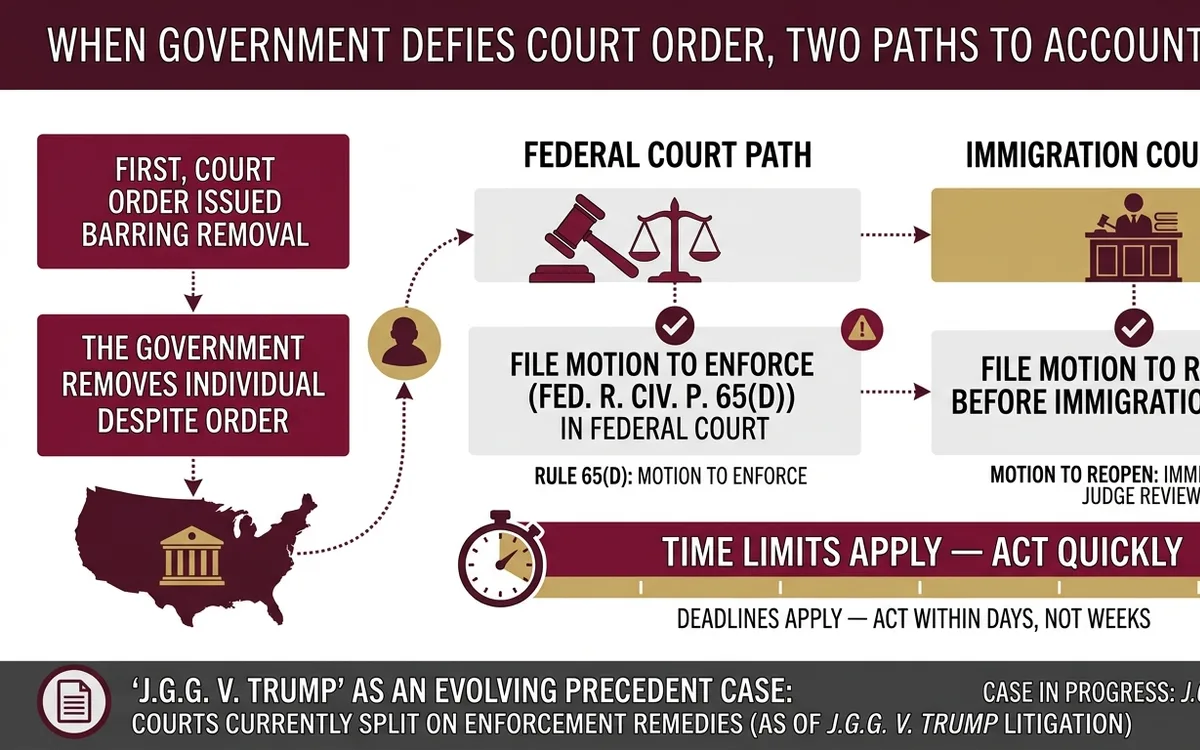
When immigration officials remove someone despite a federal court order, you can file a motion to enforce under Federal Rule of Civil Procedure 65(d) or a motion to reopen before an immigration judge. Courts are still deciding how to hold officials accountable in cases like J.G.G. v. Trump. Time limits apply, so act quickly.
The Hard Truth
Courts have not decided whether officials can be punished for ignoring a judge's order, and that question could sit on appeal for years. The ACLU argued in J.G.G. v. Trump that Trump administration officials broke the law and defied a court order, and even that argument has not produced a final ruling on accountability (source: ACLU, aclu.org). A contempt finding against a federal official is rare. Getting a court to order someone physically returned after an unlawful removal is rarer still, and it is not automatic even when a judge later agrees the removal should not have happened.
If your family member has already been removed, plan for a long court fight, not a quick reversal. The realistic timeline for resolving a dispute over compliance with a court order runs months at the least, often longer once an appeal is filed. We tell clients this before they retain us, because the alternative, promising a fast fix, would not be true.
What Happens If You Wait
Every day of delay narrows what a court can still do for you. A motion to reopen a removal order generally must be filed within 90 days of the final order, under INA § 240(c)(7)(C)(i), and that clock keeps running even if the removal itself may have violated a court order. Miss it, and you need to show the kind of exceptional circumstances that few cases meet.
Evidence disappears too. Flight manifests, ICE custody logs, and the exact timestamp of when a judge's order was entered against when a plane took off all become harder to obtain the longer you wait. If ICE Enforcement and Removal Operations in Charlotte closes its file on your family member, you lose an easy way to get the records that prove what actually happened. A person removed and barred from reentry can lose years of their life waiting for a court to catch up, even in cases where the removal turns out to have been wrong.
Step-by-Step Process
Start by confirming the order itself. Get the actual written order or injunction, not a news report about it, including the docket number, the judge's name, and the date and time it was entered. In cases tied to Alien Enemies Act removals, that may mean pulling the docket in J.G.G. v. Trump, No. 1:25-cv-00766 (D.D.C. 2025).
Next, document the timeline. Collect flight records, ICE custody logs, any notice of removal, and compare those timestamps against when the court order was signed. This is the evidence a motion to enforce or a habeas petition will rely on.
File a motion to enforce in the court that issued the original order, citing Federal Rule of Civil Procedure 65(d), which governs what an injunction must say and who it binds. If the removal also affects a pending immigration case, file a motion to reopen with the Executive Office for Immigration Review through its Courts & Appeals System (ECAS). For cases tied to Charlotte Immigration Court, 5701 Executive Center Dr, Charlotte, NC, that motion generally must be filed within 90 days of the final removal order under INA § 240(c)(7)(C)(i).
If the person is still in ICE custody or has already been removed, consider an emergency habeas corpus petition in federal district court, filed in the U.S. District Court for the Western District of North Carolina if the custody or order originated here. Contact the USCIS Charlotte Field Office at 6730 Carnegie Blvd, Charlotte, NC, or ICE Enforcement and Removal Operations' Charlotte Field Office directly to request case status and custody records while the motion is pending.
Expect the first ruling to take weeks, not days, unless the facts support emergency relief. If the motion is denied, the next step is an appeal to the Board of Immigration Appeals or, for a district court order, to the applicable U.S. Court of Appeals.
A Real-World Example
Consider a composite scenario built from patterns we see, not a real client. Ana's husband was in ICE custody in North Carolina while a motion for stay of removal was pending before a federal district court. The written order granting the stay had not yet been entered when ICE moved him onto a flight.
Ana's attorney first pulled the docket to confirm exactly when, and whether, a written order existed. Then came an emergency motion to enforce in the district court, filed alongside a parallel motion to reopen with the Charlotte Immigration Court through ECAS. The attorney also sent a preservation letter to ICE ERO Charlotte requesting custody and transport records before they could be routinely deleted.
From there, the case moved into briefing. The government filed a response, the court set a status conference, and the family waited several weeks for any ruling on the papers. The question of whether the removal violated the stay got decided on its own timeline, separate from whatever relief Ana's husband might eventually be entitled to. That is the stage most cases like this reach within the first few months: a pending motion and a record being built, not a resolution.
William J. Vasquez handles removal defense and federal immigration litigation, including motions to reopen and motions to enforce compliance with a federal court's order. He is admitted to practice before the U.S. Courts of Appeals for the Fourth, Fifth, and Eleventh Circuits, and he represents clients before the Board of Immigration Appeals nationwide, which does not require circuit-specific admission under 8 C.F.R. § 1292.1.
He has worked on cases where the central dispute was whether immigration officials actually complied with a court's order, not just whether the underlying removal case had merit. That work means filing the motion, not just explaining what one is.
Key Terms Explained
Temporary Restraining Order (TRO): A short-term court order, often lasting 14 days or less, that blocks an action, such as a removal, until the court can hold a longer hearing.
Preliminary Injunction: A court order that blocks an action for the duration of a case, issued after both sides have had a chance to argue, unlike a TRO.
Civil Contempt: A court finding that a party violated its order, which can lead to fines or other sanctions meant to force compliance, not to punish.
Motion to Enforce: A request asking the court that issued an order to make clear what the order requires and to compel compliance, filed under Federal Rule of Civil Procedure 65(d).
Motion to Reopen: A request asking an immigration judge or the Board of Immigration Appeals to reconsider a removal order based on new facts or changed circumstances, generally due within 90 days of the final order under INA § 240(c)(7)(C)(i).
Alien Enemies Act: A wartime statute, 50 U.S.C. §§ 21-24, invoked in J.G.G. v. Trump to justify removals without the usual immigration court process.
Habeas Corpus Petition: A request asking a federal court to review whether a person's detention or removal is lawful.
Administrative Procedure Act § 706: A federal law that lets a court compel an agency to act when it has unlawfully withheld or unreasonably delayed required action, or set aside action that is arbitrary and capricious.
ECAS: The EOIR Courts & Appeals System, the electronic filing platform immigration courts, including Charlotte Immigration Court, use for motions and appeals.
Frequently Asked Questions
Q: Can ICE remove someone while a motion or appeal is still pending in court? A: It depends on whether a court has actually entered a stay or injunction blocking the removal. A pending motion by itself does not stop ICE; only a signed order does, so confirm whether the order was entered and when.
Q: What do I do if my family member was removed despite a judge's order? A: Pull the court docket to confirm the order's exact text and timing, then file an emergency motion to enforce in the court that issued it while also checking whether a parallel motion to reopen is available in immigration court.
Q: Is there a deadline to challenge a removal that may have violated a court order? A: Yes. A motion to reopen generally must be filed within 90 days of the final removal order under INA § 240(c)(7)(C)(i), and separate deadlines can apply to a motion to enforce or habeas petition, so do not wait to find out which one applies to your case.
Q: Will a judge finding that officials defied an order bring my family member back? A: Not automatically. A finding that an order was violated is a separate legal question from whether a court will order someone returned, and courts are still working out what remedy applies in cases like J.G.G. v. Trump.
Clients come to us after a filing deadline has already passed somewhere else, or after a different lawyer told them nothing could be done. Our team has handled federal immigration motions, including motions to reopen and motions to enforce court orders, for clients across North Carolina and in cases tied to national enforcement actions. We describe what we have handled, not what we have won, because that is the only honest way to talk about ongoing federal litigation.
None of this is a reason to wait and see what happens. The deadlines above run whether or not you have found a lawyer yet, and the records that prove what happened to your family member get harder to pull the longer a case sits.
If a family member was removed, detained, or threatened with removal after a court order should have stopped it, call our office to schedule a consultation on an emergency motion to enforce or a motion to reopen. Our immigration team can review the docket, the timing, and what filing deadline, if any, is still open in your case.