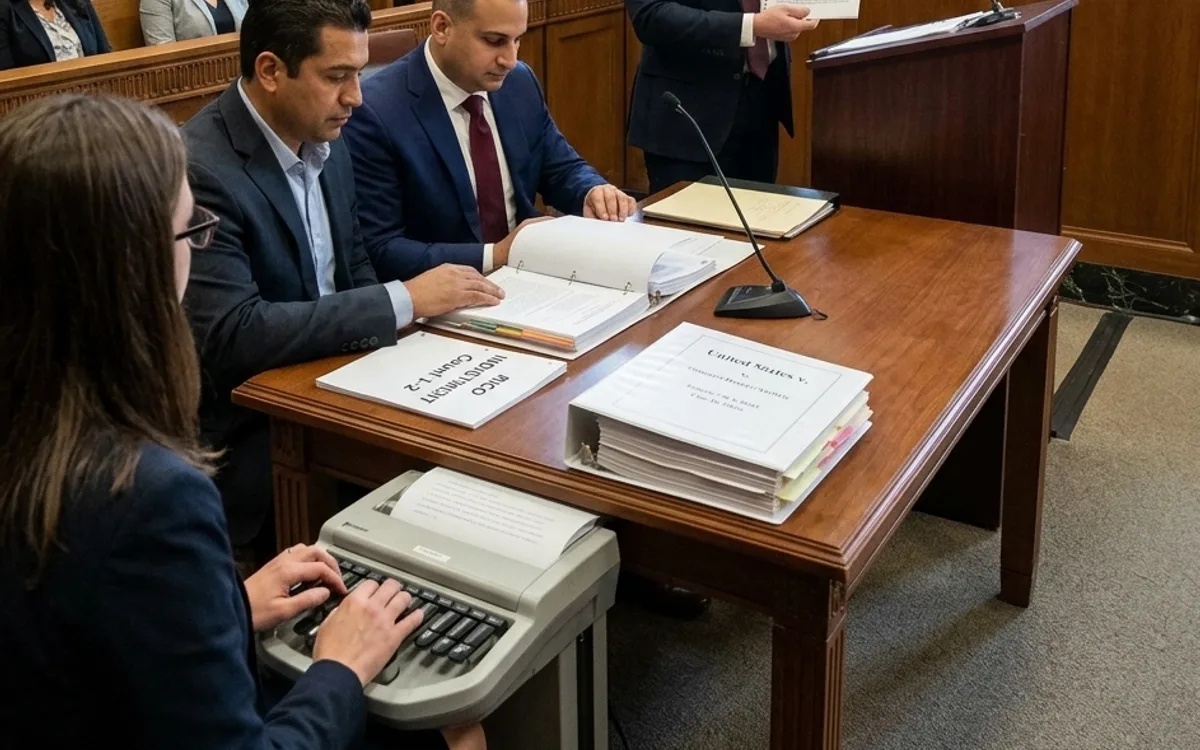
A federal agent came to the door, or a news story named someone you know, and now you are typing 'what is racketeering charges' into a search bar late at night. If you or a family member is a lawful permanent resident, the fear is not only prison time. It is a second case, running quietly alongside the first, that can end in deportation. Racketeering charges are serious for any defendant. For a non-citizen, a racketeering conviction can close a pending green card case, trigger mandatory detention by Immigration and Customs Enforcement, and eliminate most forms of relief in immigration court. This page explains what racketeering charges actually are, what prosecutors have to prove, what the charge means for a U.S. citizen defendant, and where the immigration consequences begin for everyone else. Last updated June 2025.
Racketeering charges accuse a person of participating in an ongoing criminal enterprise through a pattern of at least two related crimes, called predicate acts, within ten years. Federal racketeering is prosecuted under RICO, 18 U.S.C. §§ 1961-1968, and carries up to 20 years in prison per count, or life if a predicate offense allows it.
The Hard Truth
A racketeering charge means prosecutors allege you took part in an 'enterprise' engaged in a 'pattern of racketeering activity,' defined under [18 U.S.C. § 1961(5)](https://www.law.cornell.edu/uscode/text/18/1961) as at least two predicate acts within ten years, drawn from a list of specific crimes in [18 U.S.C. § 1961(1)](https://www.law.cornell.edu/uscode/text/18/1961) that includes bribery, extortion, mail and wire fraud, drug trafficking, and money laundering. The Supreme Court defined 'enterprise' broadly in [United States v. Turkette, 452 U.S. 576 (1981)](https://supreme.justia.com/cases/federal/us/452/576/), to include legitimate businesses and purely criminal associations with no legal structure at all. A criminal RICO conviction carries up to 20 years in prison per count under 18 U.S.C. § 1963(a), or life if the underlying predicate crime authorizes a life sentence, plus mandatory forfeiture of property traceable to the enterprise. Racketeering can also be a civil claim: under 18 U.S.C. § 1964(c), a private plaintiff who proves a RICO violation can recover three times actual damages plus attorney's fees, apart from any criminal case. The sentencing numbers are not light to begin with. The base offense level under U.S.S.G. § 2E1.1 is 19, before any increase for the severity of the underlying predicate crime, and the U.S. Sentencing Commission's FY2023 Sourcebook of Federal Sentencing Statistics, Table 13 (ussc.gov), reports an average sentence of roughly 86 months, about seven years, for offenders sentenced primarily under the racketeering and extortion guideline. For a non-citizen, those same facts carry a second consequence most people do not learn about until it is too late. If a RICO count carries a potential sentence of one year or more, [8 U.S.C. § 1101(a)(43)(J)](https://www.law.cornell.edu/uscode/text/8/1101) classifies it as an aggravated felony. An aggravated felony bars cancellation of removal under INA § 240A(a)(3), forecloses most waivers, and in many cases triggers mandatory detention under 8 U.S.C. § 1226(c) with no bond hearing before an immigration judge. A plea deal that looks favorable on the criminal side, a shorter sentence, a reduced charge, can still trigger removal if it is not structured with the immigration consequence in mind from the start. Padilla v. Kentucky, 559 U.S. 356 (2010), requires defense counsel to advise on this, but the advice only helps if someone raises the immigration question before the plea is entered, not after.
What Happens If You Wait
Waiting costs time you do not have in either case. Under Eastern District of North Carolina Local Criminal Rule 12.1, pretrial motions, including a motion to dismiss a RICO count or challenge the indictment's description of the enterprise under Fed. R. Crim. P. 7(c)(1), are due on a schedule set at arraignment, typically within a few weeks. Miss that window and the argument is waived for trial. A pending green card application or naturalization interview does not sit quietly while racketeering charges are pending. An officer at the USCIS Charlotte Field Office who learns of the charges can place the application on hold, deny it for lack of good moral character under INA § 101(f), or refer the file to ICE. A naturalization applicant later convicted of an aggravated felony is permanently barred from establishing good moral character, by statute, not by discretion. See our [adjustment of status overview](/immigration/adjustment-of-status) for how a pending case is affected. Once DHS issues a Notice to Appear after conviction, the case moves to Charlotte Immigration Court. That court had more than 60,000 pending cases as of FY2024, per TRAC Immigration data from Syracuse University (trac.syr.edu), and a case that sits unanswered on that docket does not improve with time. An ICE detainer lodged at the county jail during the criminal case can also mean transfer to immigration detention before the criminal matter concludes, which separates a defendant from the attorney building the criminal defense.
Step-by-Step Process
Indictment and initial appearance. A federal grand jury returns an indictment in the U.S. District Court for the Eastern District of North Carolina, Raleigh Division. Under Fed. R. Crim. P. 7(c)(1), the indictment must state the essential facts of the alleged enterprise and each predicate act. Detention hearing. The magistrate judge decides pretrial release under the Bail Reform Act, 18 U.S.C. § 3142. If the defendant is a non-citizen, the county jail may lodge an ICE detainer at the same time, independent of the bond decision. Pretrial motions. Deadlines run under Eastern District of North Carolina Local Criminal Rule 12.1, usually a few weeks after arraignment. Motions challenging the indictment's description of the 'enterprise,' built on the Turkette standard, are filed here. Plea negotiation or trial. Any plea discussion should involve both the criminal defense attorney and an immigration attorney, because the specific count and sentence exposure, not the RICO label itself, determines whether [8 U.S.C. § 1101(a)(43)(J)](https://www.law.cornell.edu/uscode/text/8/1101) applies. Sentencing and forfeiture. The court applies U.S.S.G. § 2E1.1 and, where applicable, orders forfeiture under 18 U.S.C. § 1963. DHS review and Notice to Appear. After a final judgment of conviction, ICE's Enforcement and Removal Operations reviews the record for removability under 8 U.S.C. § 1227(a)(2)(A)(iii) and issues a Notice to Appear if the conviction qualifies as an aggravated felony. Read our [NTA process guide](/immigration/notice-to-appear) for what the document itself says. Removal proceedings. The case is calendared before the Charlotte Immigration Court (EOIR), beginning with a short master calendar hearing and, if contested, an individual hearing where the judge rules on removability and any available relief. See our [aggravated felony overview](/immigration/aggravated-felony-overview) for which forms of relief remain open at that stage. BIA appeal. A party has 30 days to appeal an adverse decision to the Board of Immigration Appeals under 8 C.F.R. § 1003.38. Our [BIA appeals guide](/immigration/bia-appeals) covers the briefing schedule. Petition for review. Because Eastern District of North Carolina removal orders are reviewed by the U.S. Court of Appeals for the Fourth Circuit, a petition for review must be filed within 30 days under 8 U.S.C. § 1252(b)(1).
A Real-World Example
Consider a composite example based on the pattern our team sees in these cases, not a specific client. A 34-year-old lawful permanent resident, call him Mr. R, is one of fourteen defendants named in a federal RICO conspiracy indictment returned in the Eastern District of North Carolina, Raleigh Division, alleging a pattern of racketeering activity built on predicate acts of drug distribution and money laundering. At his initial appearance, the magistrate judge orders detention pending a bond hearing under the Bail Reform Act, 18 U.S.C. § 3142, and the county jail lodges an ICE detainer the same week. His criminal defense attorney files pretrial motions within the deadline set by Eastern District of North Carolina Local Criminal Rule 12.1, challenging the indictment's description of the alleged enterprise under the standard set in United States v. Turkette. Mr. R's criminal attorney and his immigration attorney coordinate before any plea discussion, because a RICO count carrying a potential sentence of one year or more becomes an aggravated felony under 8 U.S.C. § 1101(a)(43)(J) once a conviction is entered. After judgment, DHS issues a Notice to Appear, and the case is calendared before the Charlotte Immigration Court. Mr. R's removal proceedings are ongoing. The next scheduled step is a master calendar hearing, where the immigration judge will confirm the pleadings and set a schedule for any application for relief.
William J. Vasquez leads the firm's work at the intersection of federal criminal charges and immigration status. He is admitted to practice before the U.S. Court of Appeals for the Fourth Circuit, which matters directly here, because a petition for review of a removal order arising from an Eastern District of North Carolina prosecution is filed in that circuit. Vasquez has focused on removal defense and the immigration consequences of federal and state criminal charges for more than a decade, work that requires reading an indictment the way a criminal defense attorney does and a Notice to Appear the way an immigration judge does, at the same time. Read his full background on our [attorney profile page](/attorneys/william-vasquez). Our team does not serve as the criminal defense attorney of record in a federal racketeering prosecution. In RICO and related crimmigration matters, we coordinate directly with the defendant's criminal defense attorney to review how a plea agreement, verdict, or forfeiture order will affect a pending immigration case, before those decisions are final rather than after.
Key Terms Explained
RICO: The Racketeer Influenced and Corrupt Organizations Act, 18 U.S.C. §§ 1961-1968, the federal statute criminalizing participation in an enterprise through a pattern of racketeering activity. Enterprise: Any individual, partnership, corporation, or group of individuals associated in fact, even without a formal legal structure, as defined in United States v. Turkette, 452 U.S. 576 (1981). Predicate act (racketeering activity): One of the specific state or federal crimes listed in 18 U.S.C. § 1961(1), such as bribery, extortion, mail or wire fraud, drug trafficking, or money laundering. Pattern of racketeering activity: At least two predicate acts committed within ten years of each other, under 18 U.S.C. § 1961(5). Aggravated felony: A category of convictions defined in 8 U.S.C. § 1101(a)(43) that triggers mandatory removal, bars most forms of relief, and often requires mandatory detention regardless of the state label given to the underlying offense. Crime involving moral turpitude (CIMT): A conduct-based immigration category, distinct from the aggravated felony list, turning on whether the offense involves inherently base, vile, or depraved conduct; some but not all racketeering predicate acts qualify. Notice to Appear (NTA): The charging document DHS files with the immigration court to begin removal proceedings, specifying the factual and legal grounds for removability. Cancellation of removal: A form of relief under INA § 240A, unavailable to anyone convicted of an aggravated felony under § 240A(a)(3). Forfeiture: Court-ordered surrender of property traceable to the racketeering enterprise, authorized under 18 U.S.C. § 1963, separate from any prison sentence. BIA: The Board of Immigration Appeals, the administrative body that reviews immigration judge decisions before any further appeal to a federal circuit court.
Frequently Asked Questions
Q: Do racketeering charges count as an aggravated felony for deportation purposes? A: Only if the specific count carries a potential sentence of one year or more, under 8 U.S.C. § 1101(a)(43)(J). The RICO label alone does not decide it; the sentence exposure on that particular count does. Q: How does a federal RICO indictment affect a pending green card or adjustment of status application? A: USCIS can place the application on hold or deny it for lack of good moral character under INA § 101(f) once it learns of pending charges, even before a conviction. The USCIS Charlotte Field Office handles these holds case by case. Q: Can a lawful permanent resident be removed for a RICO conspiracy conviction even without a predicate violent offense? A: Yes. Removability under 8 U.S.C. § 1101(a)(43)(J) turns on the potential sentence for the RICO count, not on whether the predicate acts involved violence. Q: What happens to a pending asylum application if the applicant is charged with racketeering while the case is pending? A: The immigration court can continue the asylum case while the criminal case is pending, but a later aggravated felony conviction can bar asylum eligibility entirely and make withholding of removal the only remaining option. Q: Is North Carolina's state racketeering statute treated the same as federal RICO for immigration purposes? A: No. Immigration consequences turn on the specific predicate offense and the sentence imposed, not on whether the charge was brought under the state RICO statute, N.C. Gen. Stat. § 75D, or the federal one. Q: How does an ICE detainer interact with a pending federal racketeering case in the Eastern District of North Carolina? A: A detainer can result in transfer to immigration detention after release from criminal custody, or even before the criminal case concludes if state or local custody ends first, regardless of how the federal case is proceeding. Q: Can racketeering charges be considered a crime involving moral turpitude under the INA? A: Some predicate acts, such as fraud or extortion, can independently qualify as crimes involving moral turpitude. That is a separate legal analysis from the aggravated felony question and can apply even when the aggravated felony threshold is not met. Q: Does a RICO plea agreement avoid aggravated-felony removability if structured correctly? A: Sometimes. How the plea is written, including which count is the basis for conviction and what sentence is agreed to, can change the immigration outcome, which is why immigration counsel should review the agreement before it is signed, not after.
Clients who have worked with William J. Vasquez on cases involving both criminal charges and immigration status describe direct communication and a realistic assessment of what the immigration case does and does not allow, rather than general reassurance. The firm maintains verified client reviews on its Google Business profile and Avvo listing, reflecting work across removal defense, family-based petitions, and crimmigration matters.
A racketeering indictment and an immigration case do not run on separate tracks. They affect each other at every stage, from the bond hearing to the plea agreement to the sentencing hearing, often in ways a criminal defense attorney alone has no reason to flag.
If you or a family member is facing racketeering charges and has a pending immigration matter, a green card case, a naturalization application, or an open removal proceeding, schedule a consultation with our immigration team to review how the criminal case and the immigration case fit together before the next court date.
- Aggravated Felony Overview
- How the Notice to Appear (NTA) Process Works
- Adjustment of Status Overview
- BIA Appeals Process
- Charlotte Immigration Court Guide
- Crimmigration: Criminal Charges and Immigration Consequences