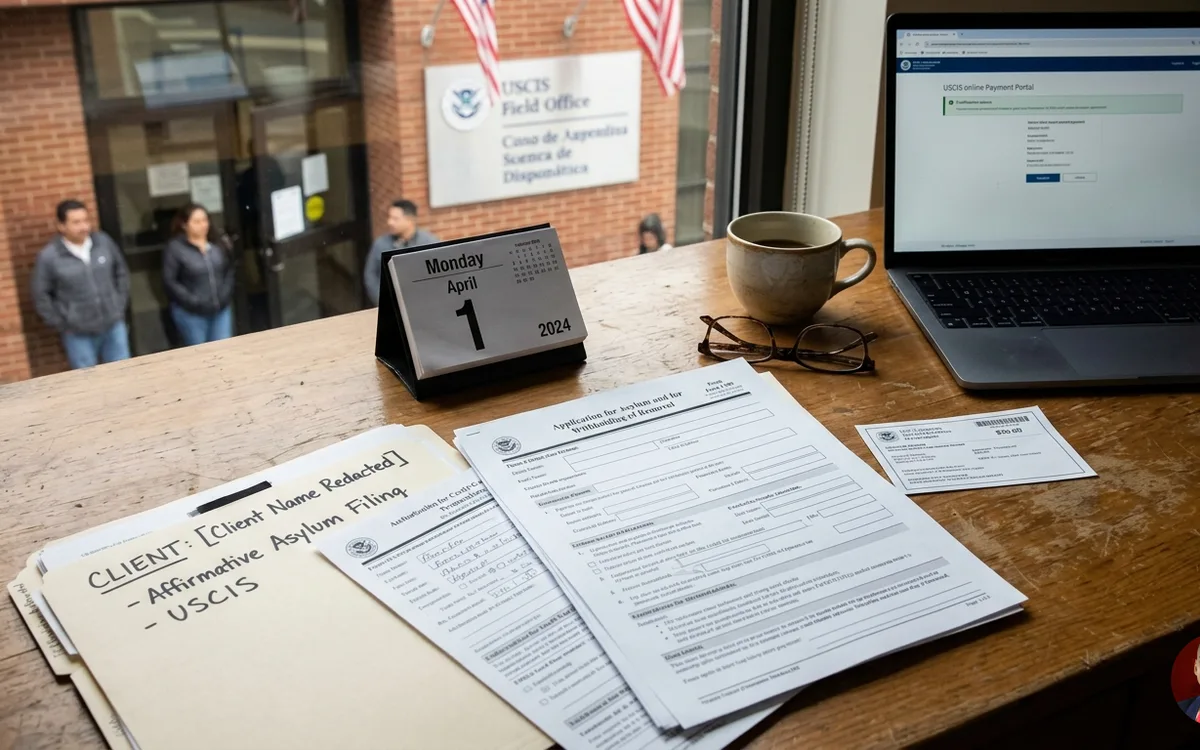
You got a letter, or you're staring at the online filing portal, and now there's a $50 line item standing between you and submitting your asylum application. Fifty dollars does not sound like much until you are the person who has it or you are not. If you are already in removal proceedings instead, you need to know something else: that $50 charge does not even apply to you. This page explains who owes the fee, who is exempt, how to pay it correctly, and what happens when a payment goes wrong. The fee is new. It did not exist for most of the last decade, and the first attempt to charge it was blocked in federal court. Getting the mechanics right before you submit matters more than the dollar amount itself.
USCIS charges a $50 fee for Form I-589 asylum applications filed affirmatively with USCIS, per 8 C.F.R. § 106.2, effective April 1, 2024. Defensive applicants filing with immigration court owe no fee. Pay online, by mail with Form G-1450, or request a waiver using Form I-912 based on inability to pay.
The Hard Truth
The fee itself rarely sinks a case. What sinks cases is the paperwork mistake that comes with it: a credit card authorization with a mismatched billing address, a money order made out to the wrong payee, a payment returned for insufficient funds after the one-year filing clock has nearly run out. USCIS will reject an affirmative I-589 that is not properly filed, fee and all, and send it back to you. If that rejection happens close to your one-year deadline under INA § 208(a)(2)(B) (8 U.S.C. § 1158(a)(2)(B)), you may not get a second chance to argue an exception. Fee waivers exist, but they are not automatic. USCIS can deny a waiver request outright, leaving you to pay the $50 anyway, on a timeline you did not choose.
What Happens If You Wait
Wait too long to sort out the fee and you are not just delaying paperwork. You are running out the one-year deadline that INA § 208(a)(2)(B) sets for affirmative asylum filings, a clock that starts the day you arrived in the United States, not the day you decide to apply. Miss it without a qualifying exception, and USCIS can deny your application on timeliness alone, before anyone reviews your fear of return. A returned payment compounds the problem. USCIS treats a dishonored check or declined card as a rejected filing, not a pending one, under 8 C.F.R. § 103.2(a)(7)(ii). The receipt date USCIS uses to measure your one-year deadline disappears, and you refile as if you never submitted at all. If you are already in removal proceedings when that happens, the immigration judge at Charlotte Immigration Court will not pause your case to let you fix a payment error.
Step-by-Step Process
1. Determine your track. If you are not yet in removal proceedings, you file affirmatively with USCIS and the $50 fee applies. If you are already before an immigration judge at Charlotte Immigration Court, 5701 Executive Center Drive, Suite 300, you file defensively with EOIR and owe no fee. 2. Check for an exemption. Unaccompanied children, as defined by 6 U.S.C. § 279(g)(2), do not owe the fee regardless of how they file. 3. If you are not exempt, decide whether to pay the $50 or request a waiver on Form I-912, filed together with your I-589. 4. Complete Form I-589 in full. USCIS rejects incomplete forms regardless of whether the fee is paid correctly. 5. Pay. If you file electronically through your USCIS online account, pay by ACH, debit, or credit card during submission. If you file on paper, attach Form G-1450 for credit card payment, or a check or money order payable to 'U.S. Department of Homeland Security,' and mail it to the address listed in the current Form I-589 filing instructions at uscis.gov. 6. Watch for your Form I-797C receipt notice. It confirms USCIS accepted both the filing and the fee. Keep it; it documents your filing date. 7. Attend your biometrics appointment at the Application Support Center assigned in your notice. 8. Wait for an interview notice from the USCIS Arlington Asylum Office, which handles affirmative interviews for North Carolina applicants. Paying the fee correctly protects your place in that process; it does not move you up the queue. 9. Receive a decision: a grant, a referral to immigration court if you lack other lawful status, or a denial if you hold valid status when the decision issues.
A Real-World Example
Consider a composite example: a Charlotte-based applicant we'll call M., present on an expired visa, decides to file affirmatively rather than wait for a Notice to Appear. M. completes Form I-589, confirms the $50 fee applies because M. does not qualify as an unaccompanied child, and chooses to pay by credit card using Form G-1450 rather than mail a money order. The first submission is rejected. The billing zip code on the G-1450 does not match the card issuer's records, a common and fixable error. M. resubmits with the corrected billing information, and USCIS issues a new receipt notice about three weeks later. From there, M. waits for a biometrics appointment notice, then for an interview notice from the USCIS Arlington Asylum Office. The waiting period between filing and interview varies by region and caseload, and nothing about paying the fee correctly changes that queue. What the correct payment does is protect the receipt date, which is what matters for the one-year filing deadline.
William J. Vasquez has spent years handling federal immigration matters, including affirmative and defensive asylum filings for clients across North Carolina. Immigration practice is federal, so he represents clients before USCIS and the Executive Office for Immigration Review regardless of which state they filed in. His work on asylum cases includes walking clients through the procedural details the 2024 USCIS fee rule added, from exemption eligibility to what to do after a rejected payment.
Key Terms Explained
Affirmative asylum: an asylum application filed directly with USCIS by someone not yet in removal proceedings, using Form I-589. Defensive asylum: asylum raised as a defense to removal before an immigration judge at EOIR, typically after DHS has placed someone in proceedings. Form I-589: the Application for Asylum and for Withholding of Removal. Form G-1450: USCIS's Authorization for Credit Card Transactions, used to pay the asylum fee and other USCIS fees by credit card. Form I-912: the Request for Fee Waiver, filed to ask USCIS to waive a required fee based on inability to pay. USCIS Lockbox: a USCIS-contracted facility that receives mailed paper filings and fee payments before routing them to the correct service center. One-year filing deadline: the INA § 208(a)(2)(B) requirement that an asylum application be filed within one year of the applicant's last arrival in the United States, unless a qualifying exception applies. EOIR: the Executive Office for Immigration Review, the Department of Justice agency that operates immigration courts, including Charlotte Immigration Court.
Frequently Asked Questions
Q: Do I have to pay the USCIS asylum fee if my case is in immigration court, not with USCIS? A: No. The $50 fee under 8 C.F.R. § 106.2 applies only to affirmative Form I-589 filings submitted directly to USCIS. If you are filing defensively before an immigration judge at Charlotte Immigration Court or elsewhere, EOIR does not charge an application fee for asylum. Q: What happens if my G-1450 credit card payment is rejected? A: USCIS treats a declined or improperly completed G-1450 as a rejected filing under 8 C.F.R. § 103.2(a)(7)(ii), not a late payment on a pending case. Common reasons include a billing address that does not match the card issuer's records, an unsigned form, or an expired card, and you will need to correct the error and resubmit the entire package. Q: Can I get the asylum fee waived? A: Yes, in some cases. You can file Form I-912 with your I-589 to request a waiver based on inability to pay, but USCIS reviews each request individually and can deny it, so you should not assume approval before you file. Q: Are unaccompanied children exempt from the asylum fee? A: Yes. Children who meet the federal definition of an unaccompanied alien child under 6 U.S.C. § 279(g)(2) do not owe the $50 fee, regardless of how they file.
Clients who come to our firm for asylum filings consistently describe the same frustration before they arrive: confusing fee instructions, a government portal that rejects a payment without explaining why, and no clear answer about whether their one-year deadline is still running. We handle the paperwork mechanics, not just the legal argument, because a rejected $50 payment can matter as much as the merits of the asylum claim itself. Our team has handled affirmative and defensive asylum filings for clients across North Carolina, and we measure the work by what gets filed correctly and on time.
Paying the fee correctly is a small part of a much longer filing. The harder work is building the asylum claim itself: the statement, the country-conditions evidence, the corroborating documents USCIS or the immigration judge will expect to see. Getting the $50 payment wrong can cost you your filing date; getting the rest of the application wrong can cost you the case.
If you are preparing to file Form I-589, affirmatively or defensively, schedule a consultation with our immigration team to review your filing, your fee or waiver eligibility, and your one-year deadline before you submit anything to USCIS or the court. Call our office or request a consultation online to get a filing checklist specific to your situation.
- Affirmative vs. Defensive Asylum: What's the Difference
- One-Year Filing Deadline for Asylum Applications
- Form I-912 Fee Waiver Eligibility Guide
- USCIS Arlington Asylum Office Interview Process
- Charlotte Immigration Court: What to Expect at a Master Calendar Hearing