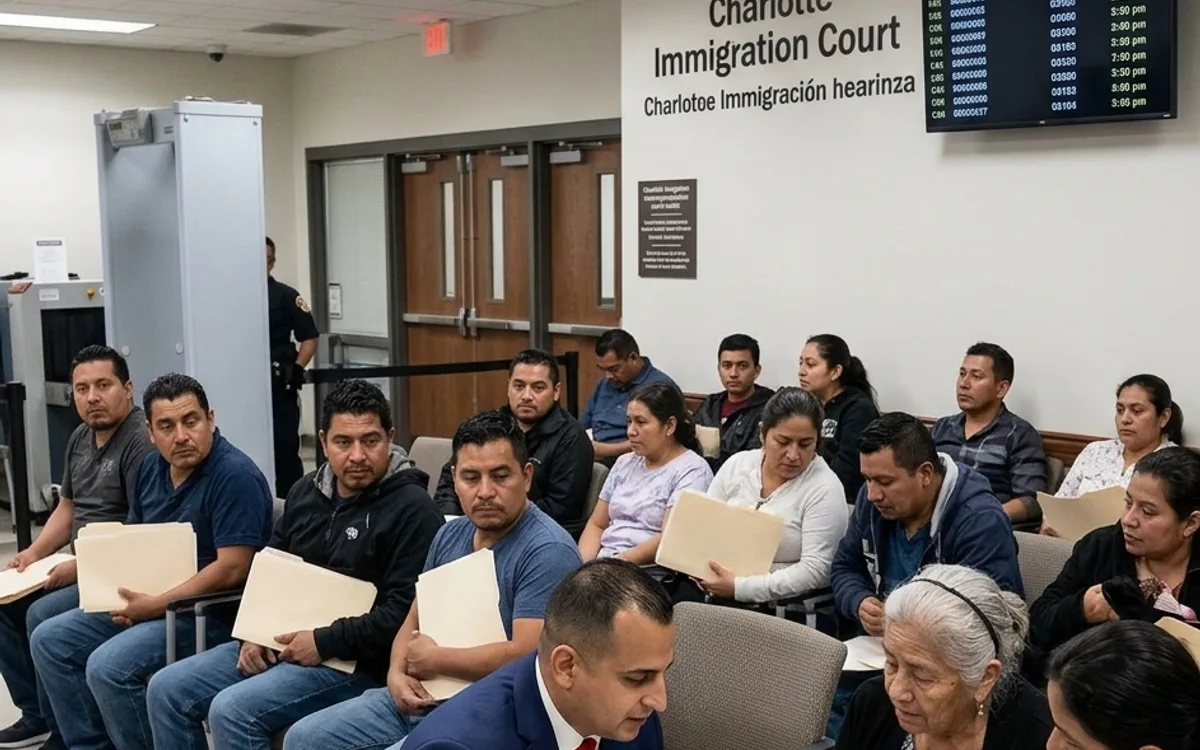
You got a hearing notice from the Charlotte Immigration Court, or you are still waiting for one two years after your Notice to Appear was filed. Either way, the numbers in EOIR's new backlog report are not reassuring. The federal immigration court system reported roughly 3.6 million pending cases nationwide as of FY2025, per TRAC Immigration's analysis of Department of Justice data (trac.syr.edu/immigration). The wait from filing to a final merits hearing now averages close to four years in many courts, including Charlotte.
That number does not tell you what happens to your case. It tells you how long you may be living with the uncertainty, and uncertainty is where decisions get made badly, like a missed address update or a filing deadline that slips by. What you do during the wait matters as much as what happens at the hearing itself.
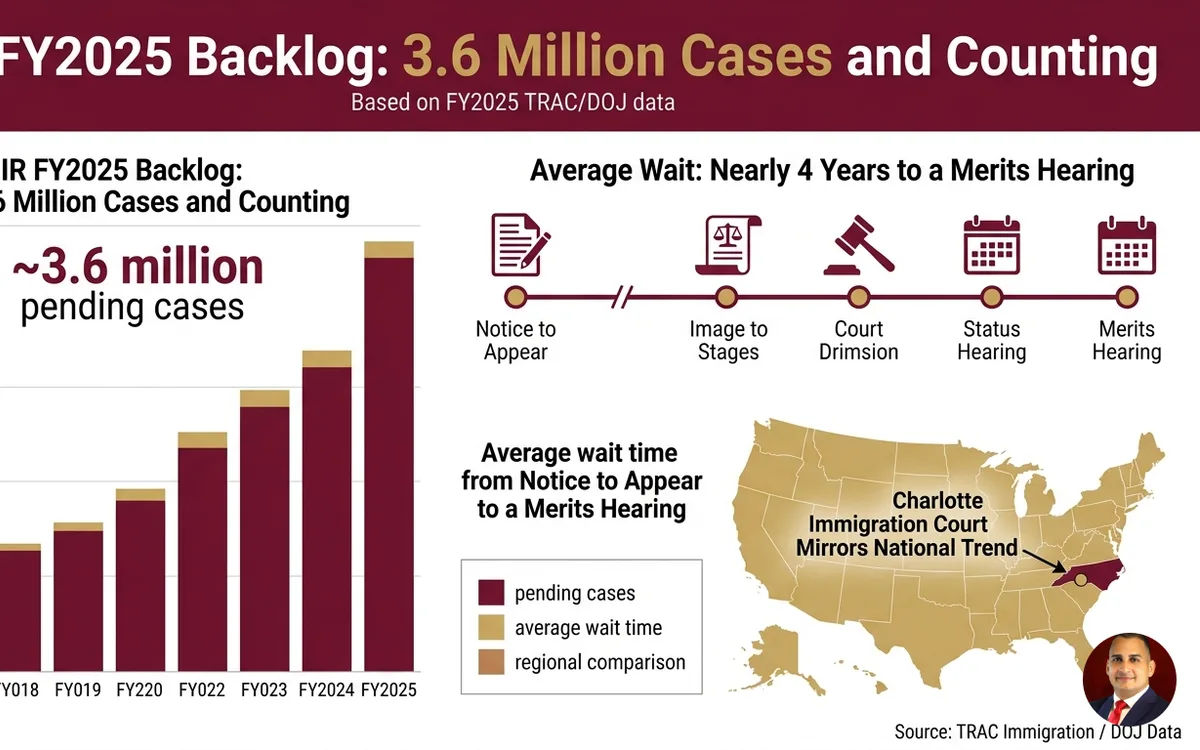
EOIR's FY2025 Adjudication Statistics report a national backlog of roughly 3.6 million pending cases, with average wait times near four years from Notice to Appear to a merits hearing, per TRAC Immigration's analysis of DOJ data. Charlotte Immigration Court reflects this trend. Your existing deadlines do not change because the backlog grew.
The Hard Truth
The backlog growing does not mean your case gets easier. It means evidence gets harder to gather. Witnesses move, documents from your home country age out of relevance, and your own memory of specific dates and events fades over two, three, four years of waiting.
Judges at the Charlotte Immigration Court are also under pressure to clear dockets faster, not slower. EOIR has pushed courts toward shorter continuances and tighter scheduling in response to the backlog reported in its FY2025 statistics (justice.gov/eoir/statistics), which means an unprepared filing or a missed deadline is less likely to get a forgiving second look than it might have five years ago. Waiting does not improve your position. It just changes what you are waiting for.
What Happens If You Wait
Every deadline in your case runs regardless of how long the overall system takes to reach you. If you miss a hearing because your address was not updated with the court on Form EOIR-33, an immigration judge can order you removed in absentia under 8 U.S.C. § 1229a(b)(5) (law.cornell.edu/uscode/text/8/1229a), and in absentia orders are difficult to reopen.
A missed filing deadline for an asylum application, a motion to reopen, or a brief due before the Board of Immigration Appeals does not get extended because the national backlog is years long. The one-year filing deadline for asylum under INA § 208(a)(2)(B) keeps running whether or not your case has moved on the docket. The longer you wait without confirming your filing status, the more likely a routine clerical gap turns into a missed deadline you cannot fix.
Step-by-Step Process
Removal proceedings at the Charlotte Immigration Court generally follow this sequence. Deadlines below are typical, not guaranteed, and can shift based on the docket congestion described in EOIR's FY2025 statistics (justice.gov/eoir/statistics).
Step | What Happens | Typical Deadline | Governing Authority
- Notice to Appear (NTA) issued | DHS files the NTA with the court, starting proceedings under INA § 240 | No fixed filing deadline, but DHS must give notice of the first hearing | 8 U.S.C. § 1229a
- Master calendar hearing | A short hearing, 5 to 15 minutes, where the judge confirms identity, takes pleadings, and sets a schedule | Scheduled weeks to months after the NTA is filed | EOIR Immigration Court Practice Manual, Ch. 3
- Filing deadlines set | The judge sets deadlines for applications such as asylum or cancellation of removal, and for supporting evidence | Typically 60 to 90 days before the merits hearing | Immigration Court Practice Manual, Ch. 3
- Evidence and brief filing | All filings go through the EOIR Courts & Appeals System (ECAS) | Set by the judge at the master calendar hearing | 8 C.F.R. § 1003.17
- Individual (merits) hearing | The full hearing: testimony, cross-examination, and argument on your application for relief | Currently averaging close to four years after the NTA nationally, per TRAC/EOIR FY2025 data | INA § 240
- Decision | The judge grants relief, denies it, or orders voluntary departure | Often issued the same day or within several weeks | 8 U.S.C. § 1229a(c)
- Appeal | Either side can appeal to the Board of Immigration Appeals | 30 days from the written decision | 8 C.F.R. § 1003.38
Missing step 2 or step 3 because a notice went to an old address is one of the most common ways a case collapses before it ever reaches a merits hearing.
A Real-World Example
Consider a composite example based on the kind of case our attorneys see at the Charlotte Immigration Court. A woman from Honduras receives an NTA in 2022 after an encounter at the border. Her master calendar hearing happens four months later. The judge sets a filing deadline for her asylum application and schedules her merits hearing for 2026, nearly four years out, consistent with the national average reported in EOIR's FY2025 statistics.
During the wait, she moves twice for work. Each time, she files Form EOIR-33 within five days to keep the court's address on file current. She also files to renew her employment authorization document twice during the gap, since work permits tied to a pending asylum application require their own renewal filings with USCIS and do not extend automatically with the court case.
When her merits hearing finally arrives, her documentary evidence, country-conditions research, and witness statements have been reviewed and refreshed every six months, not left untouched until the hearing date approached. The hearing itself takes most of a day: her testimony, cross-examination by the DHS attorney representing the government, and closing argument on the legal standard under INA § 208. The judge takes the matter under advisement and issues a written decision afterward. This is what the multi-year wait actually looks like: not inactivity, but a long sequence of smaller filings and deadlines that have to be managed correctly the whole way through.
William J. Vasquez is admitted to practice before the U.S. Court of Appeals for the Fourth Circuit, which covers removal appeals arising from North Carolina, and before the Board of Immigration Appeals nationwide under 8 C.F.R. § 1292.1. His practice focuses on removal defense and appellate work arising out of the Charlotte Immigration Court.
Unlike firms that list AILA (American Immigration Lawyers Association) membership as a credential, our attorneys do not hold that specific designation, and we describe our work in terms of what we actually do: file motions through ECAS, prepare clients for master calendar and merits hearings, and brief appeals to the BIA and the Fourth Circuit. We do not publish case outcome statistics. Results in removal proceedings depend on the specific facts, the assigned judge, and the current state of the law, including standards set out in decisions like Matter of A-B-, 28 I&N Dec. 199 (A.G. 2021), and no two cases are alike enough to summarize honestly with a percentage.
Key Terms Explained
Notice to Appear (NTA): The charging document DHS files with the immigration court to begin removal proceedings under INA § 240 (8 U.S.C. § 1229a).
Master calendar hearing: A short initial hearing, usually 5 to 15 minutes, where the judge confirms your identity, takes your plea to the charges, and sets deadlines. It is not the trial.
Individual (merits) hearing: The full hearing on your application for relief, including testimony and cross-examination. This is the hearing most affected by the backlog, since it is the one that waits years to be scheduled.
Backlog: EOIR's term for cases filed but not yet completed. EOIR's FY2025 Adjudication Statistics report a national backlog of roughly 3.6 million pending cases (justice.gov/eoir/statistics).
In absentia order: A removal order issued when a respondent fails to appear for a scheduled hearing, authorized under 8 U.S.C. § 1229a(b)(5).
ECAS (EOIR Courts & Appeals System): The electronic filing system the Charlotte Immigration Court and other EOIR courts require for most motions and briefs.
Motion to reopen: A request asking the court to reconsider a case, typically based on a change in circumstances or new evidence, governed by 8 C.F.R. § 1003.23.
Board of Immigration Appeals (BIA): The administrative body that reviews immigration judge decisions. Any attorney licensed in good standing in a single U.S. state may appear before the BIA nationwide under 8 C.F.R. § 1292.1.
Cancellation of removal: A form of relief from removal available to certain long-term residents, with eligibility standards set out in INA § 240A.
Frequently Asked Questions
Q: How long is the immigration court backlog in North Carolina right now? A: EOIR's FY2025 Adjudication Statistics report a national pending caseload of roughly 3.6 million cases, with average wait times near four years from the Notice to Appear to a merits hearing, per TRAC Immigration's analysis of DOJ data (trac.syr.edu/immigration). Charlotte Immigration Court follows this national pattern, though exact wait times vary by judge and docket.
Q: Does a longer court backlog mean my case is more likely to be denied? A: No. The backlog affects how long you wait for a hearing, not the legal standard the judge applies to your application. Relief like asylum or cancellation of removal is granted or denied based on whether you meet the statutory requirements, not on how crowded the court's docket is.
Q: How do I check the status of my immigration court case? A: Call the EOIR automated case information hotline at 1-800-898-7180, or use the online case status tool at justice.gov/eoir and enter your A-number. The tool shows your next scheduled hearing date and recent filings.
Q: What happens to my work permit while my case is pending? A: An employment authorization document (EAD) tied to a pending asylum application does not renew automatically with the court case. You must file a separate renewal application with USCIS, generally well before expiration, to avoid a gap in work authorization.
Q: What if I missed a filing deadline because of the backlog? A: The backlog does not extend your deadline. If you missed a filing deadline set by the judge, or the one-year asylum filing deadline under INA § 208(a)(2)(B), you may be able to argue for an exception such as changed circumstances, but you need to raise it promptly rather than wait.
Q: Can I handle my case without a lawyer while I wait? A: You have the right to represent yourself, but removal proceedings are adversarial: a government attorney represents DHS at every hearing, and the legal standards for relief are detailed and unforgiving of filing errors. Extra waiting time only helps if it is spent preparing correctly.
Q: What does it cost to hire an attorney for a removal defense case? A: Immigration representation is not handled on a contingency basis; there is no settlement to share a percentage of, so attorneys in this field typically charge a flat fee or hourly rate agreed to in writing in advance. Ask for a fee agreement that states exactly what work is covered, including whether a BIA appeal is included if one becomes necessary.
Q: How does the backlog affect an appeal to the Fourth Circuit? A: A growing EOIR backlog does not change the 30-day deadline to petition the Fourth Circuit for review of a BIA decision, and that deadline is strictly enforced. Fourth Circuit appeals also run on their own separate timeline, often a year or more before a decision.
Q: If I move during the years I'm waiting, what do I need to do? A: File Form EOIR-33 with the immigration court within five days of any change of address. Failing to update your address is one of the most common reasons people miss a hearing notice and receive an in absentia removal order under 8 U.S.C. § 1229a(b)(5).
Q: What's the difference between a USCIS delay and an EOIR court backlog? A: USCIS delays affect applications filed directly with the agency, like family petitions or adjustment of status, and are tracked through USCIS's own case processing times page. EOIR backlogs affect cases already in removal proceedings before an immigration judge, a separate system with its own docket, deadlines, and the Charlotte Immigration Court specifically.
Clients who come to us during a multi-year wait often say the hardest part is not knowing what is happening with their case. Reviews on our Google Business Profile reflect that same concern more than they focus on predicted outcomes, since immigration cases do not come with guaranteed results. We do not publish an aggregate rating or review count on this page, since those figures change over time; current reviews are visible directly on our Google Business Profile before you schedule a consultation.
None of this changes by reading one more article about the backlog. It changes when someone reviews your specific filing history, your deadlines, and your options, using the actual documents from your case instead of a published national average.
If you have a pending case at the Charlotte Immigration Court, or you are not sure what your Notice to Appear actually requires of you, schedule a consultation with our immigration team to review your filing history and upcoming deadlines before your next hearing date arrives. We handle removal defense, asylum applications, cancellation of removal, and appeals to the Board of Immigration Appeals and the Fourth Circuit out of our North Carolina office.

- Asylum Applications: vasquezlawfirm.com/immigration/asylum
- Cancellation of Removal: vasquezlawfirm.com/immigration/cancellation-of-removal
- BIA Appeals: vasquezlawfirm.com/immigration/bia-appeals
- Work Permit (EAD) Renewal: vasquezlawfirm.com/immigration/work-authorization
- Schedule a Consultation: vasquezlawfirm.com/consultation
- Charlotte Immigration Court Information: vasquezlawfirm.com/locations/charlotte