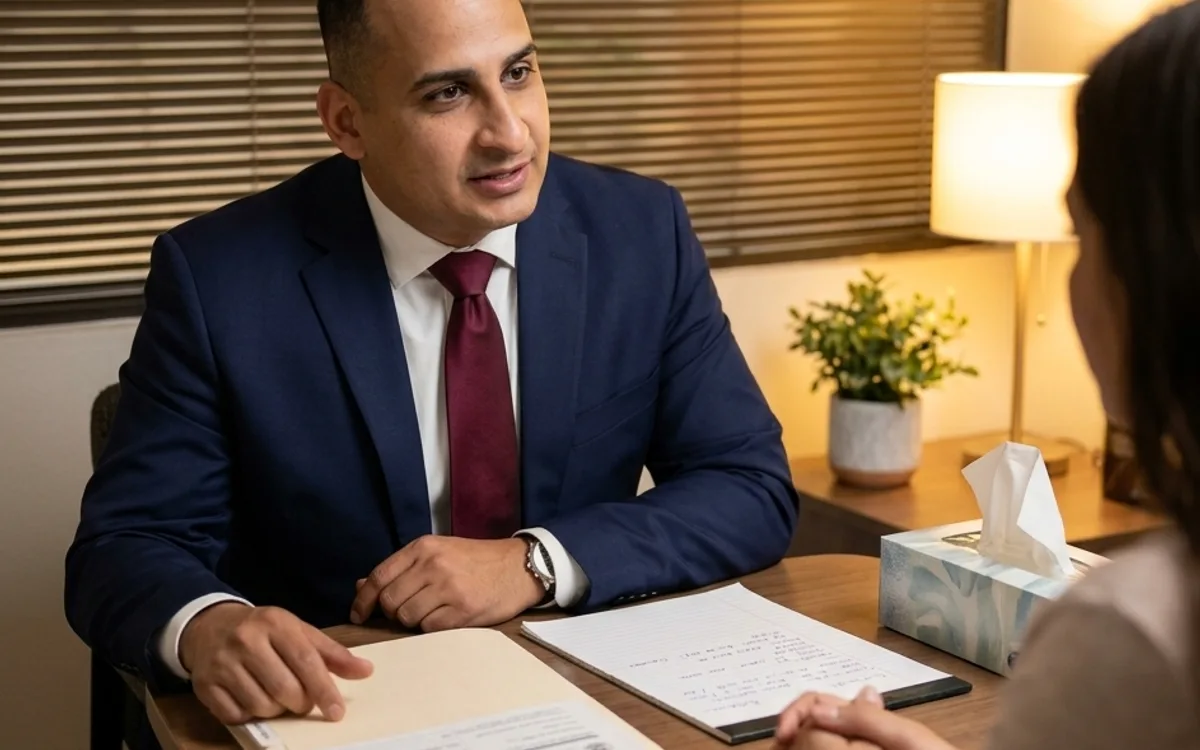
You are not required to talk to the police to get help. That matters if someone brought you to this country, or held you here, through force, fraud, or threats, and you are afraid that calling a lawyer means calling the authorities on yourself or on someone who still has leverage over your family. A T visa consultation with our office starts with your safety, not your immigration status, your entry history, or whether you are ready to report anyone. We ask what happened, what you need right now, and what frightens you about coming forward. Then we explain, in plain terms, what federal law actually requires and what it does not. Many survivors qualify for a trauma exception that removes the law-enforcement cooperation requirement entirely, and you can find out whether that applies to you in a confidential conversation before you decide anything else.
A T visa attorney helps trafficking survivors apply for T nonimmigrant status under 8 U.S.C. § 1101(a)(15)(T), which provides victims of severe labor or sex trafficking temporary legal status, work authorization, and a path to a green card after three years. Survivors with trauma that prevents cooperation with law enforcement may qualify for an exception to that requirement.
The Hard Truth
The federal government caps T visas at 5,000 principal applicants per fiscal year under 8 C.F.R. § 214.11(k). That cap has not been reached in any fiscal year on record, per USCIS's published Form I-914 data (uscis.gov/tools/reports-and-studies/immigration-forms-data), so the cap itself is rarely what slows a case down. The backlog at USCIS's Vermont Service Center, the only office that adjudicates T visas, is what slows it down. As of USCIS's processing-times page (uscis.gov/processing-times), the median wait for a Form I-914 decision runs approximately 37 months from filing. A bona fide determination, described in USCIS Policy Manual Volume 3, Part B, Chapter 5 (uscis.gov/policy-manual/volume-3-part-b), can unlock interim deferred action and work authorization months before the final decision. It is not automatic, and USCIS can decline to issue one if your filing is incomplete. The trauma exception to the law-enforcement cooperation requirement is real, but it has to be documented, usually through a mental health professional's statement or records from an organization like the National Human Trafficking Hotline (1-888-373-7888). USCIS does not grant it because a survivor says they are afraid; it has to be shown. If a certifying agency refuses to sign Form I-914 Supplement B, your case does not end there, but it does mean building the trauma-exception or alternative-evidence argument without a law enforcement certification behind you, which is a harder case to put together and takes longer to document well. The State Department's annual Trafficking in Persons Report has noted for years that the T visa is used by only a small fraction of people believed to meet the federal trafficking definition, and fear of the cooperation requirement is one of the reasons advocates cite for that gap.
What Happens If You Wait
Every month you wait costs more than time. If a law enforcement agency already granted you Continued Presence, that status is temporary, typically issued by ICE Homeland Security Investigations in one-year increments, and it does not renew itself. When it lapses before you file Form I-914, you lose both your status and your work permit, with no guarantee of a smooth transition into T visa protection during the gap. If you are already in removal proceedings at Charlotte Immigration Court, your next hearing date does not wait for USCIS to act. The EOIR Immigration Court Practice Manual, Chapter 4.16, lets your attorney ask the judge for a continuance, or for administrative closure under the BIA's controlling decision in Matter of Avetisyan, 25 I&N Dec. 688 (BIA 2012), while your I-914 is pending. Judges grant those requests far more often when the filing was made months ago than when it lands the week before a hearing. Family members abroad face their own clock. A derivative T visa is available for certain qualifying relatives, including children, but a child who turns 21 before the petition is decided can age out of eligibility depending on when the underlying I-914 was filed. Filing sooner protects that window. Evidence degrades too. Dates, locations, and the identities of the people involved get harder to reconstruct with the specificity USCIS adjudicators expect, and the hotline staff, clinic workers, or NGO caseworkers who could later confirm parts of your account move jobs or lose records. None of this means rushing an incomplete application out of panic. It means the gap between today and a confidential consultation is not neutral.
Step-by-Step Process
1. Confidential intake. We do not run an immigration status check before talking with you, and you do not need a police report in hand to have this conversation. 2. Document gathering. We help you assemble what already exists: hotline records from the National Human Trafficking Hotline (1-888-373-7888), medical or mental health records, OTIP certification or eligibility letters from HHS's Office on Trafficking in Persons, and your own written declaration of what happened. 3. Choose your cooperation path. Some survivors already cooperated with an agency like the Charlotte-Mecklenburg Police Department's Human Trafficking Unit and can request Form I-914 Supplement B certification. Others qualify for the trauma exception instead, and some have a pending or completed trafficking-related investigation that satisfies the requirement without new contact with law enforcement. 4. File Form I-914 with the Vermont Service Center, the sole USCIS office that adjudicates T visas nationwide. 5. Bona fide determination review. Per USCIS Policy Manual Volume 3, Part B, Chapter 5, a complete filing can trigger interim deferred action and work authorization eligibility while the full petition is still pending. 6. Coordinate with Charlotte Immigration Court if you are already in removal proceedings. We file a motion to administratively close or continue the case, cite Matter of Avetisyan, and coordinate with ICE's Office of Chief Counsel in Charlotte so the pending I-914 is on the record. 7. Decision. If USCIS grants T status, you receive four years of status and work authorization, renewable derivative status requests for qualifying family members proceed alongside or after yours. 8. Adjustment of status. After three years of continuous physical presence in T status, or earlier if the related investigation or prosecution concludes, you may apply to become a lawful permanent resident. For a comparison of this process against U nonimmigrant status, see our [U visa attorney page](/immigration/u-visa-attorney); for cases already docketed before a judge, see our [removal defense page](/immigration/removal-defense).
A Real-World Example
A composite example, not an actual client: a woman came to North Carolina on a promise of housekeeping work and had her passport held by the family that employed her for two years. She came to our office after a hotline worker gave her our number. The first meeting covered only what she wanted to happen next, not a recitation of every detail of the exploitation. Over the following weeks, we helped her request records from the hotline call, locate a counselor willing to write a trauma-based statement, and decide that she did not want to contact the agency that had briefly investigated her case, which made the trauma exception the right path instead of a Supplement B request. We filed Form I-914 with supporting evidence addressing each statutory element: that she was a victim of a severe form of trafficking, that she was physically present due to that trafficking, that she met the cooperation requirement through the trauma exception, and that removal would cause extreme hardship. USCIS later requested additional evidence on one element, which is common and not itself a sign the case is in trouble. While the petition remained pending at the Vermont Service Center, we tracked the bona fide determination timeline and kept her informed about what each notice from USCIS meant. That is the process a T-visa applicant can expect: documentation, a filing built around the statute's specific elements, and a wait measured in months, not days, with no promise of a particular result at the end.
William J. Vasquez has spent more than 20 years practicing federal immigration law, including T-visa petitions for trafficking survivors, VAWA self-petitions, and asylum claims that involve related trauma. He holds admission before the U.S. Courts of Appeals for the 4th, 5th, and 11th Circuits in addition to his state bar membership, which matters for immigration work because EOIR and USCIS proceedings are federal regardless of which state a client lives in. Our office coordinates with Legal Aid of North Carolina's Battered Immigrant Project and the North Carolina Human Trafficking Commission, established under N.C. Gen. Stat. § 143B-1202, on cases involving overlapping civil and criminal protections for survivors. Our team handles T-visa intake the same way regardless of whether a client has ever spoken to police: confidentially, without requiring cooperation as a condition of the first conversation. You can read more about his background on his [attorney profile page](/attorneys/william-j-vasquez) or about the firm's broader humanitarian relief work on our [immigration practice overview](/immigration).
Key Terms Explained
T nonimmigrant status (T visa): Temporary immigration status under 8 U.S.C. § 1101(a)(15)(T) for survivors of a severe form of trafficking in persons, granted for up to four years. Form I-914: The USCIS petition used to apply for T nonimmigrant status, filed with the Vermont Service Center. Form I-914, Supplement B: A law enforcement certification confirming an applicant was a victim of trafficking and is, has been, or is likely to be helpful to an investigation or prosecution. It is one way, not the only way, to meet the cooperation requirement. Trauma exception: A statutory exception, found at 8 C.F.R. § 214.11, that excuses an applicant from the cooperation requirement if trauma prevents them from cooperating with law enforcement. Bona fide determination: An interim USCIS finding that a filed I-914 appears credible and complete, which can lead to deferred action and work authorization while the full petition is still pending, per USCIS Policy Manual Volume 3, Part B. Continued Presence: A temporary status granted by ICE Homeland Security Investigations, at a law enforcement agency's request, allowing a trafficking victim to remain in the U.S. during an active investigation. It is not the same as a T visa and does not lead to permanent status on its own. Administrative closure: A docket-management tool that temporarily removes a case from an immigration judge's active calendar, governed by the BIA's decision in Matter of Avetisyan, 25 I&N Dec. 688 (BIA 2012). HHS certification letter: A letter issued by the Department of Health and Human Services' Office on Trafficking in Persons (OTIP) under TVPA Section 107, confirming eligibility for certain federal benefits available to trafficking survivors.
Frequently Asked Questions
Q: Do I have to testify against my trafficker to get a T visa? A: No. Federal law includes a trauma exception, documented at 8 C.F.R. § 214.11, that excuses you from the law-enforcement cooperation requirement if trauma prevents you from assisting an investigation or prosecution. You still need evidence supporting that exception, but it does not require confronting or helping prosecute the person who trafficked you. Q: What is the difference between Continued Presence and a T visa? A: Continued Presence is a temporary status that ICE Homeland Security Investigations grants at a law enforcement agency's request during an active investigation, usually in one-year increments. A T visa is a separate immigration status you apply for directly with USCIS using Form I-914, lasts up to four years, and can lead to a green card; Continued Presence does not. Q: How long does it take to get work authorization after filing Form I-914? A: If USCIS issues a bona fide determination on your filing, you may become eligible for interim deferred action and work authorization months before the full petition is decided, per USCIS Policy Manual Volume 3, Part B. The final decision on the I-914 itself takes longer, with a median processing time of approximately 37 months as of USCIS's processing-times page. Q: Can my family members overseas get T visa status too? A: Certain qualifying relatives, including spouses, children, and in some cases parents or siblings, can receive derivative T status. Age matters for children, since turning 21 before the petition is decided can affect eligibility depending on when the underlying I-914 was filed, so filing earlier protects that window. Q: What if the law enforcement agency refuses to sign Supplement B? A: A refusal does not end your case. You can pursue the case through the trauma exception instead, or submit other evidence showing cooperation or an applicable exception, though the filing takes more documentation to build without that certification. Q: I'm already in removal proceedings at Charlotte Immigration Court. Does filing for a T visa stop my case? A: Filing Form I-914 does not automatically pause removal proceedings. Your attorney has to separately ask the immigration judge for a continuance under the EOIR Immigration Court Practice Manual, Chapter 4.16, or for administrative closure under Matter of Avetisyan, and the judge decides whether to grant it. Q: Should I apply for a T visa or a U visa? A: It depends on the crime and the harm you experienced. T visas are specific to trafficking victims and include the cooperation exception described above; U visas cover a broader list of qualifying crimes but generally require a law enforcement certification with no equivalent trauma exception. See our comparison table on this page or visit our [U visa attorney page](/immigration/u-visa-attorney) for detail. Q: What does it cost to work with an attorney on a T visa case, and how is payment structured? A: T-visa representation is handled on a flat-fee or hourly basis set out in a written engagement agreement, discussed during your confidential consultation before you commit to anything. Contingency fee arrangements do not apply to immigration matters, including T visas, because there is no monetary recovery to take a percentage of. Q: What happens if USCIS denies my T visa petition? A: A denial does not always end your options. Depending on the reason for denial, you may be able to file a motion to reopen or reconsider, submit a new petition with additional evidence, or, if you are in removal proceedings, raise T-visa eligibility as a defense before the immigration judge. What comes next depends heavily on why USCIS denied the case, which is something to review with an attorney promptly given EOIR's own filing deadlines.
Clients who come to us through the National Human Trafficking Hotline, Legal Aid of North Carolina, and local advocacy organizations consistently describe the same thing about the intake process: that it did not feel like an interrogation. We do not publish outcome statistics for T-visa cases, because federal law treats every petition on its individual facts and because quoting a success rate would not tell a survivor anything true about their own case. What we can tell you is that our intake process is built around confidentiality first, documentation second, and a clear explanation of the cooperation requirement and its exceptions before you decide whether to proceed.
None of this requires you to decide anything today beyond whether to have one confidential conversation. You can ask every question on this page, including the uncomfortable ones about cooperation and cost, before you say anything about what happened to you.
If you are a trafficking survivor considering a T visa, or you are not sure whether what happened to you meets the federal definition, schedule a confidential consultation with our immigration team. We will walk through your situation, explain whether the trauma exception or a law enforcement certification fits your case, and outline realistic next steps, including coordination with Charlotte Immigration Court if you already have a case pending there. Call our office or request a consultation through our [immigration practice page](/immigration) to get started.
- U Visa Attorney
- Removal Defense
- VAWA Self-Petitions
- Asylum and Humanitarian Relief
- Attorney William J. Vasquez
- Immigration Practice Overview