You got a letter from the Board of Immigration Appeals, or maybe your attorney mentioned a Supreme Court case and your stomach dropped. Patel v. Garland changed what a federal court is allowed to look at when it reviews a denial of cancellation of removal, adjustment of status, or a waiver.
If you are waiting on a decision, or you already have one you disagree with, the rules for fixing it on appeal just got narrower. Appeals are still possible, but the path is narrower now, and the filing deadlines have not moved at all.
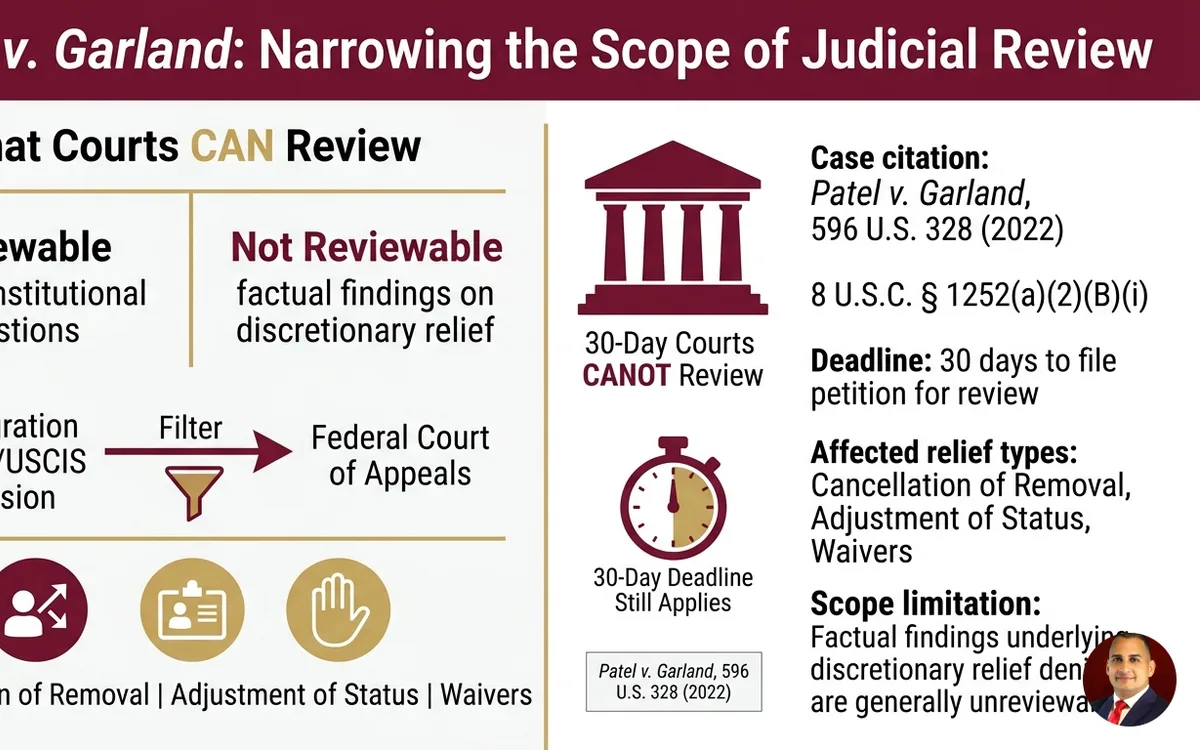
In Patel v. Garland, 596 U.S. 328 (2022), the Supreme Court held federal courts generally cannot review factual findings behind USCIS or immigration judge denials of discretionary relief, per 8 U.S.C. § 1252(a)(2)(B)(i). This narrows appeals for cancellation of removal, adjustment of status, and waiver denials. A 30-day deadline still applies to any petition for review.
The Hard Truth
In Patel v. Garland, 596 U.S. 328 (2022), decided May 16, 2022, the Supreme Court held that federal courts, including the Fourth Circuit, generally cannot review the factual determinations an immigration judge or USCIS makes when denying discretionary relief, under 8 U.S.C. § 1252(a)(2)(B)(i) (opinion summarized by SCOTUSblog's Patel v. Garland case archive). That holding is narrower than most people assume going in.
If the immigration judge got a fact wrong, such as a date, an address, or a detail in a tax filing, that error alone usually cannot be the basis for a federal court to overturn the denial. The Fourth Circuit can still review legal and constitutional questions, but it can't second-guess how an immigration judge weighed the facts in front of her.
What Happens If You Wait
A petition for review to the Fourth Circuit must be filed within 30 days of the Board of Immigration Appeals' final order, under 8 U.S.C. § 1252(b)(1) and Federal Rule of Appellate Procedure 15. That deadline is jurisdictional. Courts have consistently dismissed late petitions regardless of how strong the underlying facts are.
Waiting to decide whether Patel changes your odds costs you the one deadline that did not change at all. If the 30 days pass while you are still researching the ruling, the Fourth Circuit loses the power to hear your case no matter what the record shows.
Step-by-Step Process
The Charlotte Immigration Court is one node in a nationwide system carrying more than 3.7 million pending cases as of FY2024, per the Executive Office for Immigration Review's FY2024 Adjudication Statistics. The Fourth Circuit received several hundred immigration petitions for review in FY2023, per the Administrative Office of the U.S. Courts' Judicial Business report, and Patel changed what that court can do with most of them.
Immigration judge decision. At the Charlotte Immigration Court, the judge issues an oral or written decision after your merits hearing, filed through the ECAS electronic system required for cases before that court.
Deadline to act. You have 30 days to file a Notice of Appeal (Form EOIR-26) with the Board of Immigration Appeals, under 8 C.F.R. § 1003.38, or 30 days to ask for reconsideration, or 90 days to move to reopen based on new evidence, with the same judge, under 8 C.F.R. § 1003.23.
BIA review. The Board reviews the record under its appellate jurisdiction, defined at 8 C.F.R. § 1003.1. It can affirm, reverse, or remand the case to the Charlotte Immigration Court.
Motion to reconsider the BIA. If the Board denies your appeal, you have 30 days to file a motion to reconsider under 8 C.F.R. § 1003.2(b), arguing a legal or factual error in the Board's own decision.
Petition for review. To challenge the Board's final order in federal court, you or your Fourth Circuit appeals attorney file a petition for review with the U.S. Court of Appeals for the Fourth Circuit in Richmond, Virginia, within 30 days, under FRAP Rule 15.
Scope of review after Patel. The Fourth Circuit decides whether your claim raises a legal or constitutional question it can reach, or a factual discretionary determination it cannot, under 8 U.S.C. § 1252(a)(2)(B)(i).
Decision. The panel issues a published or unpublished opinion. Further review requires a petition for rehearing en banc or a petition for certiorari to the Supreme Court.
A Real-World Example
Consider a composite example, not a real client. Ana has lived in Mecklenburg County for over a decade. An immigration judge at the Charlotte Immigration Court denies her application for cancellation of removal, finding she did not meet the hardship standard tied to her U.S. citizen child.
Her attorney reviews the hearing transcript and identifies two possible arguments: the judge may have misapplied the legal standard for hardship, and the judge made a factual finding about her child's medical records that she disputes. Under Patel v. Garland, the factual dispute about the medical records is unlikely to be something the Fourth Circuit can revisit. The legal question, whether the judge applied the correct hardship standard, remains open to review.
Her attorney files a Notice of Appeal with the BIA within the 30-day window, builds the record around the legal argument, and prepares for the possibility of a petition for review to the Fourth Circuit if the Board denies the appeal. Each step has its own form, deadline, and decision-maker, and Ana's attorney walks through what the record will and will not support before filing anything.
William J. Vasquez handles removal defense and appellate immigration matters, including cases before the Charlotte Immigration Court, the Board of Immigration Appeals, and the U.S. Court of Appeals for the Fourth Circuit. His admission to practice before the Fourth Circuit allows him to file petitions for review arising from Board decisions in North Carolina cases.
He has spent years tracking how rulings like Patel v. Garland change what the Fourth Circuit will and will not consider on review, and he applies that analysis when deciding whether a denial is worth appealing or better addressed through a motion to reopen with new evidence. That assessment, made case by case against the actual hearing record, is what determines which procedural path a denial should take.
Key Terms Explained
Patel v. Garland, 596 U.S. 328 (2022): The Supreme Court decision holding that federal courts generally lack jurisdiction to review factual findings underlying a discretionary relief denial, decided May 16, 2022 (SCOTUSblog case archive).
Discretionary relief: Immigration relief that an immigration judge or USCIS may grant or deny within their judgment, even if an applicant meets the basic legal requirements, including cancellation of removal, adjustment of status, and most waivers.
Jurisdiction-stripping provision, 8 U.S.C. § 1252(a)(2)(B)(i): The statute Patel interpreted, limiting what federal appellate courts can review when a discretionary relief denial is challenged.
Petition for review: The document filed with a U.S. Court of Appeals, here the Fourth Circuit, asking it to review a final order of the Board of Immigration Appeals, governed by Federal Rule of Appellate Procedure 15.
Board of Immigration Appeals (BIA): The Department of Justice body with appellate jurisdiction over Immigration Judge decisions, defined at 8 C.F.R. § 1003.1.
ECAS (EOIR Courts & Appeals System): The mandatory electronic filing system for documents filed with the Charlotte Immigration Court and the BIA.
Motion to reopen vs. motion to reconsider: A motion to reopen asks a judge or the BIA to consider new evidence, typically due within 90 days; a motion to reconsider argues the decision-maker made a legal or factual error on the existing record, typically due within 30 days, under 8 C.F.R. §§ 1003.23 and 1003.2(b).
Frequently Asked Questions
Q: Does Patel v. Garland apply to a decision from before 2022? A: Yes. Patel interprets what federal courts have always been allowed to review under 8 U.S.C. § 1252(a)(2)(B)(i); it did not create a new law, so it applies to pending petitions for review and to new denials alike, regardless of when the underlying application was filed.
Q: How do I know if Patel affects my specific case? A: It depends on what kind of error you are disputing. If you disagree with a factual finding, such as how long you lived somewhere or what a document said, Patel likely limits the Fourth Circuit's ability to fix it; if you are disputing the legal standard the judge applied, that question usually remains open to review. A review of your hearing transcript and the judge's written decision is the only reliable way to tell which category your case falls into.
Q: What does a consultation about a BIA or Fourth Circuit appeal cost, and how long does it take to get an answer? A: Consultations are scheduled directly with our office; ask about current fees when you call, since fee structures vary by case type and are not contingency arrangements in immigration matters. Most consultations can review a hearing transcript and BIA decision and outline your options within the meeting itself, though a full written case assessment can take longer depending on the length of the record.
Q: Can I still file a motion to reopen if the Fourth Circuit can't review the factual findings? A: Yes. A motion to reopen based on new evidence is filed with the immigration judge or the BIA, not the Fourth Circuit, and is not affected by Patel's limits on judicial review. The 90-day deadline under 8 C.F.R. § 1003.23 still applies and runs separately from any deadline to seek federal court review.
Q: What happens if I miss the 30-day deadline to file a petition for review? A: The Fourth Circuit loses jurisdiction to hear the case. Courts treat this deadline, set by 8 U.S.C. § 1252(b)(1) and Federal Rule of Appellate Procedure 15, as jurisdictional, meaning there is generally no late-filing exception for a missed petition for review.
Clients and referring attorneys across North Carolina describe our immigration team's direct explanations of complicated procedural rules, including how recent appellate decisions change the odds before a case is even filed. We do not publish star ratings or outcome statistics. What we can tell you is how many removal defense and appellate matters our attorneys have handled across the Charlotte Immigration Court, the BIA, and the Fourth Circuit, and we are glad to discuss that history on a call.
Patel v. Garland narrowed one path and left others open. Figuring out which path your case actually qualifies for, before the clock runs out, usually matters more than the writing itself.
If you have a removal order, a BIA decision, or a denial and you are still inside the 30-day window, schedule a consultation with our immigration appeals team to review your hearing transcript and decide whether a petition for review, a motion to reconsider, or a motion to reopen fits your record. Call our office or request a consultation through our immigration case review page before the deadline passes.