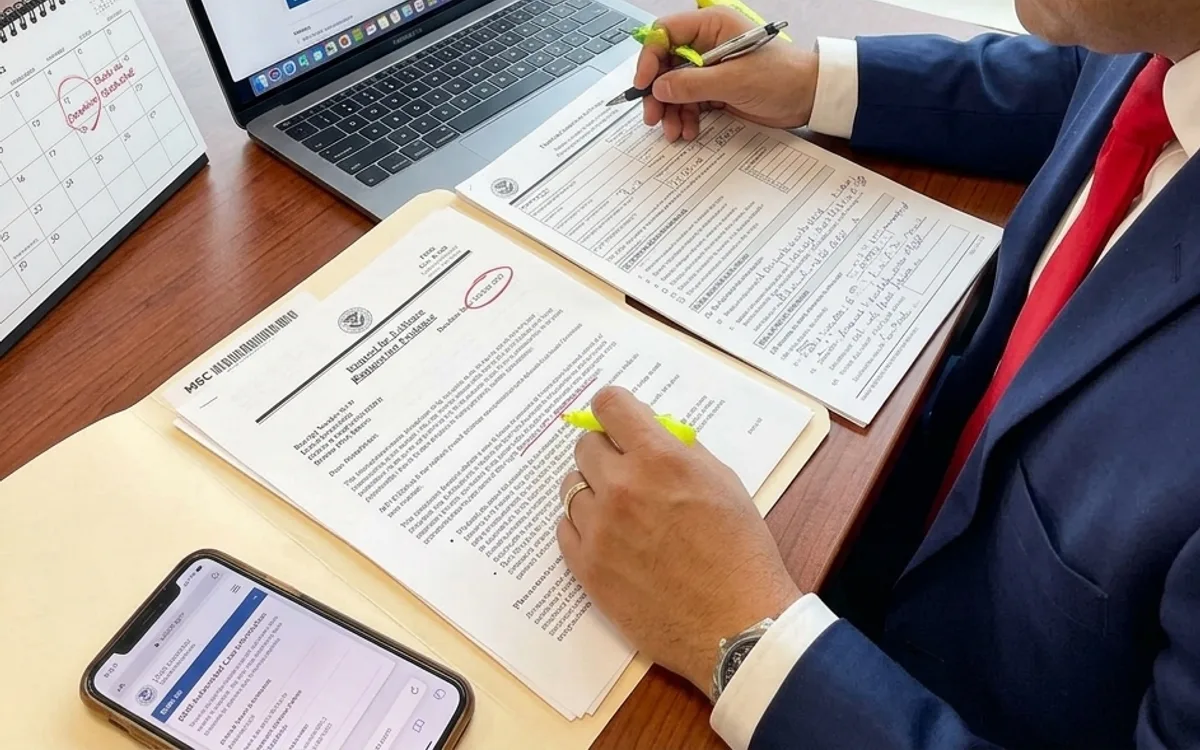
You filed something, maybe months ago, maybe years ago. An I-130, an I-485, an asylum application, a motion after a hearing you weren't sure you understood. Now you don't know where it stands. Nobody called, no letter arrived explaining what the silence means, and the USCIS online status tool left you more confused than before you checked it. That uncertainty is common. USCIS and the Charlotte Immigration Court process thousands of filings each year, and a case can sit untouched in a routine queue for months, or it can be sitting on a missed deadline that is quietly closing a door. Reviewing your case means finding out which one it is before you lose time you cannot get back.
Reviewing your immigration case means checking its current status with USCIS or the immigration court, confirming which forms were filed, and identifying any missed deadlines or RFEs. You can check status online at USCIS.gov or through the EOIR automated case hotline, or request your full file using Form G-639 for an attorney's review.
The Hard Truth
A case review will not speed up USCIS processing or move your hearing date. What it can do is tell you, honestly, whether your case is still active, whether a deadline has already passed, and whether the paperwork on file matches what actually happened in your situation. Sometimes a review turns up good news: the case is simply backlogged, not denied. Sometimes it turns up a missed filing window, a wrong address on record, or a Notice to Appear with a defect under Pereira v. Sessions, 585 U.S. 198 (2018), that changes how the case should be handled going forward. Either way, the review tells you where you actually stand, not where you hoped you stood.
What Happens If You Wait
Deadlines in immigration law do not pause while you decide whether to get a second opinion. A Board of Immigration Appeals (BIA) appeal must be filed within 30 days of an immigration judge's decision, per 8 C.F.R. § 1003.38(b). An asylum application generally must be filed within one year of arrival in the United States, per INA § 208(a)(2)(B), absent a narrow exception. Miss either window, and the law treats the case as if the claim was never raised at all. The in absentia risk is just as concrete. Per TRAC Immigration's analysis of EOIR records, respondents without an attorney are ordered removed in absentia at roughly 44%, compared to about 15% for respondents who have representation. A review can catch an outdated address on file with the immigration court before a hearing notice gets mailed to the wrong place and a removal order gets entered without you in the room.
Step-by-Step Process
## How a Case Review Works ### Step 1: Confirm your case type and current filing Start by identifying exactly which application or proceeding is open: an I-130 petition, I-485 adjustment, asylum application (I-589), a U visa or VAWA petition, a DACA renewal, or a removal case before the Charlotte Immigration Court. This determines which agency holds your file and which deadlines apply. ### Step 2: Check status directly For USCIS filings, check status at USCIS.gov using your receipt number, or call the USCIS Contact Center at 1-800-375-5283. For a case before the Charlotte Immigration Court (5701 Executive Center Drive, Suite 300, Charlotte, NC), call the EOIR automated case information hotline at 1-800-898-7180 or check the online EOIR Courts & Appeals System (ECAS) portal. This step alone often answers whether a case is pending, approved, denied, or scheduled for a hearing, no attorney required. ### Step 3: Request the full record If the online status does not explain enough, request your complete immigration file (the "A-file") using Form G-639, a Freedom of Information/Privacy Act request filed with USCIS. Processing can take several months, so file it early even if you are not yet sure whether you need representation. ### Step 4: Compare the file against applicable deadlines Once the file or status information is in hand, the review checks it against the deadlines in the table below, and against procedural defects, such as a Notice to Appear that failed to list a hearing date and time as required under Pereira v. Sessions, 585 U.S. 198 (2018). ### Step 5: Decide the next filing, if any Depending on what the review finds, the next step might be a motion to reopen, a direct response to a Request for Evidence (RFE), a renewed filing, or confirmation that no action is needed beyond waiting out the processing queue. Chapter 3 of the EOIR Immigration Court Practice Manual governs how filings are submitted and accessed in Charlotte's mandatory electronic filing system.
A Real-World Example
Consider a composite, not an actual client: a man living near Charlotte filed an I-485 adjustment application through his employer two years earlier and had heard nothing since. He assumed the silence meant denial. A review of his USCIS online status showed the case was still listed as "Request for Evidence sent," meaning USCIS had issued an RFE that never reached him, likely because of an address change he had not reported on Form AR-11. The review identified the missed RFE deadline, confirmed whether the response window, which can run from 30 to 87 days depending on the notice under 8 C.F.R. § 103.2(b)(8), had already closed, and mapped out whether a motion to reopen or a fresh filing was the available next step. The point of the review was not a promised result. It was knowing which procedural door was still open.
William J. Vasquez is admitted to the North Carolina State Bar and to practice before the United States Courts of Appeals for the Fourth, Fifth, and Eleventh Circuits, in addition to handling matters before the Board of Immigration Appeals, which under 8 C.F.R. § 1292.1 does not require circuit-specific admission. In case reviews, he has observed a recurring pattern: clients frequently discover, only after someone checks the file, that a Request for Evidence or hearing notice was mailed to an old address never updated with USCIS or the court. That administrative gap, not a weakness in the underlying case, is often what put the filing at risk. Our attorneys build each review around the specific agency record, because a USCIS adjustment file and an EOIR removal file are checked against entirely different deadlines and forms.
Key Terms Explained
**A-file (Alien File)**: The complete government record of a person's immigration history, held by USCIS and requestable through Form G-639. **Form G-639**: A Freedom of Information/Privacy Act request used to obtain a copy of your own A-file from USCIS. **ECAS (EOIR Courts & Appeals System)**: The electronic filing and case-access portal used for filings in immigration court, including Charlotte, under Chapter 3 of the EOIR Immigration Court Practice Manual. **RFE (Request for Evidence)**: A USCIS notice asking for additional documentation before a petition or application can be decided, with a response deadline stated on the notice itself. **NTA (Notice to Appear)**: The charging document that starts removal proceedings; a defective NTA missing the hearing date and time can affect how a case is handled, per Pereira v. Sessions, 585 U.S. 198 (2018). **BIA (Board of Immigration Appeals)**: The federal administrative body that reviews immigration judges' decisions; any attorney licensed in good standing in a U.S. state may appear before it nationwide under 8 C.F.R. § 1292.1. **In absentia order**: A removal order entered when a respondent does not appear at a scheduled hearing, often because a hearing notice was sent to an outdated address. **Motion to reopen**: A filing asking the court or USCIS to reconsider a decision based on new facts or a procedural defect, governed in removal cases by INA § 240(b)(5)(C).
Frequently Asked Questions
Q: How do I check the status of my immigration case online? A: For USCIS filings, create an account at USCIS.gov and enter your receipt number under "Check Case Status." For a case before the Charlotte Immigration Court, call the EOIR automated case hotline at 1-800-898-7180 with your alien registration number. Q: How do I get my full immigration file (A-file) for review? A: File Form G-639, a Freedom of Information/Privacy Act request, with USCIS. Processing can take several months, so request it as soon as you decide to pursue a review. Q: What should I do if I was denied residency and want someone to review my case? A: A denial notice states the specific ground for denial and any deadline to file a motion to reopen or an appeal. Bring that notice to a review so the next step responds to the actual ground cited, not a generic refiling. Q: Can a review tell me if my I-130 or I-485 was denied without my knowledge? A: Yes. USCIS mails decisions to the address on file, so if an address changed without an updated Form AR-11, a denial notice can go unseen. Checking status online or requesting the A-file closes that gap. Q: Is a second opinion on my immigration case useful if I already have a lawyer? A: It can be. A second review checks the same file against deadlines and procedural requirements with fresh eyes, which sometimes catches something the first review missed, particularly around notice defects or filing dates. Q: Should I review my asylum case before my court hearing? A: Yes. Confirm your Form I-589 was filed within the one-year deadline under INA § 208(a)(2)(B), absent an exception, check that your address is current with the Charlotte Immigration Court, and confirm your hearing date through the EOIR hotline before the hearing, not after.
Clients who come to us for a case review often arrive anxious about a silence they did not create. The feedback we hear most consistently is relief at finally getting a plain answer, whether that answer is good, bad, or simply "still pending." Our attorneys handle immigration matters across North Carolina, and we describe what a review can and cannot do before any filing begins: it is diagnostic, not a guarantee of any particular result.
Checking your own status with USCIS or the EOIR hotline costs nothing and takes a few minutes. If that check raises more questions than it answers, a full review of your file is the next step before a deadline passes on its own.
Schedule a case review with our immigration team to go through your USCIS or EOIR file, confirm which deadlines actually apply, and map out the next filing, if one is needed. Call our Charlotte-based office or request a consultation online to get your file checked before the next deadline closes.
- USCIS Case Status Online
- EOIR Automated Case Information Hotline
- Form G-639: Freedom of Information/Privacy Act Request
- Charlotte Immigration Court Information
- USCIS Charlotte Field Office
- Schedule a Case Review Consultation