You Signed Up to Share Your Culture, Not to Decode Immigration Law
You said yes to a program that sounded like the experience of a lifetime: twelve to fifteen months living in the United States, teaching people about your country's food, music, history, and traditions, probably at a pavilion, cultural center, or themed attraction. The paperwork was supposed to be the sponsor's job, not yours.
Then you started reading the fine print, or a friend from a past cohort mentioned a denial, and the questions started. Is this sponsor actually qualified under USCIS rules? Does the cultural component of the job count as 'genuine' to an adjudicator who has never been to your country? What happens at month fifteen, exactly?
Those questions are reasonable. The Q-1 category is narrow, the standard for what makes a program 'cultural' is specific, and the 15-month limit is fixed by regulation, not negotiable by your employer or by you. Understanding how the pieces fit together now protects the experience you came here for.
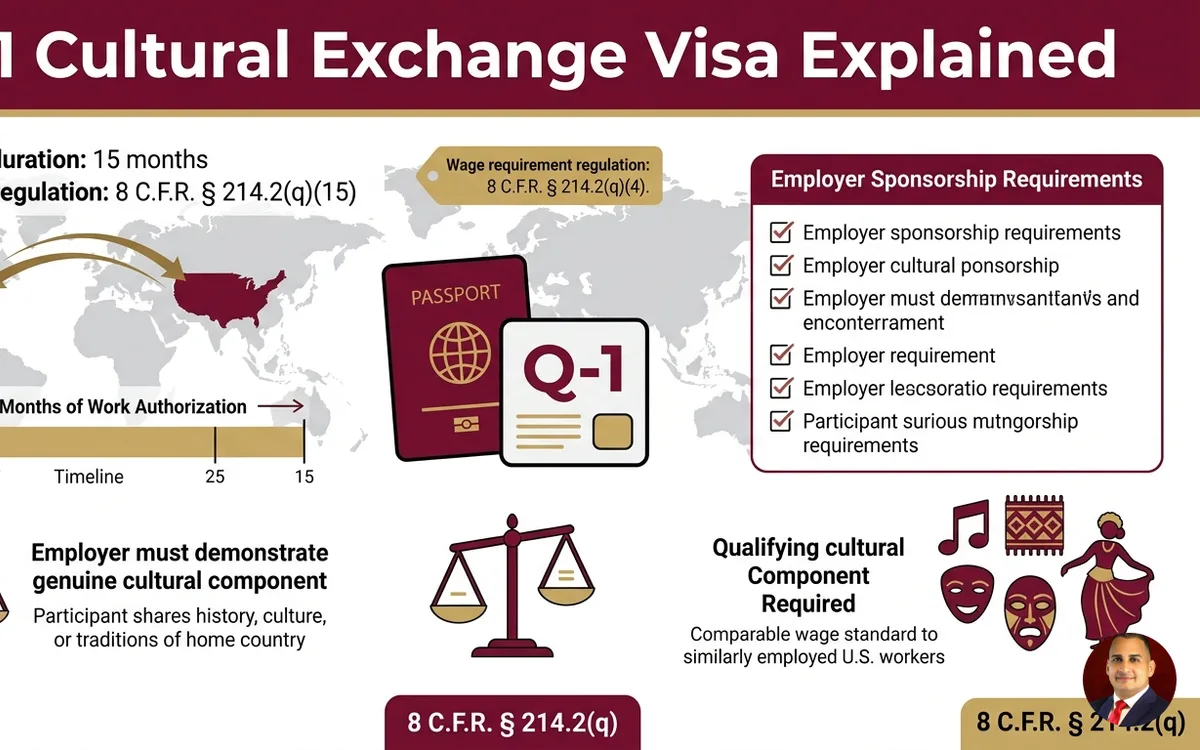
A Q-1 visa lets an international cultural exchange participant work in the United States for up to 15 months to share their country's history, culture, or traditions, per 8 C.F.R. § 214.2(q)(15). The sponsoring employer must prove a genuine cultural component and pay wages comparable to similarly employed U.S. workers, per 8 C.F.R. § 214.2(q)(4).
The Hard Truth
The Hard Part First: Not Every 'Cultural' Job Qualifies
USCIS does not take an employer's word that a program is culturally authentic. The leading agency decision on this question, Matter of Walt Disney World Co., 21 I&N Dec. 1118 (Assoc. Comm'r 1998), set the standard still used today for theme-park and pavilion-style exchange programs: the cultural component has to be a real, structured part of the job, not a label attached to ordinary retail or food-service work. An adjudicator can, and sometimes does, decide that a job description does not meet that bar.
The 15-month cap in 8 C.F.R. § 214.2(q)(15) is also not flexible. There is no extension process for a Q-1. When your time is up, you leave, and federal regulation requires one full year of physical presence outside the United States before you can be approved for another Q-1 petition. No attorney can negotiate around that rule, and anyone who tells you otherwise is not describing the law accurately.
Wage parity is the other place programs fail. Under 8 C.F.R. § 214.2(q)(4), the sponsor must attest, in writing, that it pays Q-1 participants wages and offers working conditions comparable to those of similarly employed U.S. workers at the same site. If that attestation does not hold up against the employer's actual pay practices, it becomes a problem for your petition, not just the employer's.
What Happens If You Wait
What Waiting Actually Costs You
If USCIS issues a Request for Evidence (RFE) questioning your program's cultural component or wage attestation, you typically have 87 days to respond, a timeline USCIS sets under its Policy Manual guidance on RFE response periods (uscis.gov/policy-manual). Miss that window, and the petition can be denied outright, with no automatic second chance.
If your petition is denied for an insufficient cultural component, you do not just lose this placement. You lose the months already spent waiting, and depending on your current status, you may need to leave the United States while you and the sponsor rebuild the program description from scratch. A pattern of denials can also make a future Q-1, or any other U.S. visa petition, harder to approve.
The 15-month clock does not pause for paperwork problems on the employer's end. Every week spent correcting a sponsor's attestation or program documentation is a week subtracted from your actual exchange experience. And once your authorized period ends, the one-year abroad requirement under 8 C.F.R. § 214.2(q)(15) applies regardless of why your time ran short.
Step-by-Step Process
How a Q-1 Petition Actually Moves, Step by Step
1. Program and sponsor review. Before anything is filed, the employer's program needs to satisfy 8 C.F.R. § 214.2(q)(3): a structured plan for exhibiting your country's history, culture, or traditions to the American public, distinct from ordinary job duties. This is the stage to have a lawyer look at the program description and wage data, not after a denial.
2. Form I-129 with the Q Nonimmigrant Classification Supplement. The employer files this petition, including the signed wage-and-working-conditions attestation required by 8 C.F.R. § 214.2(q)(4). Historically these have been adjudicated at the USCIS Vermont Service Center; current filing location and processing times are listed at uscis.gov/processing-times, and they shift by quarter, so check that page directly rather than relying on a fixed number.
3. Adjudication, or an RFE. USCIS may approve the I-129 outright or issue an RFE asking for more detail on the cultural component or the comparability of wages. If an RFE arrives, the response deadline is typically 87 days from the notice date, per USCIS Policy Manual guidance.
4. Consular processing or change of status. If you are outside the United States, you attend a visa interview at a U.S. consular post, such as the U.S. Embassy Seoul or the U.S. Consulate General in São Paulo. If you are already in the U.S. on a B-2 tourist visa, your attorney may instead file for a change of status, which carries its own timing and eligibility rules.
5. Admission and the 15-month clock starts. Entry is commonly through a port like Charlotte Douglas International Airport for North Carolina-connected participants, though any port of entry applies. Your authorized stay runs from admission and cannot exceed 15 months under 8 C.F.R. § 214.2(q)(15).
6. Departure and the one-year bar. You must leave before your authorized period expires. Federal regulation then requires one full year of physical presence abroad before a new Q-1 petition can be approved.
7. If adjudication stalls unreasonably. For petitions pending far outside normal processing times, a federal mandamus or Administrative Procedure Act action can be filed in the U.S. District Court for the Western District of North Carolina, Charlotte Division, following that court's Local Civil Rule 7.1 on motions practice. This is a narrow remedy for genuine delay, not a shortcut around normal adjudication.
Related reading: our J-1 exchange visitor visa page compares the State Department route, and our RFE response services page covers what a USCIS Request for Evidence actually requires.
A Real-World Example
A Composite Example: How a Review Actually Unfolds
This is a composite scenario built from common patterns, not a real client, and it does not predict any outcome for your case.
A cultural performer from Brazil accepted an offer from a themed international pavilion to demonstrate traditional dance and crafts for 15 months. Before signing, she asked our office to review the sponsor's program description and the Form I-129 Q Supplement the employer intended to file. Our review focused on whether the written program plan matched the Walt Disney World Co. standard for a genuine cultural component, and whether the wage attestation under 8 C.F.R. § 214.2(q)(4) reflected what similarly employed U.S. staff at the same site actually earned.
We flagged two gaps: the program description leaned heavily on generic retail duties with only a brief mention of cultural demonstration, and the wage comparison cited an outdated pay scale. The sponsor revised both before filing. The I-129 was submitted to USCIS, and the file is proceeding through standard adjudication.
As of this writing, her case remains in the normal processing queue, with no RFE issued yet. That is the realistic shape of this process: documentation review, employer corrections where needed, filing, and then waiting through agency timelines that are published but not fixed.
About the Attorney Reviewing Q-1 Cases at This Firm
William J. Vasquez is admitted to the North Carolina State Bar and to practice before the U.S. Courts of Appeals for the Fourth, Fifth, and Eleventh Circuits. Because Q-1 petitions, EOIR proceedings, and USCIS matters are governed by federal immigration law, he and the firm's attorneys represent clients nationwide on these filings under 8 C.F.R. § 1292.1, which allows any attorney licensed in good standing in a U.S. state bar to appear before USCIS and the immigration courts regardless of which state the client is in.
His practice includes nonimmigrant worker petitions such as Q-1, H-1B, and O-1 filings, program and sponsor review for cultural exchange employers, and federal court actions addressing unreasonably delayed USCIS adjudications. He does not hold a Florida law license, and his practice on immigration matters is federal in scope rather than tied to any state court.
Our team reviews a sponsor's program description and wage attestation before a petition is filed, not after USCIS raises questions. That sequencing is the main value we add to a Q-1 case: catching a weak cultural-component description or an outdated wage comparison while it can still be fixed.
Key Terms Explained
Terms Used on This Page
Q-1 classification: The nonimmigrant visa category created by INA § 101(a)(15)(Q) [8 U.S.C. § 1101(a)(15)(Q)] for international cultural exchange participants. (Cornell LII, 8 U.S.C. § 1101)
Genuine cultural component: The standard from Matter of Walt Disney World Co., 21 I&N Dec. 1118 (Assoc. Comm'r 1998), requiring that a Q-1 job meaningfully exhibit the participant's home culture to the American public, not simply attach a cultural label to ordinary work duties.
Wage parity attestation: The sponsor's signed statement, required under 8 C.F.R. § 214.2(q)(4), that it pays Q-1 workers wages and offers conditions comparable to similarly employed U.S. workers at the same site.
Form I-129, Q Supplement: The petition the employer files with USCIS to request Q-1 classification, including the program description and wage attestation.
Vermont Service Center: The USCIS office that has historically adjudicated Form I-129 Q Supplement filings; current filing location is confirmed on the Form I-129 instructions at uscis.gov.
Request for Evidence (RFE): A USCIS notice asking for additional documentation before deciding a petition, typically giving 87 days to respond per the USCIS Policy Manual.
15-month maximum period of admission: The hard cap on Q-1 stay set by 8 C.F.R. § 214.2(q)(15), with no extension provision built into the regulation.
One-year abroad requirement: The rule, also in 8 C.F.R. § 214.2(q)(15), requiring one full year of physical presence outside the U.S. after a Q-1 period ends before a new Q-1 petition can be approved.
Change of status: A request filed with USCIS to switch from one nonimmigrant category, such as B-2 tourist status, to Q-1 status without leaving the United States.
Mandamus / APA action: A federal lawsuit asking a court to compel an agency to act on an unreasonably delayed petition, filed here in the U.S. District Court for the Western District of North Carolina under its Local Civil Rule 7.1.
Frequently Asked Questions
Q: How long does a Q-1 visa last, and can it be extended? A: A Q-1 authorizes stay for up to 15 months under 8 C.F.R. § 214.2(q)(15). There is no extension process; when the 15 months end, you must leave the United States.
Q: Can I bring my spouse or children on a Q-1 visa? A: No. The Q-1 category does not include a derivative visa for spouses or children, unlike categories such as H-1B or J-1, so family members would need to qualify independently for their own visa if they want to accompany you.
Q: How soon can I apply for a new Q-1 after my 15 months end? A: You must spend one full year physically present outside the United States before a new Q-1 petition can be approved, per 8 C.F.R. § 214.2(q)(15). There is no waiver of this waiting period for Q-1 participants.
Q: What happens if my Q-1 petition is denied for an insufficient cultural component? A: USCIS will issue a denial notice explaining the deficiency, usually pointing to the program description's failure to meet the standard from Matter of Walt Disney World Co. The employer can revise the program description and wage documentation and file a new I-129, but this restarts the adjudication timeline.
Q: What's the difference between a Q-1 and a J-1 visa? A: A Q-1 is an employer-sponsored work visa adjudicated by USCIS under Form I-129, capped at 15 months with no extension. A J-1 is a State Department exchange program administered through designated sponsor organizations on Form DS-2019, with duration and extension rules that vary by exchange category.
Q: Do I need a lawyer to review my sponsor before accepting a Q-1 offer? A: It is not legally required, but reviewing the sponsor's program description and wage attestation before filing catches problems while they can still be corrected, rather than after USCIS issues an RFE or denial.
What Clients Say About Working With Our Team
Clients who come to us before filing tend to describe the same thing afterward: a clear, specific explanation of what the sponsor's paperwork actually said, and what it needed to say instead. Families and participants value being told plainly when a program description has a gap, rather than being reassured that everything will work out.
We do not publish star ratings or outcome percentages on this page. Case results vary by sponsor, program, and individual facts, and a number pulled from someone else's case tells you nothing reliable about yours. What we can tell you is how we work: document review first, honest flags on weak spots, and straight talk about the 15-month limit from the start.
If you have an offer letter from a cultural exchange sponsor sitting in your inbox right now, the review that matters most happens before anyone files anything with USCIS. That review takes a conversation, not a guess.
Schedule a consultation with our immigration team to have your Q-1 sponsor's program description and wage attestation reviewed before the Form I-129 is filed. We handle Q-1, J-1 comparison questions, and related nonimmigrant worker petitions for clients nationwide from our Charlotte, North Carolina office. Call or request a consultation through our website to get a straight answer on your program before your 15-month clock starts running.