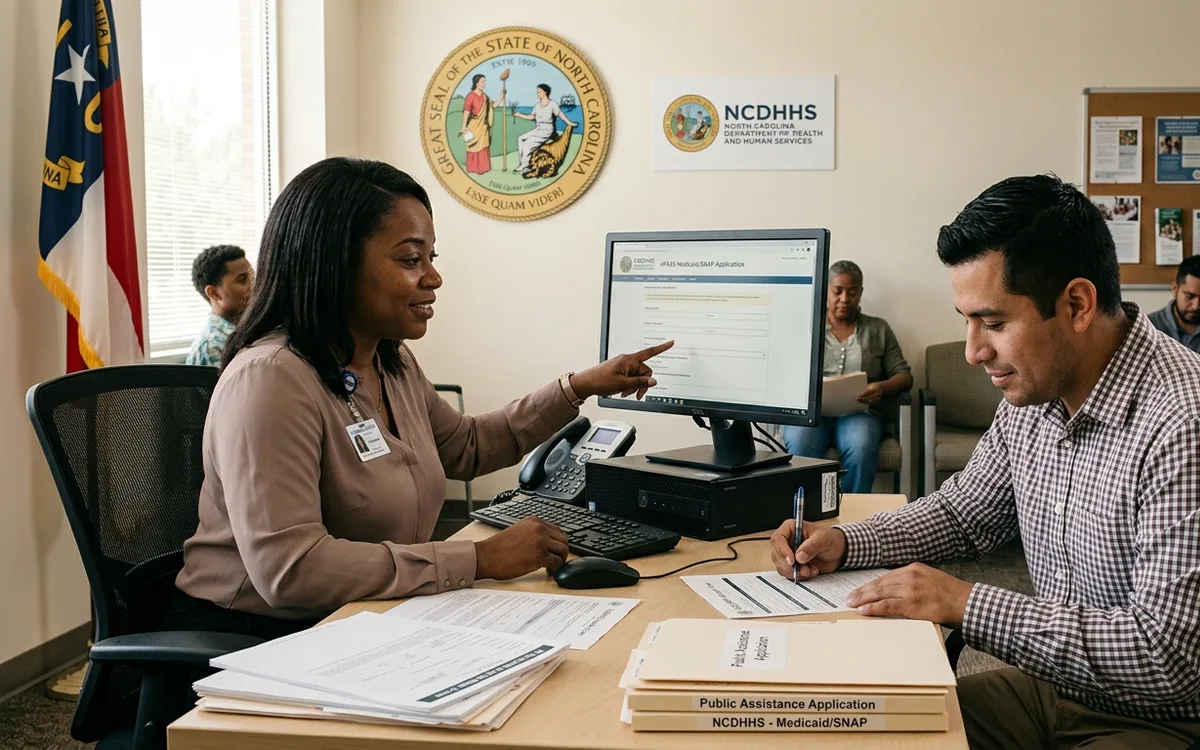
Your daughter was born here. She has a fever that won't break, and the county Medicaid office is five minutes from your apartment. You are also a lawful permanent resident still waiting on a background check update, and somewhere you read that filling out that Medicaid form could get you reported to ICE.
That fear is common in North Carolina immigrant households right now, and it has a specific source: a Department of Justice legal opinion reinterpreting a 1996 welfare law most people have never heard of. The opinion does not change what North Carolina's county benefits offices do day to day. It does change how federal lawyers argue about state reporting duties in court, and that distinction matters enough to get right before you decide whether to apply.
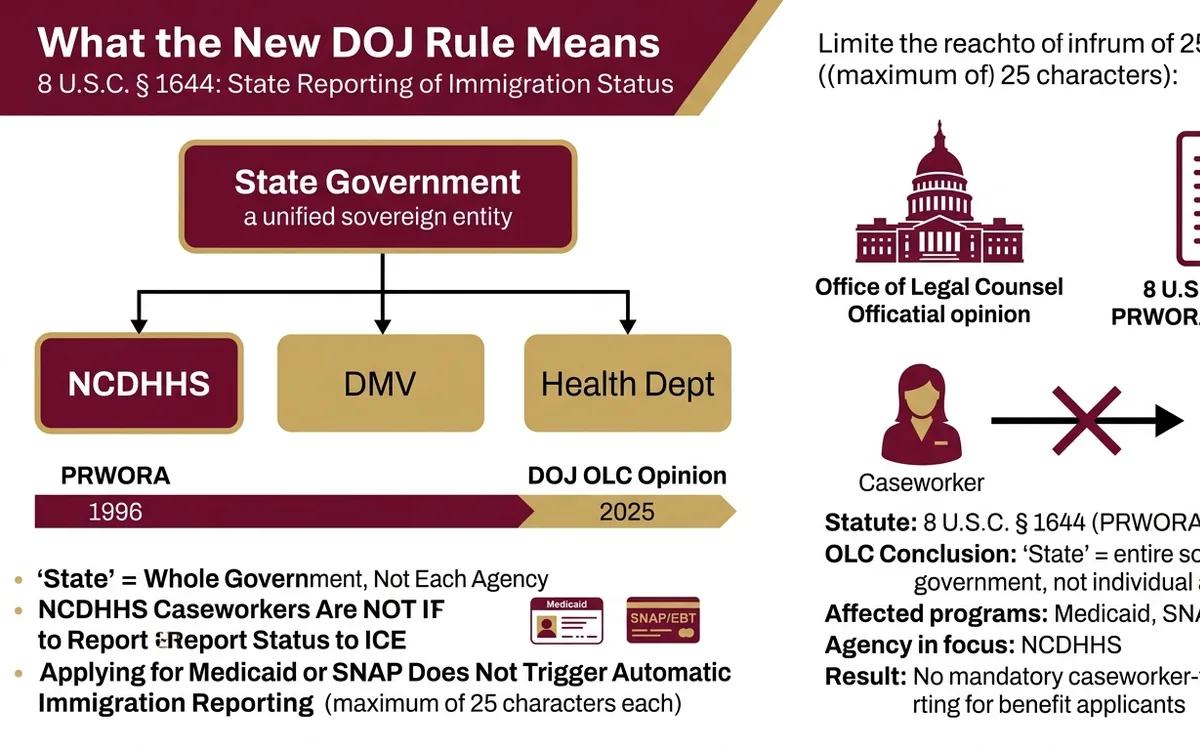
A DOJ Office of Legal Counsel opinion reinterprets 8 U.S.C. § 1644 (PRWORA Section 404), the law letting states report immigration status to federal agencies. OLC concludes 'State' means the entire sovereign government, not each agency separately. This does not force NCDHHS caseworkers to report your status to ICE when you apply for Medicaid or SNAP.
The Hard Truth
What the DOJ Opinion Actually Says
Section 404 of the Personal Responsibility and Work Opportunity Reconciliation Act of 1996 (Pub. L. No. 104-193, § 404, 110 Stat. 2105), codified at 8 U.S.C. § 1644, says no state may be restricted by any other state law from sending the federal government information about a person's immigration or citizenship status. In an opinion titled 'Reconsidering State Reporting Requirements in Section 404 of the Personal Responsibility and Work Opportunity Reconciliation Act of 1996' (available at justice.gov/olc), the DOJ Office of Legal Counsel concluded that 'State' in that statute means the entire sovereign government, not each individual state agency acting on its own.
That is a narrower point than headlines suggest. Section 404 has always been permissive language: it stops a state from banning its own agencies from sharing immigration information with federal authorities. It does not, on its own, order a county Department of Social Services caseworker to look up your immigration status and hand it to ICE when you file a Medicaid application. That duty would have to come from somewhere else, and right now it does not exist in North Carolina's benefits intake process.
Section 404 Is Not Section 1373, and the Difference Matters
A separate statute, 8 U.S.C. § 1373, bars state and local governments from restricting communication with federal immigration authorities about a person's citizenship or immigration status. Courts have examined how far that statute reaches, including in City of El Cenizo v. Texas, 890 F.3d 164 (5th Cir. 2018), which upheld a Texas law requiring local cooperation with federal detainers. Section 404 sits next to that body of law but serves a different function: it protects a state's ability to report, it does not require NCDHHS to build a reporting pipeline to ICE out of your benefits file.
What This Firm Cannot Promise You
We cannot tell you how a specific Mecklenburg County or Wake County DSS caseworker will handle your file years from now if federal guidance keeps shifting. OLC opinions interpret existing law; they are not binding regulations, and they do not rewrite NCDHHS's SAVE verification procedures under 42 C.F.R. § 435.956. What the opinion does signal is that the Department of Justice is laying groundwork for broader information-sharing arguments in future litigation or agency guidance. That is worth knowing before you decide what to put on a form, even though it changes nothing about today's intake process.
What Happens If You Wait
What Waiting, or Guessing, Actually Costs
Fear of a hypothetical reporting duty has a real cost. A U.S. citizen child who qualifies for Medicaid goes without a wellness visit or an asthma inhaler refill because a parent delayed the application. That harm is immediate and has nothing to do with the parent's own immigration case.
There is also a procedural cost. When USCIS's SAVE Program cannot confirm your status automatically (Step 1), NCDHHS must request additional verification (Step 2), which the SAVE Program generally completes within 3 to 10 federal working days, according to USCIS's published SAVE service standards. If you do not respond to NCDHHS's request for documents during that window, the agency can deny the application for failure to verify, not because you were actually ineligible.
If you have a pending adjustment of status or asylum application, a denial letter that misstates which benefit you applied for, or an incorrect assumption about public charge exposure, can end up shaping how you answer a later USCIS request. The current public charge rule at 8 C.F.R. §§ 212.21 to 212.23 (effective December 23, 2022) excludes Medicaid, SNAP, and most non-cash benefits from the public charge test entirely, but a Request for Evidence that raises the issue anyway can take months to resolve while your case sits. None of this is about the DOJ opinion. It is about ordinary administrative deadlines that do not pause because a reader is worried about an unrelated legal theory.
Step-by-Step Process
Step by Step: Applying for Benefits in North Carolina Without Jeopardizing an Immigration Case
Identify your actual immigration category first: lawful permanent resident, refugee, asylee, someone with a pending application, or a household with mixed status. Eligibility differs sharply by category under 8 U.S.C. §§ 1612 and 1613, and this step determines everything that follows.
Confirm who in the household actually needs to disclose status. Under 42 C.F.R. § 435.945(j), only the individual seeking coverage must provide a Social Security number or immigration documentation. A citizen child's Medicaid application does not require a parent to disclose the parent's own status.
File the application with your county Department of Social Services, through NCDHHS's Division of Social Services, which administers Medicaid and SNAP intake statewide.
NCDHHS runs an automatic SAVE Program check (Step 1) through USCIS. Most status confirmations happen instantly at this stage.
If Step 1 cannot confirm your status, often because of a name change, a recently issued card, or a data entry error, NCDHHS submits a Step 2 additional verification request to USCIS. Respond to any document request from your caseworker right away.
If SAVE still cannot confirm your status, federal regulation requires NCDHHS to give you a reasonable opportunity to submit other evidence before denying the application, under 42 C.F.R. § 435.956(d). Keep a copy of your green card, EAD, or I-94 record ready to submit.
If the application is denied, you have the right to request a state fair hearing within the deadline printed on your denial notice. Read that notice closely and calendar the deadline the day it arrives.
If you have a pending USCIS matter, such as adjustment of status, asylum, or a DACA renewal, talk to an immigration attorney before responding to any request for evidence that references a benefits application. A SAVE mismatch and a public charge question are handled differently, and mixing them up can slow down both.
A Real-World Example
A Composite Example: the SAVE Mismatch
Consider a composite, not a real client: a lawful permanent resident we will call Marisol applied for NC Medicaid for her two-year-old, a U.S. citizen. Marisol's own green card had been reissued the prior year after a legal name change following her marriage, and the name on USCIS's SAVE database still reflected her maiden name.
NCDHHS's Step 1 automated check could not confirm her status under the new name, so the caseworker submitted a Step 2 request to USCIS. Marisol received a letter asking her to submit a copy of her green card and marriage certificate within a set number of days. She brought both documents to her county DSS office in person rather than mailing them, and asked the caseworker to confirm receipt in writing.
Her child's eligibility determination did not depend on Marisol's own immigration status at all, since only the applicant, the child, needed to be verified. The case moved through NCDHHS's standard verification timeline, and Marisol's attorney reviewed the file only to confirm that no incorrect reporting language appeared in any notice. This scenario shows the mechanism: document mismatch, Step 2 request, documentary cure. It says nothing about whether any particular application was approved.
William J. Vasquez leads the immigration practice at this firm. He is admitted to the North Carolina State Bar and to the bars of the U.S. Courts of Appeals for the Fourth, Fifth, and Eleventh Circuits, and has focused his practice on federal immigration law, including matters that intersect with public benefits eligibility and SAVE Program verification disputes. Read his full background at our attorney profile page.
Our immigration team tracks DOJ Office of Legal Counsel opinions, USCIS policy manual updates, and NCDHHS administrative procedure changes as part of ongoing case preparation, not as a one-time read. This page was reviewed by our editorial team and reflects guidance current as of the publication date above.
Key Terms Explained
Section 404 (8 U.S.C. § 1644)
A provision of the 1996 federal welfare law (Pub. L. No. 104-193, 110 Stat. 2105) stating that no state may be restricted from sending the federal government information about a person's citizenship or immigration status.
SAVE Program
The Systematic Alien Verification for Entitlements Program, run by USCIS, which state benefits agencies use to confirm an applicant's immigration status electronically under 42 C.F.R. § 435.956.
Step 1 / Step 2 Verification
Step 1 is SAVE's instant automated database check. Step 2 is an additional manual verification request a caseworker submits when Step 1 cannot confirm status, generally completed within 3 to 10 federal working days per USCIS's published SAVE standards.
Public Charge
A ground of inadmissibility under 8 U.S.C. § 1182(a)(4), evaluated under the current DHS rule at 8 C.F.R. §§ 212.21 to 212.23, which excludes Medicaid, SNAP, and most non-cash benefits from consideration.
Office of Legal Counsel (OLC)
A division within the Department of Justice that issues legal opinions interpreting federal statutes for other executive branch agencies. OLC opinions guide federal legal positions; they are not regulations and do not bind state agencies directly.
Fair Hearing
An administrative appeal process a benefits applicant can request after a denial, with a deadline stated on the denial notice itself.
Board of Immigration Appeals (BIA)
The administrative body that reviews decisions from immigration judges. It is separate from benefits eligibility disputes, which go through state fair hearing processes instead.
Frequently Asked Questions
Q: Does applying for Medicaid or SNAP in North Carolina get reported to ICE? A: Section 404 of PRWORA (8 U.S.C. § 1644) permits states to share immigration information with federal agencies, but it does not require NCDHHS caseworkers to report your status to ICE as part of ordinary Medicaid or SNAP intake. NCDHHS's role in verification is limited to confirming eligibility through USCIS's SAVE Program under 42 C.F.R. § 435.956.
Q: Will a SAVE Program mismatch automatically deny my application? A: No. If USCIS's SAVE Program cannot confirm your status through its automated check or an additional verification request, federal regulation requires NCDHHS to give you a reasonable chance to submit documentary evidence, such as a green card or EAD, before any denial under 42 C.F.R. § 435.956(d).
Q: Does receiving Medicaid or SNAP affect my pending green card or naturalization case? A: Under the current public charge rule at 8 C.F.R. §§ 212.21 to 212.23, effective December 23, 2022, Medicaid, SNAP, and most non-cash benefits are excluded from the public charge test entirely. Public charge review applies mainly to a narrower set of cash assistance and long-term institutional care programs.
Q: What is the difference between 8 U.S.C. § 1373 and Section 404 of PRWORA? A: Section 1373 restricts state and local governments from limiting communication with federal immigration authorities about status, and was examined in City of El Cenizo v. Texas, 890 F.3d 164 (5th Cir. 2018). Section 404 is a narrower, benefits-specific provision addressing a state's ability to report, not a mandate that a specific agency must do so.
Clients who come to us after a confusing NCDHHS notice or a SAVE verification letter consistently describe the same relief: having someone read the actual document with them before they respond to it. We do not publish outcome statistics for immigration matters; federal agency decisions depend on facts specific to each case, and no law firm can promise a result in advance. What we can describe factually is the volume of these matters our team has handled across North Carolina, from benefits-related inquiries to removal defense before the Charlotte Immigration Court.
If you are holding a NCDHHS notice, a SAVE verification letter, or a USCIS Request for Evidence that mentions a public benefits application, the next useful step is reading it with someone who can tell you which statute actually applies to your situation. Most of these letters are solvable with a document, not a lawsuit.
Our immigration team offers consultations to review NCDHHS correspondence, SAVE Program verification issues, and how a pending benefits application interacts with an adjustment of status, asylum, or naturalization case. Schedule a consultation with our team to go through your specific notice and deadline before you respond to it.
- Public Charge Rules and Immigration Eligibility (/immigration/public-charge)
- Adjustment of Status: Step-by-Step Process (/immigration/adjustment-of-status)
- Removal Defense Before the Charlotte Immigration Court (/immigration/removal-defense)
- Understanding the SAVE Program and USCIS Verification (/immigration/save-program-verification)
- NC Medicaid and SNAP Denials: Appeal Rights (/immigration/public-benefits-appeals)