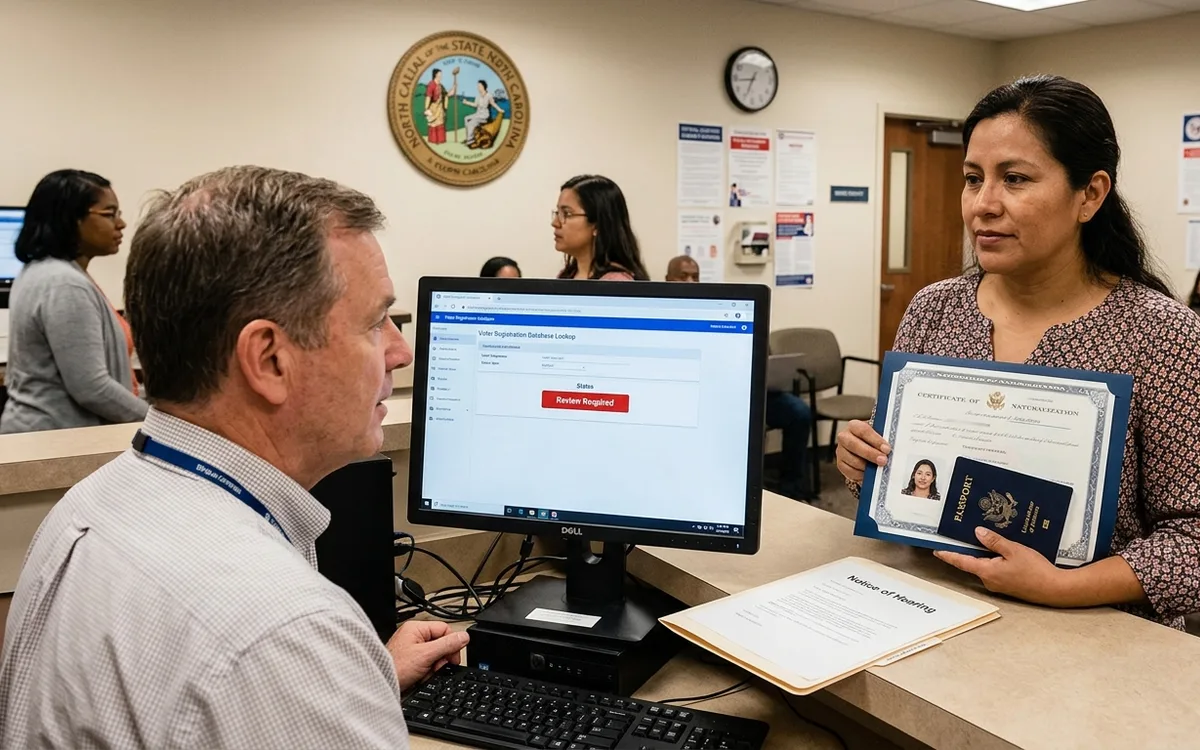
The letter arrived with a county seal, and your stomach dropped. You took the oath. You have the certificate. Now a notice from the Board of Elections says your registration is being challenged because a database says you might not be a citizen.
You are not imagining the fear. Seeing the word "noncitizen" attached to your name in any government document, after you worked for years to become a citizen, is disorienting. The notice rarely explains why a federal database and your actual status disagree. It just sets a clock running.
Here is what matters right now: this is a voter-registration list-maintenance challenge under North Carolina election law, not a reopening of your citizenship. It has a deadline you can meet, and the documents you need already exist. You just need to find them before the clock runs out.
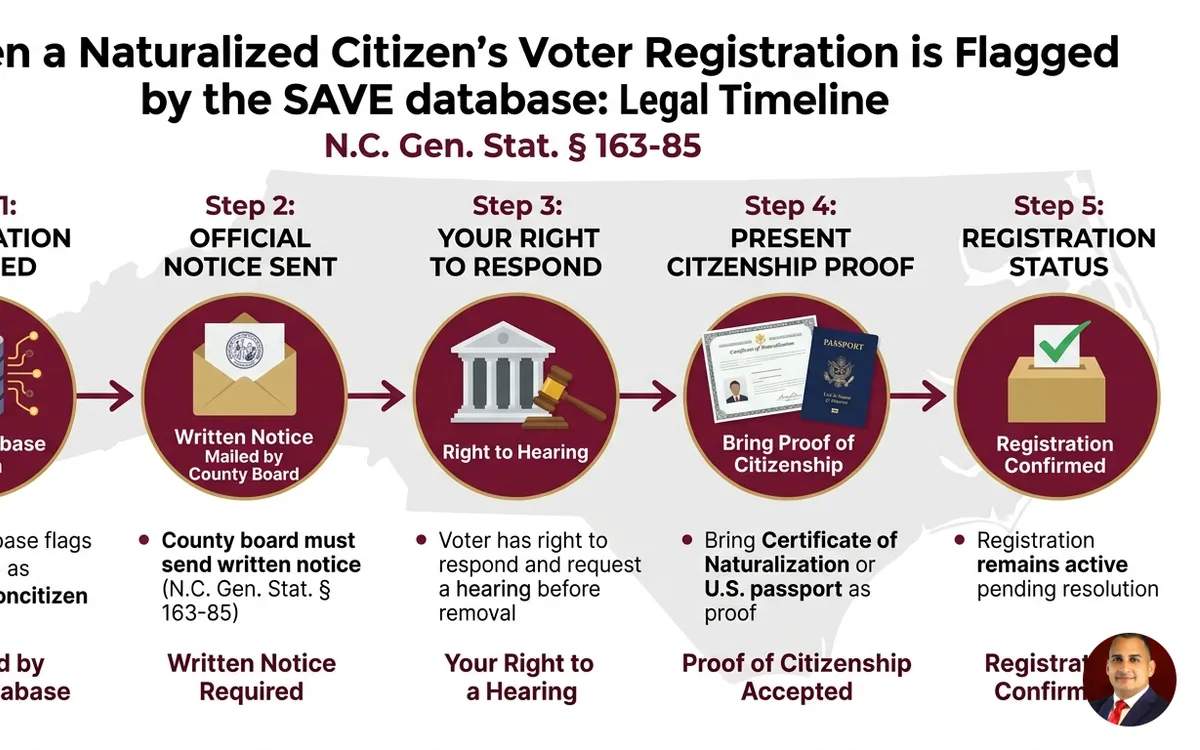
If North Carolina's SAVE database flags your voter registration as a noncitizen after you naturalized, you still have the right to respond before removal from the rolls. Under N.C. Gen. Stat. § 163-85, county boards must send written notice and allow a hearing. Contact your county board immediately and bring your Certificate of Naturalization or U.S. passport.
The Hard Truth
Does a Voter Challenge Put Your Citizenship at Risk?
No. A SAVE database mismatch does not reopen your naturalization case or put your citizenship status in jeopardy by itself. But that is not permission to ignore the notice. The challenge is a real proceeding under North Carolina election law, and the county board has no obligation to resolve doubt in your favor if you never show up with proof.
Most of these mismatches trace back to a lag between your oath ceremony and when USCIS's own records update, not to anything you did wrong. USCIS's Processing Times page lists the N-400 median processing time for the Charlotte Field Office at 5.1 months as of its October 2025 update (USCIS, Check Case Processing Times). Election officials have told Democracy NC that the SAVE system itself can trail an oath ceremony by additional weeks to months, and that gap identified at least 61 naturalized citizens across nine North Carolina counties who received list-maintenance challenge notices ahead of the November 2024 general election (Democracy NC, "Caught in the Gap," 2024).
One more wrinkle: the National Voter Registration Act's 90-day rule (52 U.S.C. § 20507(c)(2)) blocks a state from running systematic bulk purges within 90 days of a federal election, but it does not stop an individual, name-specific challenge like the one you received. A challenge filed against you personally can still move forward right up to the eve of an election.
The blunt part: the burden, in practice, falls on you to produce the Certificate of Naturalization, a naturalization certificate number, or a valid U.S. passport. A county board volunteer reviewing your file does not have access to your USCIS A-file. If you cannot produce paperwork fast, the clock keeps running regardless of who is actually right.
What Happens If You Wait
What Happens If You Miss the Response Deadline?
Miss the response window in the notice, typically 10 days under N.C. Gen. Stat. § 163-86, and the county board can remove you from the voter rolls without a hearing. That removal does not announce itself. It shows up months later, when a poll worker tells you that your name is not on the list.
Re-registering after a removal takes time you may not have before an election. North Carolina's registration deadline is 25 days before election day under N.C. Gen. Stat. § 163-82.6. A removal close to that window can cost you a vote in that specific election, outside of North Carolina's narrower same-day registration period during early voting.
There is a second cost that matters more for some readers. If you have a pending immigration filing, an I-131 travel document application, an I-765 work permit renewal, or a family petition, an unresolved voter-eligibility dispute sitting in a county file is a paper trail you do not want open when USCIS or an immigration court later reviews your record. It is unlikely to trigger enforcement on its own. It is still one more document a reviewing officer could misread, and misreadings cost time you will not get back.
Step-by-Step Process
What Are the Steps After You Receive a SAVE Challenge Notice in North Carolina?
Read the notice for the deadline date and the county board's name. Each of North Carolina's 100 county boards of elections handles challenges separately, and the clock starts on the date the notice was mailed, not the date you open it.
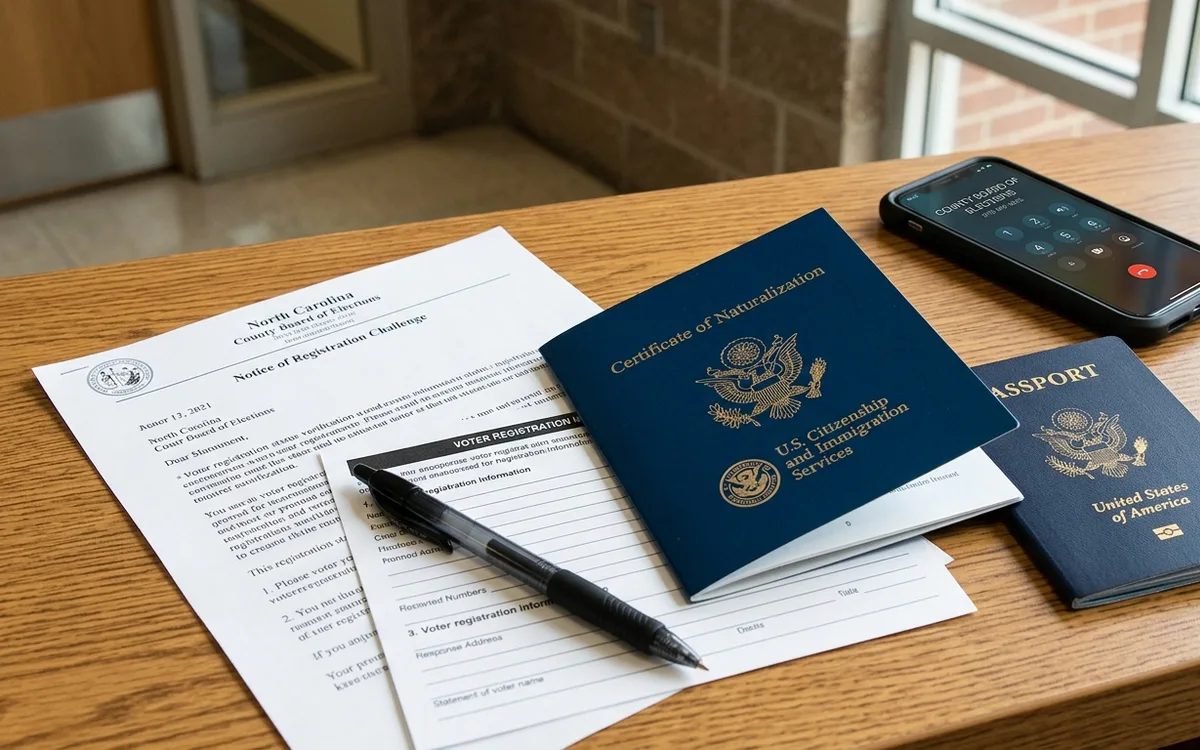
Locate your Certificate of Naturalization (USCIS Form N-550) or your N-400 approval notice. If you cannot find it, request a replacement using USCIS Form N-565, or check your filing status through USCIS's online case status tool while you gather other proof, such as a current U.S. passport.
Submit a written response to the county board before the deadline, referencing N.C. Gen. Stat. § 163-85. Attach a copy, never the original, of your naturalization certificate or passport. Send it by certified mail or hand-deliver it with a receipt, so you can prove when you responded if the county later disputes the date.
If the board schedules a hearing, attend it. Bring the original documents along with your copies. A family member, or legal counsel where the matter is complicated, can attend with you.
If the county board rules against you, you can appeal to the North Carolina State Board of Elections. Keep every piece of mail and every confirmation number from this point forward.
If the challenge overlaps with a pending USCIS matter, including an Application for Travel Document (Form I-131) or an Application for Employment Authorization (Form I-765) filed through the service center handling applicants in the USCIS Charlotte Field Office's jurisdiction, flag both matters together. Our naturalization and citizenship services page outlines how we sequence overlapping filings so one does not stall the other.
If the dispute touches anything beyond a simple list-maintenance mismatch, including a prior removal order or a question about the naturalization itself, it is no longer only a voting-rights issue. That becomes a removal defense matter under 8 U.S.C. § 1229a, and it needs attention from someone who handles EOIR filings, not just election law.
A Real-World Example
A Composite Example: Responding to a List-Maintenance Challenge in Mecklenburg County
The following is a composite built from the kind of fact pattern our team sees, not a specific client. Any resemblance to an actual person is coincidental.
A woman naturalized in Charlotte in March, after her oath ceremony at the USCIS Charlotte Field Office. She registered to vote that same week. In August, a list-maintenance review flagged her file because the SAVE database had not yet reflected her updated status, a lag several county boards have reported to the North Carolina State Board of Elections.
She received a mailed notice giving her 10 days to respond under N.C. Gen. Stat. § 163-86. She located her Certificate of Naturalization, made a copy, and submitted a written response with a certified-mail receipt before the deadline. Because the county's process schedules a hearing only when a response is incomplete or contested, her documented response moved her file into the board's regular review queue rather than a hearing docket.
Her case shows the mechanism, not a guaranteed result. Response quality and timing matter. A hearing date, a county's internal backlog, and that county's specific practice can all change how long a file takes to close.
William J. Vasquez focuses his practice on federal immigration matters, including naturalization, employment authorization, and the kind of status-verification disputes that surface when county election officials check the SAVE database. Immigration practice is federal regardless of state bar lines. His authority to appear before USCIS and the Executive Office for Immigration Review (EOIR) comes from federal immigration-bar standing under 8 C.F.R. § 1292.1, which allows an attorney in good standing to represent clients before USCIS and immigration courts nationwide.
Our team has handled a number of matters for naturalized clients in North Carolina whose voter registrations were challenged or questioned because of a SAVE database mismatch, coordinating the county board response with whatever federal immigration filing was happening at the same time. We describe this as handled matters, not outcomes. The county board, not this firm, decides each challenge.
If your situation involves both a voter challenge and an open USCIS filing, mention both when you schedule a consultation. Sorting out which deadline controls first is often the difference between a clean response and a missed one.
Key Terms Explained
What Do These Immigration and Election Terms Mean?
SAVE (Systematic Alien Verification for Entitlements): A Department of Homeland Security database that government agencies, including county boards of elections, can check to verify a person's immigration or citizenship status.
List-maintenance challenge: A formal process under the National Voter Registration Act (52 U.S.C. § 20507) and North Carolina law (N.C. Gen. Stat. § 163-82.14) that allows a county board to review, and potentially remove, a voter's registration based on an eligibility question.
Certificate of Naturalization (USCIS Form N-550): The document USCIS issues after your oath ceremony proving you are a U.S. citizen by naturalization.
N-400: USCIS's Application for Naturalization, the form that starts the process of becoming a U.S. citizen.
County Board of Elections: The local government body in each of North Carolina's 100 counties responsible for voter registration, list maintenance, and election administration.
EOIR (Executive Office for Immigration Review): The Department of Justice agency that runs the federal immigration courts, including the Charlotte Immigration Court, separate from USCIS and separate from any state election process.
Frequently Asked Questions
Q: Can a voter registration challenge affect my immigration status or a pending green card application? A: Generally no. A county election board's list-maintenance challenge is a state election law process, not a USCIS or immigration court proceeding, and it does not by itself reopen your naturalization. It can still create a confusing paper trail, so resolve it with documentation instead of ignoring it.
Q: How long does it take for the SAVE database to reflect my naturalization after my oath ceremony? A: USCIS does not publish a fixed turnaround for SAVE updates specifically, and county election officials have reported real-world lags of several weeks to a few months after an oath ceremony, according to guidance the North Carolina State Board of Elections has given county boards. Keep your Certificate of Naturalization accessible during this window.
Q: What should I bring to a county board hearing on a citizenship-based voter challenge? A: Bring your original Certificate of Naturalization or a current U.S. passport, plus a copy to leave with the board. If you cannot locate your certificate, request a replacement using USCIS Form N-565 before the hearing date if time allows.
Q: Is it a crime for a noncitizen to register or vote in North Carolina? A: Yes. Federal law makes it a crime for a noncitizen to vote in a federal election (18 U.S.C. § 611), which is part of why county boards take SAVE mismatches seriously even when the underlying cause is a database lag rather than an actual ineligible registration.
Q: Where can I check my immigration case status while I gather documents for a challenge response? A: USCIS's online case status tool, accessible through the USCIS website with your receipt number, shows the current status of a pending N-400, I-765, or I-131 filing, which can help you document timing if your naturalization is recent.
Clients come to our team after a government notice they did not expect, whether that is a SAVE-database voter challenge, a Notice to Appear, or a USCIS denial. We describe our work the way we would want it described to us: by what we handled, not by a promised result. Our team has handled naturalization matters, employment authorization filings, and status-verification disputes for clients across North Carolina, including matters coordinated with the USCIS Charlotte Field Office and the Charlotte Immigration Court.
We do not publish outcome statistics, because case results depend on facts, documents, and decision-makers outside any firm's control, not on marketing claims. What we can tell you is how the process works and what we will do at each step.
A notice with a deadline does not wait for you to feel ready. If you are holding a list-maintenance challenge letter right now, the most useful thing you can do today is find your Certificate of Naturalization or your passport and confirm the exact date your county board set for a response.
If anything about your situation is more complicated than a straightforward SAVE lag, a prior removal order, a name mismatch, a pending immigration filing, or a pattern of challenges in your county, it is worth talking through with someone who handles both sides of this problem.
Our team handles naturalization filings, SAVE-database status disputes, and the federal immigration matters that sometimes overlap with a county voter challenge. Schedule a consultation with our immigration team to review your notice, your deadline, and your documentation before you respond to your county board of elections.
- /immigration/naturalization-n-400
- /immigration/removal-defense
- /contact
- /locations/charlotte-nc
- /locations/raleigh-nc