You already hold U.S. citizenship. You got it automatically, the day your parent naturalized or the day you were born abroad to a citizen parent, depending on your situation. Nobody granted it to you at a ceremony. No judge swore you in.
The problem shows up later. A passport office asks for proof you don't have. An employer's E-Verify check flags a mismatch and your start date slips. You call USCIS and the person on the phone has never heard the phrase 'derivative citizenship.'
That gap, between the citizenship you hold and the citizenship you can prove on paper, is what Form N-600 exists to close. It is a paperwork problem with a legal structure behind it, not a new application for status you don't already have.
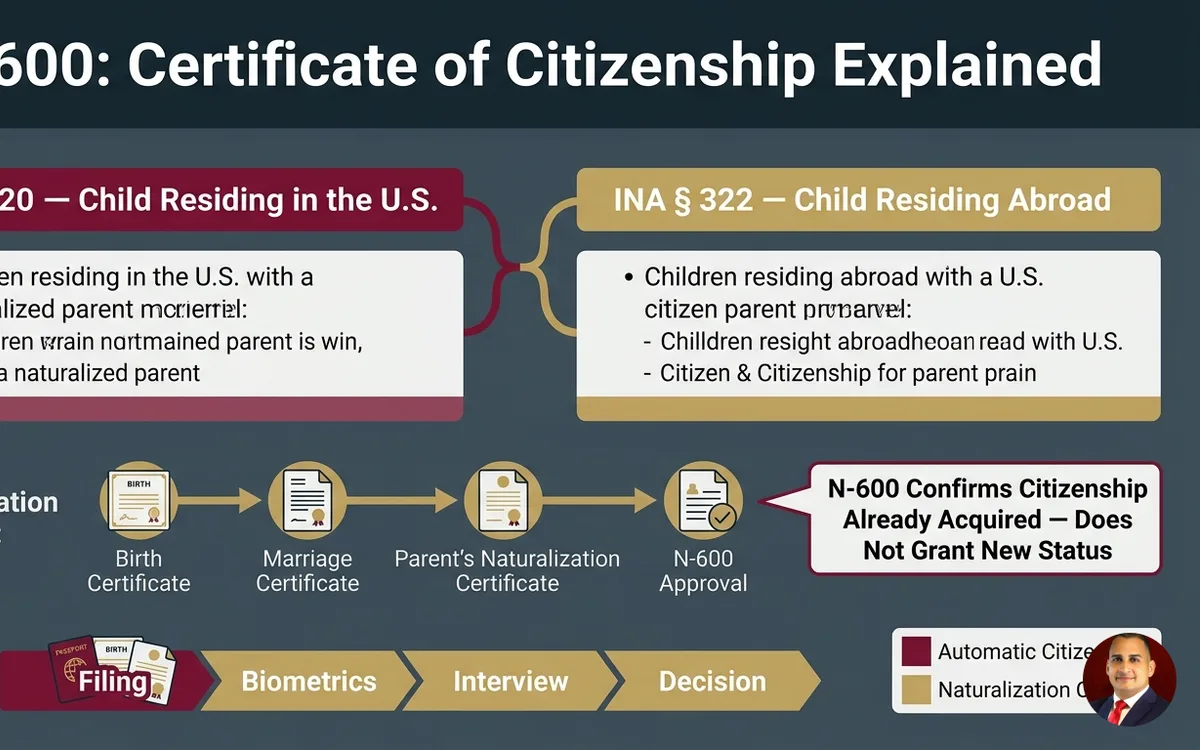
An N-600 Certificate of Citizenship proves citizenship you already acquired automatically, usually through a parent's naturalization under INA § 320 or by birth abroad under INA § 322. It does not grant new status. USCIS requires birth, marriage, and naturalization records showing the full parent-child chain before approving the application.
The Hard Truth
USCIS does not take your word for it. An adjudicator reviewing your N-600 has to see the full documentary chain, your birth certificate, your parents' marriage certificate or a legitimation record if they weren't married, your parent's naturalization certificate, and proof your parent held lawful permanent resident status before naturalizing, all lining up with the exact timing rules in INA § 320(a).
Most of these documents are decades old. A naturalization certificate number gets lost. A divorce decree that would prove which parent had legal custody never gets filed with the right county. In Tuan Anh Nguyen v. INS, 533 U.S. 53 (2001), the Supreme Court upheld Congress's authority to impose exacting proof requirements for exactly this kind of claim, particularly where a parent's marital status or custody arrangement is part of the chain.
If your parent naturalized after you turned 18, the Child Citizenship Act of 2000 generally does not reach back to cover you under INA § 320. That cutoff surprises a lot of adult applicants, and no amount of good documentation changes a hard age-based rule.
What Happens If You Wait
A stalled N-600 does not just sit in a drawer while you wait for a better time to deal with it. A passport application can be suspended pending proof of citizenship, which means a sick relative abroad or a job that requires travel has to wait on paperwork instead of on you.
An E-Verify mismatch at a new job can cost you the job within days, not months, because employers are not required to wait while you sort out old records. REAL ID-compliant license renewals at some NC DMV offices now ask for the same proof.
The records themselves get harder to find every year. A parent or grandparent who could sign an affidavit about your custody arrangement, or who remembers which county recorded a legitimation, is not getting younger. Vital records offices purge or transfer older files, and county courthouses lose paper divorce decrees in ways that are never your fault and always your problem to fix.
Step-by-Step Process
Step 1: Confirm which statute actually applies to you. INA § 320(a) covers children who were under 18 and residing in the U.S. in a parent's legal custody when that parent naturalized. INA § 322 covers children who acquired citizenship while living abroad with a citizen parent. Picking the wrong basis is the single most common cause of an avoidable denial.
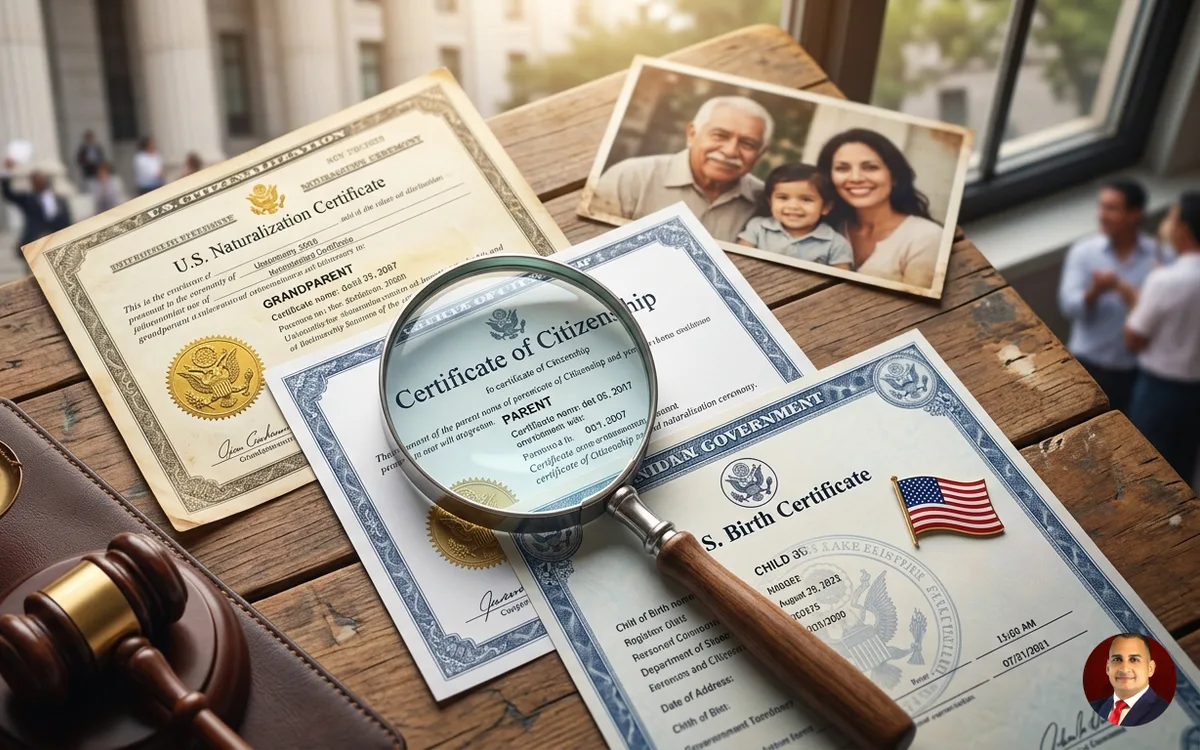
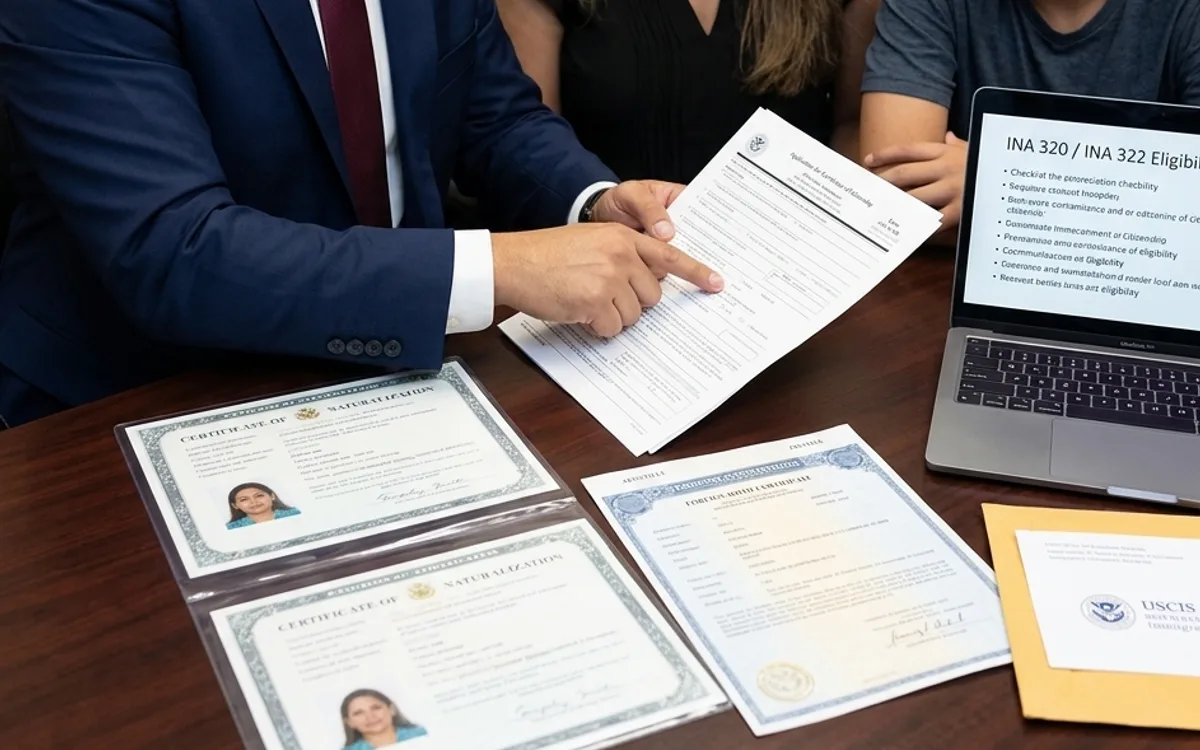
Step 2: Assemble the documentary chain before you file. This typically means your birth certificate, your parents' marriage certificate (or a legitimation or sole-custody order if they were never married), your citizen parent's naturalization certificate or certificate of citizenship, and evidence your parent held lawful permanent resident status before naturalizing.
Step 3: File Form N-600 with USCIS. The current base filing fee is $1,170 when filed online, per USCIS's 2024 fee schedule under 8 C.F.R. § 106.2, unless you qualify for a fee waiver.
Step 4: Attend biometrics. North Carolina applicants are typically scheduled at the USCIS Application Support Center on Arrowpoint Boulevard in Charlotte.
Step 5: Attend the interview if USCIS requires one. The Charlotte Field Office waives interviews in some N-600 cases based on the strength of the paper record, but it is the officer's call, not yours.
Step 6: Receive a decision. An approval results in a Certificate of Citizenship. A denial notice will state the specific ground, which matters for what comes next.
Step 7: If denied, you generally have two paths. You can refile with new or corrected evidence addressing the stated ground for denial, or you can file an action for a declaratory judgment of citizenship under 8 U.S.C. § 1503(a) in federal district court, under the procedure set out in Fed. R. Civ. P. 57. For North Carolina residents, that suit is filed in the U.S. District Court for the Western District of North Carolina or the Eastern District of North Carolina, depending on where you live.
A Real-World Example
Consider a composite situation built from the kind of records problems that come up often. Call her Daniela, born abroad in the late 1980s to an unmarried U.S. citizen father and a mother who never naturalized. Daniela's father naturalized when she was 15, but the family never filed anything with USCIS at the time, and nobody kept the original naturalization certificate.
The first step was reconstructing the chain. Daniela requested a certified copy of her birth certificate from the foreign civil registry, then worked with the North Carolina Office of Vital Records in Raleigh to locate records tied to her father's later residence. Because her parents were never married, the file also needed a legitimation record showing her father had formally acknowledged paternity before her 18th birthday, a requirement that traces back to INA § 320(a) and the custody and acknowledgment rules discussed in Tuan Anh Nguyen.
With the naturalization certificate number unrecoverable from family records, the next step was a FOIA request to USCIS for her father's naturalization file, which took several months to return. Only after that record came back did the N-600 go in, along with a sworn affidavit from a relative addressing the custody arrangement during Daniela's childhood.
From filing to the biometrics appointment at the Charlotte Application Support Center took several months, which is typical for this stage of the process. What happens after biometrics, an interview, a request for more evidence, or a decision, depends on how completely the record answers USCIS's specific questions about timing and custody.
William J. Vasquez is admitted to the North Carolina State Bar and to the U.S. Court of Appeals for the Fourth Circuit, which covers federal appeals from the U.S. District Courts for the Western and Eastern Districts of North Carolina, the courts where a denied N-600 applicant in this state would bring a declaratory judgment action under 8 U.S.C. § 1503(a). Immigration matters before USCIS and the Board of Immigration Appeals are federal, so this work proceeds under federal immigration-bar standing rather than a state-specific license.
He is a member of the American Immigration Lawyers Association and has spent years working through derivative and acquired citizenship claims, cases that turn on old birth records, foreign civil registries, and naturalization files that sometimes have to be reconstructed from scratch through FOIA requests to USCIS.
Our team has handled N-600 and N-600K filings across a range of family structures, including cases involving divorced parents, children born outside marriage, and parents who naturalized after a long gap in immigration paperwork. We describe that work by its volume and focus, not by a result we can promise before reviewing your documents.
Key Terms Explained
Form N-600: The USCIS application used to request a Certificate of Citizenship for someone who already acquired or derived U.S. citizenship automatically, rather than through the naturalization ceremony process.
Form N-600K: A related application for a child who currently resides outside the United States and is seeking to acquire citizenship through a U.S. citizen parent under INA § 322, before the child turns 18.
Derivative citizenship: Citizenship a child acquires automatically after birth, most commonly when a parent naturalizes while the child is still under 18 and in that parent's legal custody, under INA § 320(a).
Acquired citizenship: Citizenship a child is born with automatically, based on having one or more U.S. citizen parents at the time of birth, even if the birth occurred abroad.
Certificate of Citizenship: The federal document USCIS issues as proof of citizenship for someone who acquired or derived it automatically. It is distinct from a Certificate of Naturalization, which is issued to someone who went through the naturalization application and oath process themselves.
Child Citizenship Act of 2000 (CCA): The federal law that created the current automatic-citizenship rules under INA § 320 and § 322. It applies going forward from February 27, 2001, and generally does not reach back to cover someone who was already over 18 on that date.
8 U.S.C. § 1503(a): The federal statute allowing a person denied recognition as a U.S. national to sue in federal district court for a judgment declaring them to be a U.S. national, using the declaratory judgment procedure in Fed. R. Civ. P. 57.
Legitimation: A legal process or set of facts, varying by country and by era, that formally establishes a father's parental relationship to a child born outside marriage, often required to complete the custody and relationship elements of INA § 320(a).
Frequently Asked Questions
Q: My parent naturalized after I turned 18. Can I still get a Certificate of Citizenship? A: Generally no, not under INA § 320(a), which requires the child to be under 18 when the qualifying parent naturalizes. There are narrow exceptions tied to specific birth dates and prior versions of the law, so the exact dates matter.
Q: Is a Certificate of Citizenship the same as a Certificate of Naturalization? A: No. A Certificate of Naturalization is issued to someone who went through the naturalization application and oath themselves. A Certificate of Citizenship proves citizenship that was acquired or derived automatically, usually as a child, without any ceremony.
Q: What happens if USCIS denies my N-600? A: The denial notice states the specific ground for denial. You can refile with new evidence addressing that ground, or file suit in federal district court for a declaratory judgment of citizenship under 8 U.S.C. § 1503(a), using the procedure in Fed. R. Civ. P. 57.
Q: My father's naturalization certificate was lost decades ago. Can I still prove his status? A: Often yes, through a Freedom of Information Act (FOIA) request to USCIS for his historical naturalization file, or through certified copies from the court or USCIS office where he naturalized. This step takes time and should be started early.
Q: Do I need an interview for my N-600? A: Not always. The USCIS Charlotte Field Office waives interviews in some cases based on the completeness of the documentary record, but the decision belongs to the adjudicating officer.
Clients come to us after a passport office, an employer, or a benefits agency has already told them their paperwork isn't enough. What they consistently tell us afterward is that they finally understood why USCIS wanted what it wanted, and what the actual document chain was supposed to look like. We do not advertise outcome statistics for citizenship cases, because federal adjudicators decide these cases on a document-by-document basis, not by firm track record.
If a passport office or an employer has already flagged your citizenship as unproven, the first useful step is figuring out which statute actually applies to your situation and what's missing from your file. That assessment is specific to your parents' marital history, where you were born, and exactly when your parent naturalized.
Our team reviews N-600 and N-600K cases for people who already hold citizenship and need it documented, including cases involving missing naturalization records, divorced parents, or a prior denial. Schedule a consultation to go through your specific document chain and the statute that applies to your case before you file or refile.