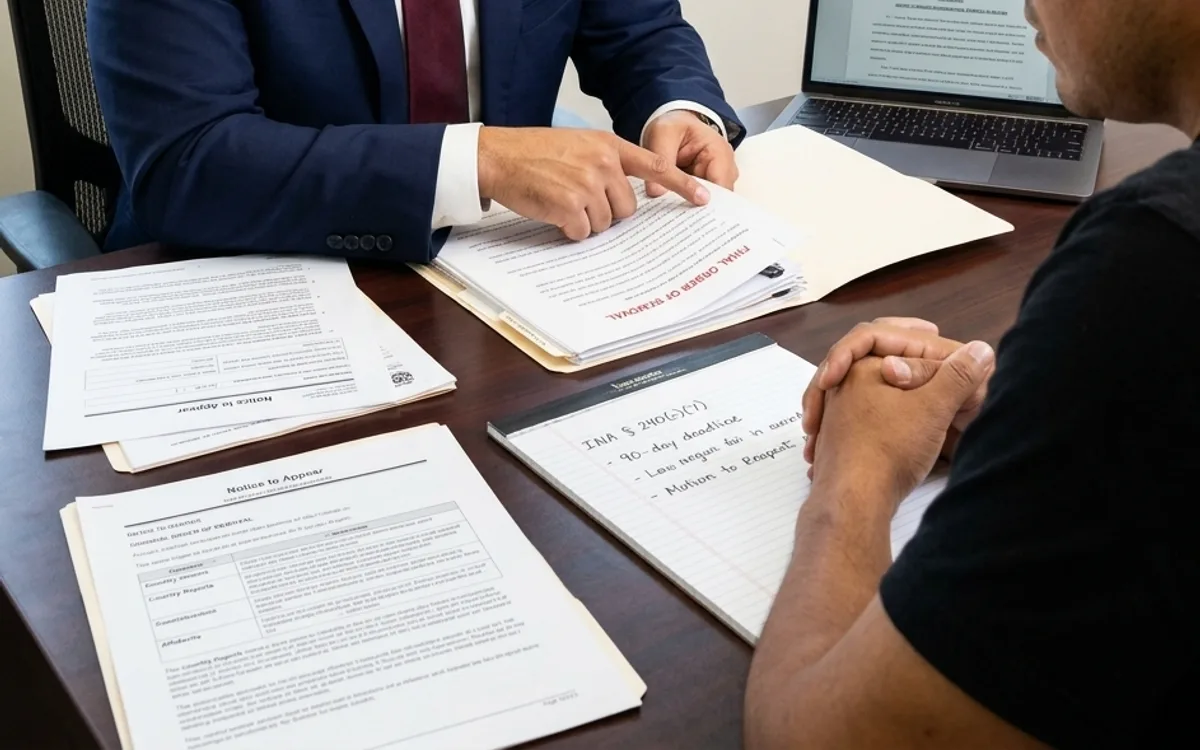
You already lost once. An immigration judge signed a removal order, maybe after a hearing you never knew about because the notice went to the wrong address, and that order now sits on your record as final. A motion to reopen is the one narrow door the law still leaves open, and it does not stay open long. You generally have 90 days from that order, or your case has to fit one of a short list of statutory exceptions, before the chance closes. This is not a second try at your old case. It is a request asking the court to look at something it never saw: new evidence, a country that has changed since your hearing, or a notice defect buried in the record.
A motion to reopen asks an immigration judge or the Board of Immigration Appeals to vacate a final removal order and reconsider new evidence. Under INA § 240(c)(7), you generally get one motion within 90 days, unless your case fits an exception for changed country conditions, lack of notice, or a timely joint motion with ICE.
The Hard Truth
## Most Motions to Reopen Get Denied Most motions to reopen do not succeed. EOIR's FY2023 Adjudication Statistics (https://www.justice.gov/eoir/page/file/statistics) show immigration judges grant only a minority of the motions filed nationwide each year, and TRAC Immigration at Syracuse University (https://trac.syr.edu/immigration/) has tracked similarly low grant rates across multiple years of case-by-case data. A decision on an appeal of a denied motion at the Board of Immigration Appeals commonly takes 12 to 18 months, based on EOIR's published case-processing figures. The numerical and time limits exist because Congress wanted finality, not a third or fourth chance. INA § 240(c)(7)(A) (https://www.law.cornell.edu/uscode/text/8/1229a) allows one motion to reopen per case, full stop, outside the recognized exceptions. File it late, file a second one without an exception, or file it without evidence the judge has not already reviewed, and it gets denied on procedural grounds before anyone reaches the merits of your claim. The Fourth Circuit Court of Appeals, which covers North Carolina, reviews a BIA denial of a motion to reopen under an abuse-of-discretion standard. That is one of the most deferential standards in federal law. It does not ask whether the BIA reached the best answer, only whether the BIA acted arbitrarily, and that gap matters for what a motion needs to look like before it is filed.
What Happens If You Wait
## What Happens If You Wait The removal order does not pause itself while you decide whether to call a lawyer. ICE Enforcement and Removal Operations, through its Charlotte Sub-Office, has legal authority to execute a final order the moment it is entered, with or without a new court date. Miss the 90-day deadline under INA § 240(c)(7)(C)(i), and your only way back in is proving a narrow exception: changed country conditions, a timely joint motion with ICE counsel, or a notice defect under 8 C.F.R. § 1003.23(b)(4)(ii) (https://www.ecfr.gov/current/title-8/chapter-V/subchapter-A/part-1003/subpart-C/section-1003.23). Miss those too, and the one-motion numerical limit in INA § 240(c)(7)(A) can shut the door unless you can show the filing falls outside it. Filing the motion itself does not stop removal. You need a separate, affirmative stay request (see our Stay of Removal page at /immigration/stay-of-removal), and ICE ERO Charlotte can act before the motion is ever decided if no stay is in place. Every week spent undecided is a week not spent gathering the new, material evidence the motion depends on, while the statutory clock keeps running regardless.
Step-by-Step Process
## Step-by-Step: Filing a Motion to Reopen Out of the Charlotte Immigration Court **1. Pull your full record first.** Before drafting anything, our team files a FOIA request with USCIS's National Records Center for your complete A-file. This often turns up the actual notice-of-hearing history, which matters directly if your claim is that you never received a Notice to Appear. **2. Confirm which legal theory fits.** Changed country conditions, lack of proper notice, ineffective assistance of prior counsel, or a joint motion with DHS counsel each carry different evidence requirements and different deadlines under INA § 240(c)(7). Picking the wrong theory is one of the most common reasons these motions get denied on arrival. **3. Build the evidentiary record.** A motion to reopen lives or dies on new evidence that was not available at the prior hearing. Country-condition claims need recent reports from the State Department, UNHCR, or similar sources, dated after your hearing. Notice claims need proof of your actual address on file with the court at the time the hearing notice was mailed. **4. For an ineffective-assistance claim, meet the Lozada showing.** Matter of Lozada, 19 I&N Dec. 637 (BIA 1988) (https://www.justice.gov/eoir/page/file/1328876/download) requires an affidavit describing the agreement with prior counsel, notice to that attorney with a chance to respond, and, where applicable, a bar complaint. Skipping any one of these pieces is a frequent, avoidable reason these motions fail. **5. E-file through ECAS.** Motions on cases pending before the Charlotte Immigration Court (5701 Executive Center Drive, Charlotte, NC) must go through EOIR's Immigration Court Online Filing system. Paper filings are not accepted for represented parties on ECAS-enrolled dockets. **6. File a separate stay request and notify ICE ERO Charlotte.** A motion to reopen does not pause removal on its own. A stay request goes in alongside it, and ICE ERO Charlotte needs formal notice once both are filed. **7. Wait on the decision.** Expect months, not weeks. A ruling from the immigration judge can come faster than a BIA appeal, which commonly runs 12 to 18 months per EOIR's published processing data. **8. If denied, know your next option.** A denial can go up to the BIA, and from there, in appropriate cases, to the Fourth Circuit Court of Appeals by petition for review. See our BIA Appeals page at /immigration/bia-appeals for how that process works.
A Real-World Example
Consider a composite drawn from matters like these, not an actual client. A man we will call Mr. T received a removal order in absentia from the Charlotte Immigration Court three years earlier. He had moved twice since his initial filing and never updated his address with the court, so the hearing notice went to an apartment he no longer lived in. The first step was a FOIA request to USCIS's National Records Center for his A-file, which confirmed the notice had gone to the old address and that no updated address was ever recorded. That record became the evidentiary core of a motion to reopen under 8 C.F.R. § 1003.23(b)(4)(ii), arguing lack of proper notice rather than reopening the underlying asylum claim itself. The motion was filed through ECAS on the Charlotte docket, with a separate stay request filed the same day and ICE ERO Charlotte notified immediately after. Mr. T then waited for a ruling, during which the stay request, not the motion itself, was what kept the removal order from being executed. This sequence, A-file first, correct legal theory second, stay request alongside the motion, reflects the actual mechanics of this kind of filing, regardless of how any individual case is ultimately decided.
William J. Vasquez handles removal defense matters before the Charlotte Immigration Court and the Board of Immigration Appeals, including motions to reopen built around notice defects, changed country conditions, and ineffective-assistance claims under Matter of Lozada. He is a member of the American Immigration Lawyers Association, whose practice advisories on motion-to-reopen strategy inform how our team approaches the evidentiary work before anything is filed. His practice has focused for years on the procedural side of removal defense, the motions, filings, and record-building that happen after a case has already gone wrong once. That includes the FOIA process for pulling a client's A-file, which is often the first concrete step toward identifying whether a notice defect or other procedural ground actually exists.
Key Terms Explained
## Key Terms **Motion to Reopen:** A request asking an immigration judge or the BIA to reconsider a final removal order based on new, material evidence not available at the original hearing. Governed by INA § 240(c)(7). **Motion to Reconsider:** A request arguing the judge or BIA made a legal or factual error based on the existing record, with no new evidence submitted. Governed by INA § 240(c)(6), with a 30-day deadline. **In Absentia Order:** A removal order entered because the respondent did not appear at a scheduled hearing. Can be rescinded under 8 C.F.R. § 1003.23(b)(4)(ii) if notice was improper or exceptional circumstances caused the absence. **Changed Country Conditions:** An exception to the 90-day filing deadline and numerical limit, available when conditions in the respondent's home country have materially changed since the prior hearing in a way relevant to asylum, withholding, or CAT claims. **Sua Sponte Reopening:** Reopening initiated at the immigration judge's or BIA's own discretion, outside the statutory motion process, available only in exceptional circumstances under the standard described in Matter of M-S-, 27 I&N Dec. 509 (A.G. 2019). **Numerical Bar:** The limit of one motion to reopen per case under INA § 240(c)(7)(A), subject to specific statutory exceptions. **A-File:** The U.S. government's complete administrative file on a noncitizen, maintained by USCIS and obtainable through a FOIA request to the National Records Center. **ECAS:** EOIR's Immigration Court Online Filing system, used for e-filing motions on dockets, including the Charlotte Immigration Court, that are enrolled in electronic filing. **Stay of Removal:** A separate, affirmative request to pause enforcement of a removal order while a motion or appeal is pending. Not automatic once a motion to reopen is filed.
Frequently Asked Questions
Q: How long do I have to file a motion to reopen? A: Generally 90 days from the date of the final removal order under INA § 240(c)(7)(C)(i). Changed country conditions, a timely joint motion with ICE counsel, and certain lack-of-notice claims under 8 C.F.R. § 1003.23(b)(4)(ii) are recognized exceptions to that deadline. Q: Does filing a motion to reopen stop my deportation? A: No, not by itself. You need a separate, affirmative stay of removal request filed alongside the motion, and ICE ERO Charlotte can still act if no stay is in place. Q: How many motions to reopen can I file? A: One per case under the numerical limit in INA § 240(c)(7)(A), unless your filing fits a recognized exception, such as changed country conditions or a joint motion with DHS. Q: What is the difference between a motion to reopen and a motion to reconsider? A: A motion to reopen presents new evidence not available before; a motion to reconsider argues the judge or BIA made a legal or factual error on the existing record. The deadlines differ too, 90 days for reopening versus 30 days for reconsideration under INA § 240(c)(6). Q: What does a motion to reopen based on ineffective assistance of counsel require? A: It requires the showing set out in Matter of Lozada, 19 I&N Dec. 637 (BIA 1988): an affidavit describing the agreement with prior counsel, notice to that attorney with an opportunity to respond, and, where applicable, a complaint filed against them. Q: How long does a motion to reopen take to decide? A: Timing varies by venue and judge, but a BIA appeal of a denied motion commonly takes 12 to 18 months based on EOIR's published case-processing data. An immigration judge's initial ruling on the motion itself can take considerably less time. Q: What happens if my motion to reopen is denied? A: You can appeal the denial to the BIA, and in appropriate cases, petition the Fourth Circuit Court of Appeals for review of the BIA's decision. See our BIA Appeals page for how that process works. Q: What does it cost to have an attorney file a motion to reopen? A: Fees depend on the complexity of the evidence needed, particularly whether an A-file FOIA request, country-conditions research, or a Lozada showing is required. We discuss fee structure directly during a consultation before any filing begins.
Clients who have worked with our immigration team describe direct communication about deadlines and what evidence a motion actually needs, not vague reassurance. Reviews on Google and Avvo reference responsiveness during time-sensitive filings and clear explanations of what a motion to reopen can and cannot do. We do not cite a star rating or outcome statistic here because neither reflects how an individual motion to reopen will be decided.
If you have a final removal order and think your case fits one of these narrow exceptions, the next right step is figuring out which one, backed by a real record, before anything gets filed. That assessment starts with pulling your A-file, not with guessing.
If you have a final removal order from the Charlotte Immigration Court or elsewhere and believe new evidence, a changed country, or a notice problem could support reopening your case, schedule a consultation with our immigration team to review your A-file and identify whether your facts fit INA § 240(c)(7) or 8 C.F.R. § 1003.23(b)(4)(ii). Call our Charlotte office or request a consultation through our Motion to Reopen intake at /immigration/motion-to-reopen/consultation before your filing window closes.
- Stay of Removal — /immigration/stay-of-removal
- BIA Appeals — /immigration/bia-appeals
- Asylum Law — /immigration/asylum
- Attorney William J. Vasquez — /attorneys/william-j-vasquez
- Contact Our Immigration Team — /contact