You got a notice in the mail, or you didn't. Either way, you're scared to walk into Charlotte Immigration Court right now, and that fear has a reason behind it. The Department of Homeland Security has started warning immigrants that missing a hearing, or even showing up without status, could trigger a civil fine of up to $18,000, according to a March 2025 report by the National Immigrant Justice Center (immigrantjustice.org). That number is designed to keep people away from court. It does not change what the law actually requires of you, and it does not mean you have no options left.
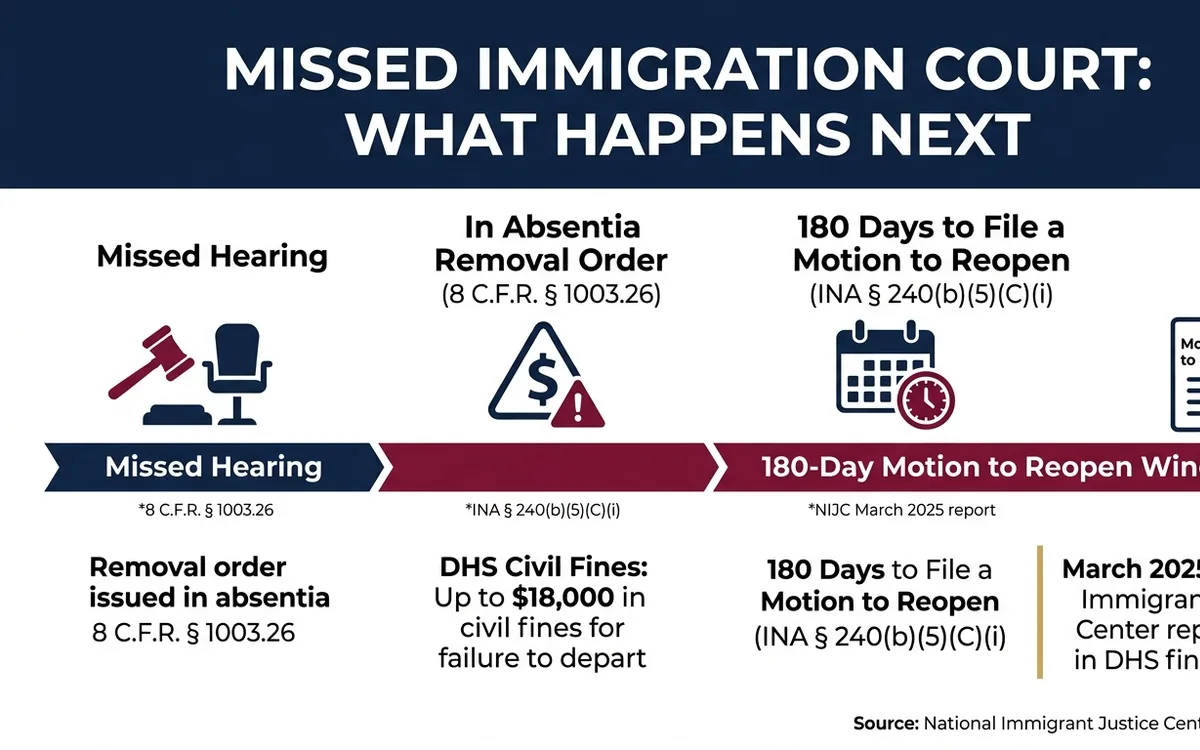
If you miss immigration court, a judge can order removal in absentia under 8 C.F.R. § 1003.26. DHS has also begun threatening civil fines up to $18,000 for failure to depart, per a March 2025 National Immigrant Justice Center report. You generally have 180 days to file a motion to reopen under INA § 240(b)(5)(C)(i).
The Hard Truth
Why Missing Court Is Harder to Fix Than People Think
Most in absentia removal orders are hard to undo. Once a judge orders removal because you weren't in the room, the order is final unless you can prove you meet a narrow legal exception, and the clock on that proof starts running immediately. Nationally, in absentia orders have been issued in roughly one-third of non-detained adult cases in recent years, according to TRAC Immigration data compiled at Syracuse University (trac.syr.edu, 2024).
The Charlotte Immigration Court, like every EOIR court, is working through a national backlog of more than 3.7 million pending cases, per EOIR's Adjudication Statistics (October 2024). A hearing date set today may not arrive for one to three years, and a missed date years from now does just as much damage as one missed tomorrow. Fear of showing up does not slow down any of these deadlines.
What Happens If You Wait
What You Lose by Waiting
Every day you avoid filing anything makes the legal picture worse, not better. An in absentia order generally triggers a 10-year bar to most forms of relief once it becomes final, under INA § 240(b)(7), and DHS can act on it at any point afterward, including during a routine check-in or a traffic stop.
The civil penalty DHS has described, up to $18,000 for failure to depart, is tied to 8 U.S.C. § 1324d (INA § 274D), the existing statute covering failure to leave after a final removal order, as reported by the National Immigrant Justice Center in March 2025. This is not a brand-new law, which means the fine risk is real now, not contingent on future legislation.
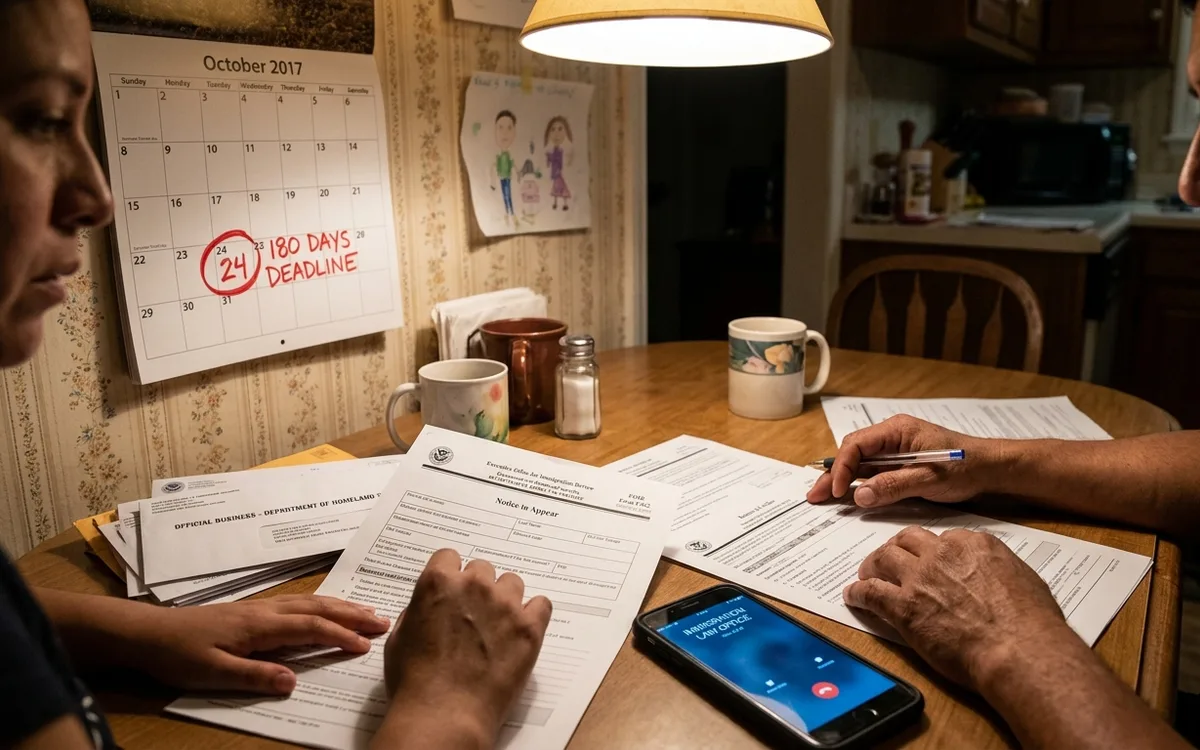
Waiting also closes doors procedurally. A motion to reopen based on lack of notice has no fixed deadline, but a motion based on exceptional circumstances must be filed within 180 days of the in absentia order under INA § 240(b)(5)(C)(i). That clock does not pause while you decide whether to call anyone.
Step-by-Step Process
What to Do After You Miss, or Before You Miss, a Hearing at Charlotte Immigration Court
Check your hearing date yourself. Call the EOIR automated case information line at 1-800-898-7180, or look up your case on the ACIS portal at acis.eoir.justice.gov using your A-number. This costs nothing and takes a few minutes; do it today if you're unsure of your date.
If you already missed a hearing, confirm whether an in absentia order was entered and note its date. Every deadline below runs from that date, not from today.
Determine whether you received proper notice. Under Pereira v. Sessions, 138 S. Ct. 2105 (2018), a Notice to Appear missing the hearing time or place can support a motion to reopen for lack of notice, which under 8 C.F.R. § 1003.26 carries no 180-day cutoff.
File the correct motion with the same judge who entered the order, at Charlotte Immigration Court, 5701 Executive Center Dr., Charlotte, NC. Represented respondents file through the ECAS e-Registry system; unrepresented respondents file by mail or in person.
Expect the judge to decide most motions on the papers, without a new hearing, within weeks to a few months depending on the docket.
If denied, you generally have 30 days to appeal to the Board of Immigration Appeals, and from there a petition for review runs through the Fourth Circuit, the federal appellate court covering North Carolina.
If DHS issues an actual civil fine notice under 8 U.S.C. § 1324d, treat it as a separate matter from the removal case. Keep every piece of mail; the window to contest a fine notice is short.
Our removal defense team handles motions to reopen and BIA appeals arising out of Charlotte Immigration Court on a regular basis, and can review your file before you file anything.
A Real-World Example
A Composite Example: What the Process Looks Like
Consider a composite scenario, not a real client. Maria, a Mecklenburg County resident, missed a 2024 hearing at Charlotte Immigration Court after her Notice to Appear listed a hearing location but no time, a defect similar to the one at issue in Pereira v. Sessions. She didn't learn about the in absentia order until a routine check-in at the USCIS Charlotte Field Office months later.
Her attorney first pulled her full court file through the ECAS system to confirm exactly what notice had gone out and when. Because the notice omitted a required element, the filing was a motion to reopen for lack of proper notice under 8 C.F.R. § 1003.26, which has no 180-day deadline, rather than a motion based on exceptional circumstances, which would have required filing within 180 days of an order that was already months old by the time she learned of it.
The judge reviewed the motion on the papers and set a briefing schedule asking for a response from DHS counsel before ruling. That decision can take weeks or months. Either a denial or a grant is possible; this composite illustrates the steps available, not a predicted result. The value of pulling the file first was identifying which legal theory actually matched her facts, instead of filing under the wrong deadline and losing the notice argument altogether.
About the Attorney Handling Your Case
William J. Vasquez leads the immigration practice at Vasquez Law Firm, PLLC, based in North Carolina, and has focused on removal defense, motions to reopen, and BIA appeals for over a decade. He is licensed by the North Carolina State Bar, admitted to practice before the U.S. Courts of Appeals for the Fourth, Fifth, and Eleventh Circuits, and holds membership in the American Immigration Lawyers Association (AILA), a national practice-credentialing organization rather than a bar license.
You can confirm his bar standing through the North Carolina State Bar's online attorney directory, and review his full professional background at vasquezlawfirm.com/attorneys/william-vasquez. Immigration proceedings are federal, so his authority to appear before EOIR and the BIA applies nationwide, while his underlying state bar license is specifically North Carolina.
Key Terms Explained
In absentia removal order: A removal order a judge enters when a respondent does not appear for a scheduled hearing, authorized under 8 C.F.R. § 1003.26.
Motion to reopen: A written request asking the same immigration judge to reconsider a case, typically based on new evidence, lack of proper notice, or exceptional circumstances; governed in part by INA § 240(b)(5)(C)(i).
Notice to Appear (NTA): The charging document that starts removal proceedings. In Pereira v. Sessions, 138 S. Ct. 2105 (2018), the Supreme Court held that an NTA missing the hearing time or place does not trigger the 'stop-time rule' for certain forms of relief.
Failure to depart penalty: A civil fine authorized under 8 U.S.C. § 1324d (INA § 274D) for a noncitizen who does not leave the country within the period set by a final removal order.
ECAS e-Registry: The electronic filing system represented respondents' attorneys use to submit motions and documents to immigration courts, including Charlotte Immigration Court.
A-number: The unique identifying number USCIS and EOIR assign to a noncitizen's file, needed to check a case through the automated case information line or the ACIS portal.
Frequently Asked Questions
Q: What happens if I'm too scared to go to my immigration court hearing in Charlotte? A: Missing the hearing is almost always worse than attending it, even if you're afraid of detention. A judge can enter an in absentia removal order under 8 C.F.R. § 1003.26, and DHS has signaled it may pursue civil fines up to $18,000 for failure to depart after a final order, per a March 2025 National Immigrant Justice Center report. If attending feels unsafe, call before the date, not after.
Q: Can DHS actually fine me $18,000 for missing court? A: DHS has described using 8 U.S.C. § 1324d, an existing statute covering failure to depart after a final removal order, to pursue civil penalties, as reported by the National Immigrant Justice Center in March 2025. That reporting describes an enforcement push under an existing law, not a new statute, and any specific fine notice can still be contested through its own process.
Q: How do I find out if I already have an in absentia order against me? A: Call the EOIR automated case information line at 1-800-898-7180 or check the ACIS portal at acis.eoir.justice.gov with your A-number. Both are free and don't require a lawyer to use.
Q: Is there a deadline to reopen a missed hearing case? A: It depends on why you missed it. A motion based on lack of proper notice under 8 C.F.R. § 1003.26 has no fixed deadline, while a motion based on exceptional circumstances must generally be filed within 180 days of the order under INA § 240(b)(5)(C)(i).
Q: Does a missed hearing affect a future green card or visa application? A: Yes. An unresolved in absentia order generally triggers a 10-year bar to most relief once it becomes final, and USCIS will see the open removal order when reviewing most other benefit applications.
Clients contacting our firm after a missed hearing often describe the same two fears: that it's already too late, and that calling a lawyer will draw more attention from immigration authorities. Neither has to be true. Reviewers consistently describe our team's intake process as the first time anyone explained, in plain terms, what their notice actually said and what options remained. We do not quote outcome statistics because immigration results are not predictable from one case to the next, but we can tell you, case by case, what the realistic paths forward look like.
The $18,000 figure making the rounds is meant to make you freeze. Freezing is the one response that guarantees a worse legal position than you have right now, whether that means a new in absentia order, a missed 180-day window, or a fine notice you never contest. Reading this page is a reasonable first step. The next one is finding out, specifically, what your own notice and your own case file actually say.
Vasquez Law Firm, PLLC offers consultations to review your Notice to Appear, your EOIR case history, and, if applicable, your in absentia order, to tell you which motion fits your facts and what deadline applies to it. Call our office or schedule online to have our removal defense team pull your file before you decide anything else.