
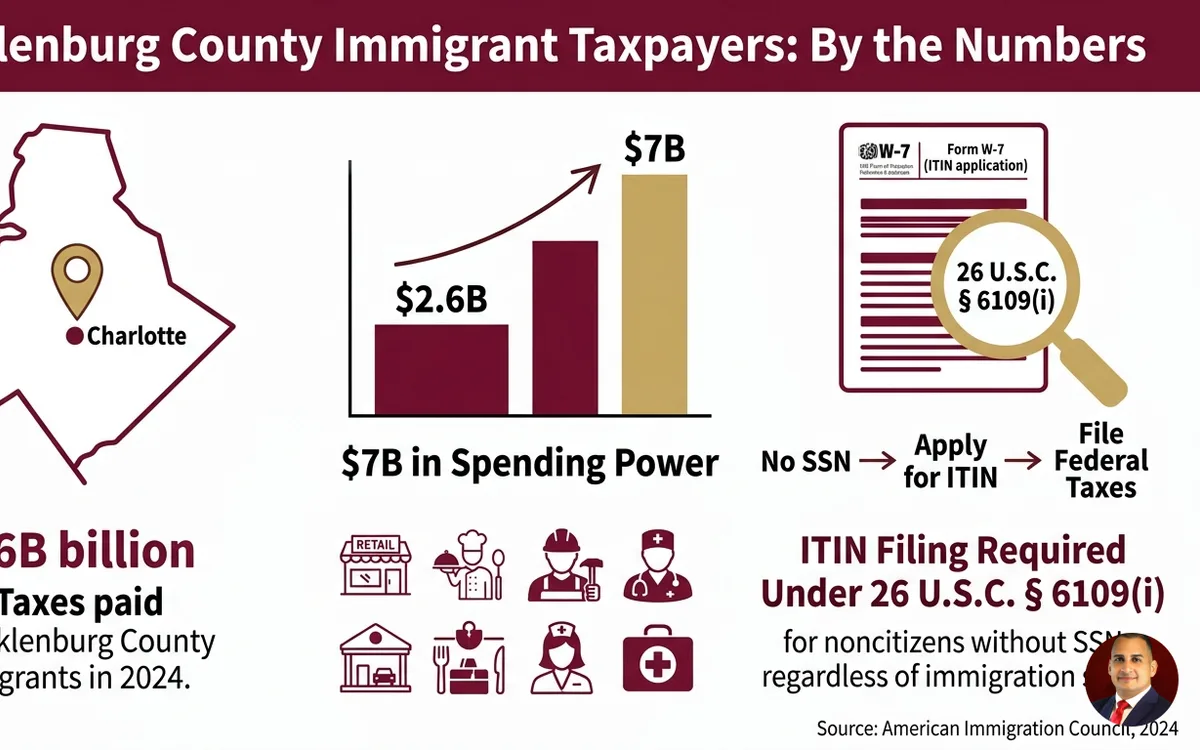
You pay taxes every year, maybe through an ITIN, maybe through a paycheck that already withholds federal and state amounts. You still wonder if any of it protects you. A new report says immigrants in Mecklenburg County paid $2.6 billion in taxes in 2024 and held $7 billion in spending power (American Immigration Council). That number does not answer the question keeping you up at night: what happens to your status, your work permit, or your family if something changes.
Tax compliance and immigration status are separate legal questions, and conflating them costs people real protection. You can be current on every tax filing and still face a pending EAD renewal, a gap in your asylum application, or a notice to appear you don't fully understand. The rest of this page walks through what the report actually means, what the law requires of you as a taxpayer, and the concrete next step if your immigration paperwork needs attention before it becomes a deadline you missed.
Yes. Immigrants in Mecklenburg County paid $2.6 billion in taxes and held $7 billion in spending power in 2024, per the American Immigration Council. Federal law requires noncitizens without a Social Security number to file using an Individual Taxpayer Identification Number (ITIN) under 26 U.S.C. § 6109(i), regardless of immigration status.
The Hard Truth
Paying taxes does not create, protect, or speed up immigration status. No IRS filing, no ITIN, and no amount of county-level economic data changes what an immigration judge or USCIS officer decides on your file. The $2.6 billion figure (American Immigration Council, 2024) is a policy and economic argument, not a legal shield.
If your work authorization has lapsed, if you missed a filing deadline at the Charlotte Immigration Court, or if your Notice to Appear has a defect you haven't raised, that problem exists independent of how much you contributed to the county tax base last year.
What Happens If You Wait
An expired EAD does not pause quietly. Once your Employment Authorization Document lapses, your employer is required to stop accepting it for Form I-9 purposes, and your paycheck stops, not your bills. USCIS processing for an EAD renewal (Form I-765) currently runs several months at the Charlotte Field Office, so a renewal filed after the card expires often means weeks or months without lawful work.
The same pattern holds in immigration court. Charlotte Immigration Court deadlines, filed through the EOIR's ECAS electronic portal, are calculated in days, not general timeframes. Miss a filing deadline on a motion or a brief and the court can treat the argument as waived, regardless of how strong the underlying claim was. Delay compounds: an ITIN that lapses, a Form W-7 renewal left undone, and a work permit that expires while you wait to see what happens all narrow your options at the exact moment you need more of them, not fewer.
Step-by-Step Process
Confirm your tax filing identifier. If you don't have a Social Security number, you file using an Individual Taxpayer Identification Number, assigned under 26 U.S.C. § 6109(i) by submitting IRS Form W-7 with your tax return. ITINs expire if unused for three consecutive tax years; check your expiration before filing season.
Check your work authorization category. Under 8 C.F.R. § 274a.12, eligibility for an Employment Authorization Document depends on your specific immigration status. Pending asylum, TPS, and adjustment of status each qualify under a different subsection, and confirming which one applies to you comes before filing Form I-765.
File EAD renewals early. The USCIS Charlotte Field Office processes Form I-765 renewals on the same national timeline as other service centers. File at least 180 days before expiration where your category allows it, consistent with current USCIS guidance on automatic extension eligibility.
Track every Immigration Court deadline. If you have a case before the Charlotte Immigration Court, filings go through EOIR's ECAS electronic portal. Deadlines in the Immigration Court Practice Manual, Chapter 3, are calculated in calendar days from service, not from when you read the notice.
Review your Notice to Appear for defects. Under Pereira v. Sessions, 138 S. Ct. 2105 (2018), a Notice to Appear that omits the hearing date or location can affect whether the stop-time rule applies to certain forms of relief. This is a technical argument that needs a document review, not a guess.
Get your tax and immigration documents reviewed together, before the next deadline rather than after. Bring your ITIN records, EAD history, and any Immigration Court notices to one review so both sides are read together, not separately.
A Real-World Example
Consider a composite example drawn from patterns our office sees in Mecklenburg County, not a real client. A restaurant cook in east Charlotte has filed taxes for six years using an ITIN. She also has a pending asylum application filed three years ago and an EAD that renews every two years under 8 C.F.R. § 274a.12(c)(8).
Her EAD renewal notice arrives, but the form asks for an A-number she doesn't recognize next to her ITIN. She brings both documents in for review. The first step is confirming which number applies to which filing, the ITIN to the IRS and the A-number to USCIS, because mixing them on a form can delay processing by weeks.
The second step is checking her asylum application's place in the Charlotte Immigration Court queue, including whether a prior Notice to Appear was properly served under EOIR rules. From there, the realistic next steps are: file the I-765 renewal with the correct identifiers, confirm the ITIN is still valid under the three-year nonuse rule, and calendar the next Immigration Court filing deadline through ECAS. No part of this process is instant, and no attorney can promise how the asylum application itself will be decided. What a review can do is make sure the paperwork in front of the agency is accurate and timely.
William J. Vasquez is admitted to the North Carolina State Bar and practices immigration law, a field of federal jurisdiction handled before USCIS, the Charlotte Immigration Court, and the Board of Immigration Appeals regardless of state bar admission. His work includes EAD and work-authorization filings, ITIN-related questions that intersect with immigration filings, and removal defense matters before EOIR. He does not claim a certification or specialization designation beyond his bar admission, and the firm's broader immigration team, not any single credential, handles the range of filings described on this page.
Key Terms Explained
ITIN (Individual Taxpayer Identification Number): A tax processing number issued by the IRS under 26 U.S.C. § 6109(i) to people who must file a U.S. tax return but don't qualify for a Social Security number. ITINs expire after three consecutive years of nonuse.
EAD (Employment Authorization Document): The physical work permit card issued by USCIS. Eligibility categories are listed in 8 C.F.R. § 274a.12, and which category applies depends on your specific immigration status, such as a pending asylum application or TPS.
NTA (Notice to Appear): The charging document that starts removal proceedings in Immigration Court. Pereira v. Sessions, 138 S. Ct. 2105 (2018), held that an NTA missing the hearing time or place does not trigger the stop-time rule for certain forms of relief.
EOIR (Executive Office for Immigration Review): The Department of Justice agency that runs the Immigration Courts, including the Charlotte Immigration Court, and the Board of Immigration Appeals.
ECAS (EOIR Courts & Appeals System): The electronic filing portal Immigration Courts use for case documents and motions, referenced in the Immigration Court Practice Manual, Chapter 3.
TPS (Temporary Protected Status): A designation that allows nationals of specific countries to remain and work in the United States for a set period, established and renewed through Federal Register notices from DHS.
Frequently Asked Questions
Q: Do undocumented immigrants have to pay taxes in North Carolina? A: Yes. Federal law requires anyone who earns income in the United States to file a tax return regardless of immigration status, using either a Social Security number or an Individual Taxpayer Identification Number issued under 26 U.S.C. § 6109(i).
Q: Will filing taxes with an ITIN affect my immigration case? A: Filing taxes is a separate legal requirement from immigration status, but how your tax records are presented in an immigration filing should be reviewed before submission, especially if income or address history needs to match other documents.
Q: How do I renew my work permit through the USCIS Charlotte Field Office? A: You file Form I-765 with USCIS directly rather than at the local field office, and your eligibility category under 8 C.F.R. § 274a.12 determines your renewal timeline and whether you qualify for an automatic extension while the renewal is pending.
Q: What does the $2.6 billion tax figure mean for my immigration case? A: It is an economic and policy data point reported by the American Immigration Council, not a legal factor an immigration judge or USCIS officer applies to an individual case; your case depends on your specific filings, deadlines, and evidence.
Q: What happens if I miss a filing deadline at the Charlotte Immigration Court? A: Deadlines set under the Immigration Court Practice Manual and filed through the ECAS portal are calculated in calendar days, and missing one can result in a motion, application, or brief being deemed waived or abandoned.
Clients describe our office as direct about what a filing can and cannot do before they pay for a consultation. Reviews reference clear explanations of EAD timelines, ITIN questions, and Immigration Court procedure, the kind of detail that matters when a deadline is real. We don't publish outcome statistics because past immigration decisions are not predictive of any individual case, and no immigration practice can honestly claim otherwise.
The Mecklenburg County data confirms what immigrant taxpayers already know: compliance on one side of the ledger does not simplify the other. If you have an EAD renewal coming up, an ITIN question tied to a pending application, or an Immigration Court notice you haven't acted on, the next useful step is a document review, not another data point.
Schedule a consultation with our immigration team to review your EAD renewal, ITIN filing, or Charlotte Immigration Court deadline before it becomes a missed one. Call our North Carolina office or request a consultation online, and bring your tax and immigration documents so we can review both together.

- Work Permit (EAD) Renewal Help
- ITIN and Tax Filing Questions for Immigrants
- Charlotte Immigration Court Removal Defense
- Notice to Appear Defects and Pereira Claims
- TPS Applications and Renewals
- Schedule an Immigration Consultation