You got the J-1 visa. The DS-2019 came through, the program start date is set, maybe it's a physician residency through Conrad 30, a research fellowship at Duke or UNC-Chapel Hill, or an au pair placement that finally felt like a yes after months of paperwork. Then someone, a sponsor, a lawyer, a line in the visa stamp itself, mentions 212(e). Suddenly the exchange you worked for comes with a condition: two years back home before you can change status, adjust status, or take the H-1B offer sitting in your inbox. That condition does not apply to everyone, and it is not always permanent even when it does. Figuring out whether you are subject, and what to do if you are, is the actual question this page answers. This page was last updated in June 2025 to reflect current USCIS and Department of State guidance.
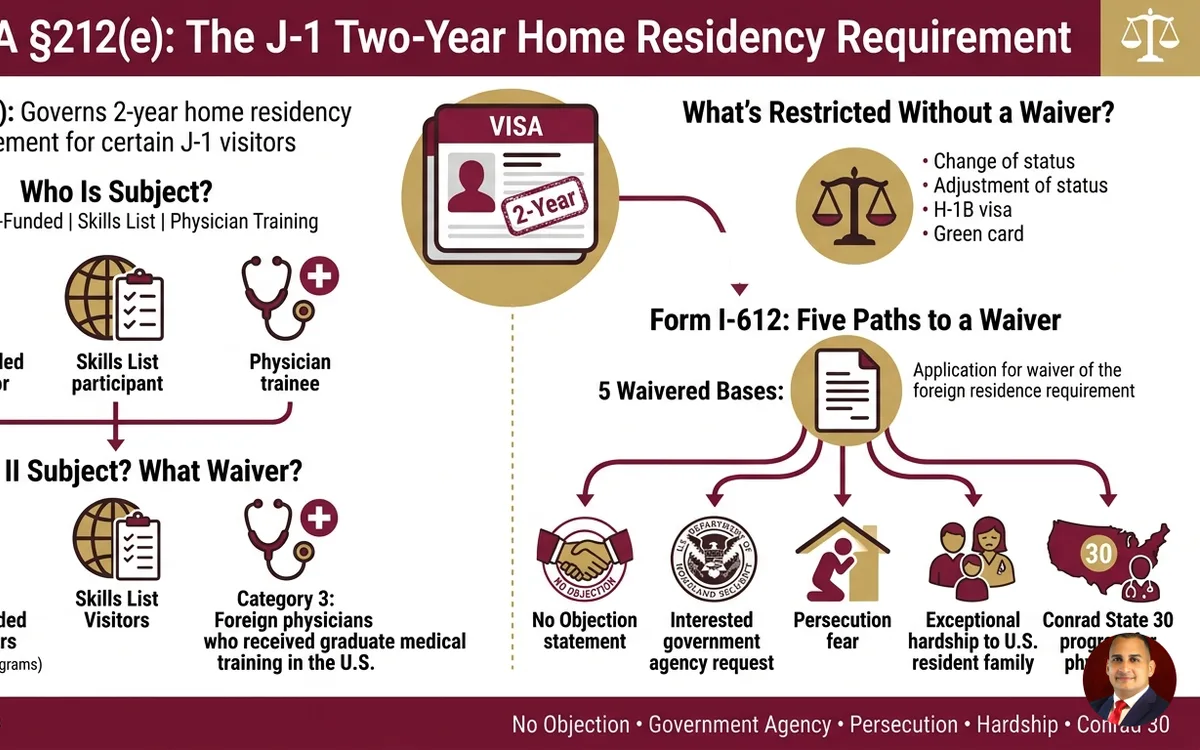
INA §212(e) requires certain J-1 exchange visitors, including those funded by their home government, listed on the Skills List, or trained as physicians, to return home for two years before changing status, adjusting status, or obtaining an H-1B or green card. A waiver filed on Form I-612 can remove this requirement through one of five legal bases.
The Hard Truth
Who Is Subject to INA §212(e)?
Not every J-1 holder is subject to the two-year home residency requirement, but many assume they are when they're not, and some assume they're clear when they're not. You are subject if any of three things is true: your program was financed, even partly, by your home government or by the U.S. government; your field of study or occupation appears on your home country's Skills List maintained by the Department of State; or you came to the United States for graduate medical education or training, which covers nearly all Conrad 30 and J-1 physicians.
If none of those apply, you are not subject, and no waiver is needed. If one does apply, the requirement is real. You cannot change to another nonimmigrant status inside the United States, you cannot adjust to permanent residence, and in most cases you cannot get an H-1B approved, until you either complete two years of physical presence in your home country or obtain a waiver.
Waivers are not automatic and not guaranteed. The Department of State's Waiver Review Division makes a recommendation; USCIS makes the final decision on Form I-612. A denial at either stage is possible, and an approved no-objection statement from your embassy does not bind USCIS to approve the waiver.
What Happens If You Wait
What Happens If You Wait?
While a 212(e) waiver sits unresolved, the real risk isn't the statute itself — it's everything else tied to your status that keeps moving on its own schedule. An H-1B petition requires a cap-subject filing window that opens each year in March, per USCIS H-1B cap season guidance. Miss it because your waiver is still pending, and the earliest your employer can refile is the following year.
A job offer tied to a start date does not wait for the Waiver Review Division. Neither does a marriage-based adjustment of status filing, which generally requires waiver-free status at the time of filing; see our adjustment of status services for how that timing works. If your DS-2019 sponsor terminates your SEVIS record, for a program violation, funding lapse, or administrative error, your sponsor sets a short departure or resolution window under the institutional obligations in 22 C.F.R. Part 62, and that window can close before you've found a lawyer.
Filing a waiver application late does not protect you from these deadlines. It only means you reach them with less time to fix a problem.
Step-by-Step Process
What Are the Five J-1 Waiver Options?
A 212(e) waiver actually covers five distinct legal theories, not a single application. The evidence required, who decides, and how long it takes all depend on which one applies to you. See the comparison table on this page for how the five bases differ side by side.
Step 1: Confirm Whether You Are Subject
Your DS-2019 and visa stamp may show a 212(e) annotation, but that notation is not always accurate or complete. Confirm your status against the Skills List published by the Department of State for your country, and check your SEVIS record for government-funding codes.
Step 2: Identify the Strongest Available Basis
Most applicants qualify for only one basis, sometimes two. A physician on a J-1 graduate medical training visa with a rural hospital job offer typically pursues Conrad 30 or an Interested Government Agency waiver, not a no-objection waiver, which physicians subject to 212(e) through medical training cannot use.
Step 3: Obtain the No-Objection Statement or Agency Letter
For a no-objection waiver, your home country's embassy in Washington submits a statement directly to the Department of State. For Conrad 30, the application goes first to a state health agency, in North Carolina the North Carolina Office of Rural Health, NC DHHS, which allocates 30 physician waiver slots per federal fiscal year under the national Conrad State 30 Program.
Step 4: File Form I-612 With USCIS
Once the Department of State's Waiver Review Division issues its recommendation, often favorable but non-binding, you file Form I-612 with USCIS. Current processing-time estimates for I-612 vary by service center and caseload; check the live figure at uscis.gov/processing-times before you file, since the posted range changes often.
Step 5: Wait for the Final Decision, Then Act
USCIS, not the State Department, makes the binding decision. A denial can sometimes be challenged through a motion to reopen or reconsider, or, in limited circumstances, through federal litigation under the Administrative Procedure Act in the U.S. District Court for the Eastern District of North Carolina; our BIA appeals services cover related administrative appeal strategy where applicable. An approval clears the way to change status, including to H-1B status through our H-1B visa sponsorship services, or to adjust status if otherwise eligible.
A Real-World Example
A Composite Example: A Research Scholar's Waiver Timeline
A J-1 research scholar at a Research Triangle university, funded in part through a government-sponsored exchange grant, learns during a visa renewal conversation that her funding source makes her subject to 212(e). She has a standing offer for a postdoctoral position that would require an H-1B change of status in eighteen months.
Her attorney first confirms the government-funding basis by reviewing her DS-2019 and the original grant documentation. Because her home government funded only the first year of her program, counsel examines whether a no-objection route is viable, and separately gathers documentation for a possible exceptional hardship claim tied to her U.S.-citizen spouse's medical condition.
The embassy's no-objection statement takes roughly two to three months to process in this scenario, consistent with the general turnaround described on travel.state.gov's waiver guidance page. The I-612 filing follows, and the file moves into a service center queue alongside other pending waiver applications that fiscal year.
At each stage, she keeps her existing J-1 status current and coordinates renewal paperwork with her university's Responsible Officer so her SEVIS record stays active while the waiver is pending. This scenario is illustrative only and does not reflect an actual client matter or outcome.
About Attorney William J. Vasquez
William J. Vasquez leads the firm's immigration practice and is licensed to practice law in North Carolina, with federal court admission that includes the U.S. Courts of Appeals for the Fourth, Fifth, and Eleventh Circuits. He has practiced immigration law for more than a decade, handling matters before USCIS, the immigration courts, and the Board of Immigration Appeals.
His work on exchange-visitor matters includes coordinating directly with university international offices, including J-1 Responsible Officers at institutions in the Research Triangle, to resolve SEVIS record issues and align waiver timing with H-1B cap deadlines. That coordination extends to our physician visa services for Conrad 30 applicants. Because immigration law is federal, our attorneys represent J-1 waiver applicants nationwide, not only those physically located in North Carolina.
Key Terms Explained
Key Terms Used on This Page
212(e) / INA §212(e): The statutory provision, 8 U.S.C. §1182(e), requiring certain J-1 exchange visitors to reside in their home country for two years before changing or adjusting status.
DS-2019: The Certificate of Eligibility for Exchange Visitor Status, issued by a State Department-designated sponsor, that establishes the terms of a J-1 program.
Form I-612: The USCIS application, Form I-612, used to request a waiver of the two-year home residency requirement.
SEVIS: The Student and Exchange Visitor Information System, the database that tracks J-1 status from program start to completion or termination.
Skills List: A list maintained by the Department of State for each country, identifying fields of study considered in short supply there; presence on the list is one basis for being subject to 212(e).
Conrad State 30 Program: A program allowing each state, including North Carolina through the NC Office of Rural Health, to request waivers for up to 30 J-1 physicians per federal fiscal year who agree to work in underserved areas.
Interested Government Agency (IGA) waiver: A waiver requested by a federal agency, such as the Department of Health and Human Services, on the basis that the applicant's work serves the agency's interest.
No-objection waiver: A waiver based on a statement from the applicant's home government, submitted directly to the Department of State, indicating the government has no objection to the applicant remaining in the United States.
Frequently Asked Questions
Frequently Asked Questions
Q: How do I know if I'm subject to the two-year home residency requirement? A: Check your DS-2019 for a 212(e) annotation, then confirm independently using the Department of State's Skills List for your country and your program's funding source. Government funding, Skills List presence, or graduate medical training each independently triggers the requirement.
Q: Can I change my status while a waiver application is pending? A: No. USCIS will not approve a change of status, adjustment of status, or most H-1B petitions while you remain subject to 212(e) and the waiver is undecided, per 8 U.S.C. §1182(e).
Q: Will my program sponsor know I'm applying for a waiver? A: Not automatically. The waiver process runs through the Department of State and USCIS, not your sponsor, though your sponsor's cooperation on DS-2019 and SEVIS records is often needed to keep your underlying status valid while you wait.
Q: Does marrying a U.S. citizen remove the 212(e) requirement? A: No, marriage alone does not waive the requirement, but it can support an exceptional hardship waiver if you can document that your U.S.-citizen spouse or child would face hardship significantly beyond normal family separation if you had to leave for two years.
Q: What happens if the Waiver Review Division or USCIS denies my waiver? A: A denial does not always end the case. Depending on the basis, you may file a motion to reopen or reconsider with USCIS, or in limited cases pursue federal court review under the Administrative Procedure Act; a denial can also still leave the option of completing the two-year residence abroad.
Q: What does a J-1 waiver cost in attorney fees? A: Attorney fees vary by waiver basis and complexity; a straightforward no-objection waiver typically involves less attorney time than an exceptional hardship or persecution-based waiver, which requires substantial documentary evidence. Form I-612 itself carries no USCIS filing fee as of this writing, per USCIS's I-612 fee schedule, but ask for a written fee agreement before filing.
Q: What evidence does an exceptional hardship or persecution-based waiver require? A: An exceptional hardship waiver typically requires medical records, financial documentation, and country-condition evidence showing hardship to your U.S.-citizen or permanent-resident spouse or child beyond ordinary separation. A persecution-based waiver requires evidence that you would face persecution on account of race, religion, or political opinion if you returned, often including country-condition reports and, where available, prior affidavits or claims.
What Clients Say
Clients who come to us with exchange-visitor status questions are often making a decision that affects a job offer, a marriage, or years of training, not an abstract filing. Feedback we hear most often centers on direct communication about timelines and clear explanations of which waiver basis actually fits their situation. We do not publish outcome statistics, consistent with our standard of describing legal work by what was handled, not by a won or lost result.
Reading about five waiver bases does not tell you which one applies to your DS-2019, your funding source, and your timeline. That determination depends on documents specific to your program, your country, and your field, the kind of review that is hard to do accurately from a blog post.
Call our office to schedule a consultation focused on your 212(e) status and waiver options. Bring your DS-2019, visa stamp, and any funding or sponsor correspondence so our immigration team can tell you, specifically, whether you're subject to the home residency requirement and which of the five waiver routes fits your situation, including coordination with your program sponsor and planning toward H-1B status or adjustment of status once a waiver is filed.
- H-1B Visa Sponsorship Services
- Marriage-Based Adjustment of Status
- BIA Appeals
- Physician Visa Services (Conrad 30)
- Contact Our Immigration Team