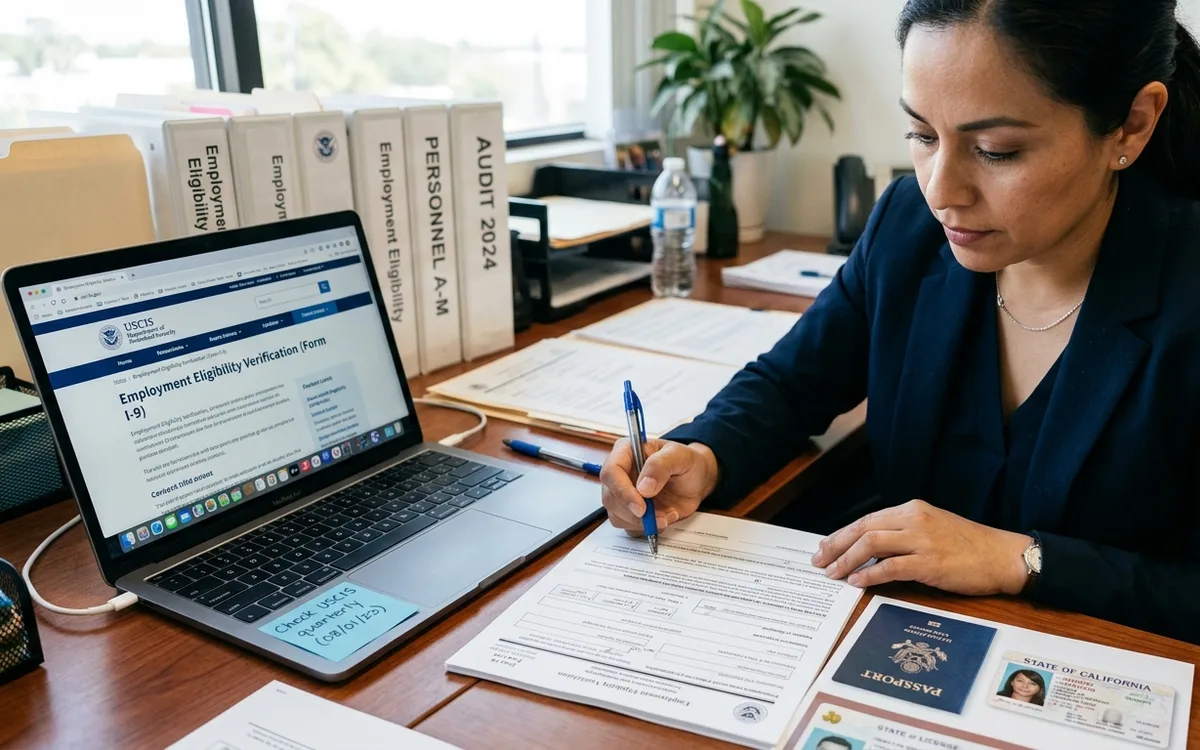
The 2026 Form I-9 edition does not forgive sloppy paperwork from 2024 or 2025. If a Notice of Inspection from Homeland Security Investigations (HSI) just arrived in your mail, you have three business days to produce every I-9 you have on file, old edition and new, per 8 C.F.R. § 274a.2(b)(2)(ii). Most employers scrambling to understand 'the 2026 I-9 form' are not asking out of curiosity. They are holding a letter, staring at a stack of personnel files, and trying to figure out whether their HR department has been doing this right for years. The honest answer is usually: partly.
The 2026 Form I-9 edition (dated 01/20/26 in the lower corner, per USCIS) updates the Section 2 remote document-examination procedure and the List B/List C document tables. USCIS set a transition period before the prior 08/01/23 edition becomes invalid. North Carolina employers must also verify new hires through E-Verify under N.C. Gen. Stat. § 64-26.
The Hard Truth
A new form edition does not undo old mistakes, and it does not slow down an audit already in motion. OCAHO (the Office of the Chief Administrative Hearing Officer, the body that hears employer-sanction cases under 28 C.F.R. Part 68) does not care which edition you used in 2023 if the underlying Section 2 review was never done correctly. Civil penalties for paperwork violations currently run $288 to $2,861 per violation, and $698 to $5,579 per worker for a first-offense knowing-hire violation, under 8 C.F.R. § 274a.10(b), adjusted for inflation under the Federal Civil Penalties Inflation Adjustment Act (89 Fed. Reg. 13208, Feb. 26, 2024). Multiply either figure by every employee file in your cabinet and the exposure stops being abstract. Switching to the correct 2026 edition going forward is necessary. It is not, by itself, a defense to what already happened.
What Happens If You Wait
Miss the transition deadline and every new hire you process on the outdated edition becomes its own separate paperwork violation, not one mistake but one per form. Federal contractors under FAR Clause 52.222-54 face a sharper problem: enrollment in E-Verify within 30 days of contract award and verification of assigned employees within 90 days of enrollment are conditions of the contract itself, and falling behind can jeopardize the award, not just draw a fine. North Carolina employers with 25 or more employees already have a standing duty to run new hires through E-Verify under N.C. Gen. Stat. § 64-26; an employer who has let that lapse is building a second violation on top of the first. And if HSI has already issued a Notice of Inspection, the three-business-day production window does not pause while you sort out which edition is correct. The clock on your response runs from the date on the letter, not the date you open it.
Step-by-Step Process
1. Confirm which edition is in your HR system today. The edition date prints in the lower left corner of the form; check new hires processed in the last 90 days against it. 2. Replace blank stock and any fillable PDF template before the next new hire, not after. USCIS posts the current edition and mandatory-use date at uscis.gov/i-9; confirm the live deadline there rather than relying on a saved bookmark. 3. Decide whether your company qualifies for the DHS remote document-examination alternative under 8 C.F.R. § 274a.2(b)(1)(viii). It is available only to employers enrolled in E-Verify in good standing, and it requires a live video inspection of the documents, not a photo sent by email. 4. Run an internal self-audit of existing I-9s before an outside agency does it for you. Separate technical and procedural errors, which can usually be corrected, from substantive omissions, which cannot be fixed after the fact without documentation of the correction. 5. Correct errors the right way: draw a single line through the incorrect entry, enter the correct information, initial and date the correction, and never use white-out or a replacement form. The Ketchikan Drywall standard (United States v. Ketchikan Drywall Services, Inc., 25 OCAHO no. 1358 (2013), aff'd 9th Cir.) treats concealment of an original entry as evidence of a knowing violation, which carries a higher penalty tier than an honest paperwork mistake. 6. If a Notice of Inspection arrives, assemble the requested I-9s and supporting documents within three business days and route the response through counsel before anything leaves the building. 7. If HSI issues a Notice of Intent to Fine after reviewing the forms, you have the right to request a hearing before an OCAHO administrative law judge under 28 C.F.R. Part 68 rather than simply paying the proposed amount.
A Real-World Example
A Mecklenburg County manufacturer with about 140 employees ran its own self-audit after learning a competitor had received a Notice of Inspection. The review turned up a mix of problems: several Section 2 reviews completed more than three business days after the hire date, a handful of List C documents that no longer matched current USCIS terminology, and two files missing a preparer signature entirely. HR had kept using the 08/01/23 edition for new hires processed after the 2026 edition should have been in use. The company's attorney separated the errors into two categories before touching any file: technical and procedural errors eligible for correction under the standard line-through-and-initial method, and the missing preparer signature, which cannot be manufactured after the fact and instead required a documented explanation attached to the file. The attorney also confirmed the company's E-Verify enrollment status before advising on the remote-examination question, since that option is unavailable to anyone not already enrolled. The audit produced a corrected set of files, a written log of what was changed and why, and a documented internal policy for the next hire. None of that guarantees how a future inspection would be evaluated; it only means the company can show its work if one arrives.
William J. Vasquez has spent more than a decade handling federal immigration matters, including employer-sanction defense before OCAHO and compliance counseling for North Carolina employers facing HSI inspections. He is admitted to practice before the federal immigration bar and has represented employers through the Notice of Inspection process, the self-audit and correction stage, and OCAHO hearings when a Notice of Intent to Fine is issued. His practice focuses on helping employers build defensible I-9 and E-Verify programs before an inspection happens, not only responding after one arrives. He does not promise a particular penalty outcome in any matter, because OCAHO penalty amounts are set by regulation and by an administrative law judge's independent review of the facts, not by negotiation alone.
Key Terms Explained
Form I-9: The employment eligibility verification form required for every new hire under the Immigration Reform and Control Act of 1986 (IRCA), codified at 8 U.S.C. § 1324a. Section 1, Section 2, and Supplement B: Section 1 is completed by the employee no later than the first day of work. Section 2 is completed by the employer within three business days of the start date and requires physical or DHS-approved remote examination of identity and work-authorization documents. Supplement B is used for reverification when an employee's work authorization expires or for rehire within three years. E-Verify: The federal internet-based system that compares I-9 information against Social Security Administration and DHS records. North Carolina employers with 25 or more employees must use it for new hires under N.C. Gen. Stat. § 64-26. OCAHO: The Office of the Chief Administrative Hearing Officer, the administrative court within the Department of Justice that hears employer-sanction cases under 28 C.F.R. Part 68. Notice of Inspection (NOI): The document HSI serves on an employer to begin an I-9 audit. It triggers a three-business-day window to produce I-9 forms and supporting records, per 8 C.F.R. § 274a.2(b)(2)(ii). Knowing violation: A legal standard, discussed in United States v. Ketchikan Drywall Services, Inc., 25 OCAHO no. 1358 (2013), aff'd 9th Cir., under which an employer's actual knowledge or deliberate disregard of a worker's unauthorized status, including concealment of a prior I-9 error, can increase the penalty tier beyond an ordinary paperwork violation. FAR Clause 52.222-54: The federal contract clause requiring covered federal contractors to enroll in E-Verify and verify covered employees within set timeframes as a condition of the contract.
Frequently Asked Questions
Q: Do I have to switch to the 2026 Form I-9 immediately? A: USCIS sets a transition period during which the prior edition remains valid before it expires; check the current deadline at uscis.gov/i-9, since using an expired edition after that date is itself a paperwork violation under 8 C.F.R. § 274a.2. Q: Can I use the DHS remote document-examination option for every new hire? A: No. The remote alternative procedure under 8 C.F.R. § 274a.2(b)(1)(viii) is available only to employers enrolled in E-Verify in good standing, and it requires a live video review, not a scanned copy or photo. Q: What happens if I find an error in an old I-9 during a self-audit? A: Correct it with a single line-through, the correct entry, and your initials and date. Do not erase, white out, or replace the page, since concealing the original entry can turn an honest mistake into evidence of a knowing violation under the Ketchikan Drywall standard. Q: How long do I have to respond to an HSI Notice of Inspection? A: Three business days from the date on the notice to produce the requested I-9 forms and supporting documents, per 8 C.F.R. § 274a.2(b)(2)(ii). Q: Does North Carolina require E-Verify separately from the federal I-9 requirement? A: Yes. N.C. Gen. Stat. § 64-26 requires North Carolina employers with 25 or more employees to verify new hires through E-Verify, in addition to completing Form I-9 under federal law.
Employers who have worked with our office describe the same pattern: a straightforward explanation of what the law actually requires, a clear list of what to fix first, and no inflated promises about how an inspection or hearing will turn out. Reviews consistently note direct communication during a stressful compliance review, not after it. We do not publish outcome statistics for employer-sanction matters, because OCAHO penalty decisions are fact-specific and are not a fair basis for predicting another employer's result.
If you are still reading because you are not sure whether your company's I-9 files would hold up under a self-audit, that uncertainty is itself useful information. It means it is worth finding out before HSI tells you.
Our office handles I-9 self-audits, E-Verify compliance counseling, and OCAHO employer-sanction defense for North Carolina businesses. Schedule a consultation with our team to review your current I-9 practices, confirm your transition to the 2026 edition, and put a correction plan in place before an inspection, not after one.
- I-9 Audit and Self-Audit Defense
- E-Verify Compliance Counseling for North Carolina Employers
- OCAHO Employer-Sanction Hearing Representation
- HSI Notice of Inspection Response Services
- Immigration Practice Overview