Last updated April 2025. You are married to, or raising a child with, a U.S. citizen or green card holder, and you have never been arrested or placed in removal proceedings. Now the path forward runs through a plane ticket and an interview at a U.S. consulate abroad, and someone has told you that leaving could trigger a 3-year or 10-year bar under INA § 212(a)(9)(B) (https://www.law.cornell.edu/uscode/text/8/1182) that keeps you apart from your spouse and children. That fear is well-founded. Families who travel for their immigrant visa interview without first finding out whether USCIS will forgive the unlawful presence face exactly that outcome.
The I-601A provisional waiver exists so you can get that answer before you ever leave. Filed while you are still in the United States, it lets USCIS decide, in advance, whether your qualifying relative's hardship is severe enough to excuse the bar, so that if the waiver is approved, the trip abroad is a scheduled visit rather than an open-ended separation. This page walks through how that process works for North Carolina families, what the extreme-hardship standard actually requires, and what your options are if the answer is not what you hoped for.
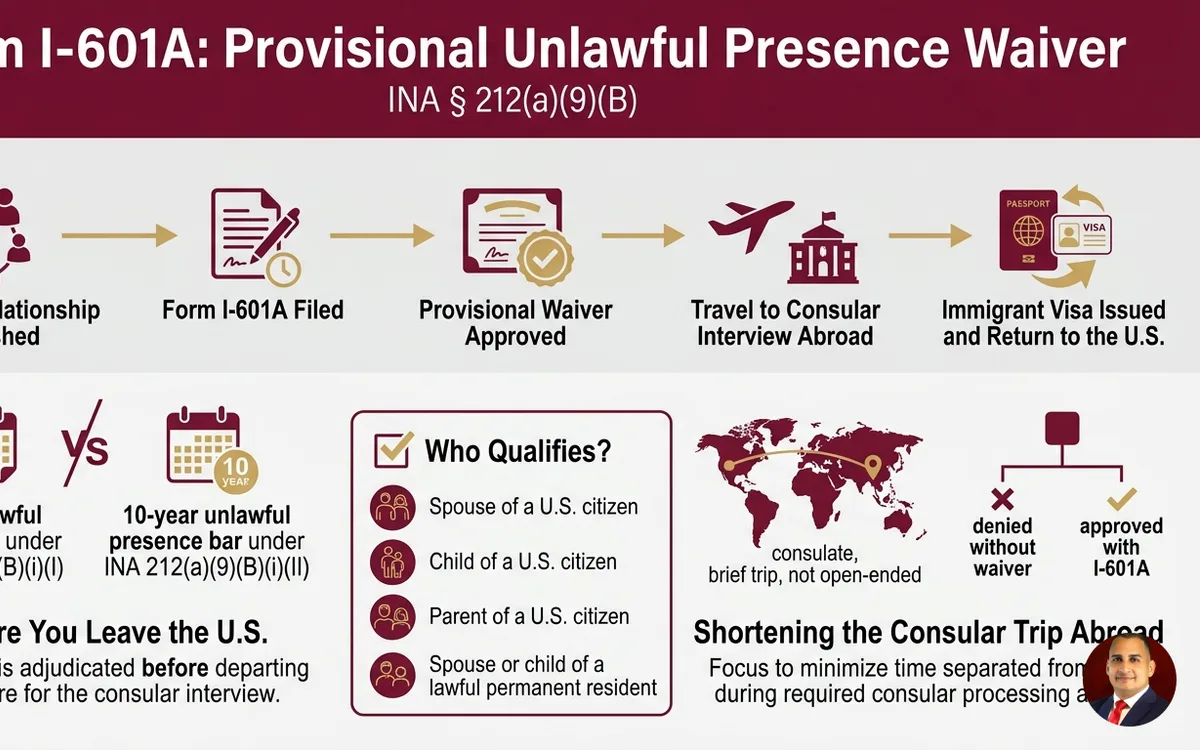
Form I-601A lets the undocumented spouse, child, or parent of a U.S. citizen (or the spouse/child of a lawful permanent resident) ask USCIS to forgive the 3-year or 10-year unlawful-presence bar under INA § 212(a)(9)(B) before leaving for the immigrant visa interview abroad, so the required consular trip is brief rather than open-ended.
The Hard Truth
Provisional approval covers only the unlawful-presence bar. USCIS can approve Form I-601A, and the consular officer in Ciudad Juárez or at another post can still deny the immigrant visa for an unrelated ground of inadmissibility discovered at the interview, such as a prior fraud finding or a criminal issue that never came up during the I-601A review.
The legal standard is also harder to meet than most families expect. Matter of Cervantes-Gonzalez, 22 I&N Dec. 560 (BIA 1999) (https://www.justice.gov/eoir/page/file/1348116/download) sets out the extreme-hardship factors USCIS applies: the qualifying relative's health, their ties to the United States, conditions in the country you would be excluded from if the waiver is denied, and financial loss that goes beyond what any family experiences during an ordinary separation. Sadness and inconvenience do not meet that standard on their own.
Weak packets share a pattern: a single letter from the spouse describing how hard separation would be, with no medical records, no psychological evaluation, and no documentation tied to a specific condition or dependency. The National Benefits Center routinely denies filings built that way, citing a lack of evidence specific to the qualifying relative's actual circumstances.
What Happens If You Wait
Delay costs you specific, calendar-bound ground. Once the National Visa Center (https://nvc.state.gov) processes your immigrant visa fee and DS-260 through CEAC and schedules your interview date, you are on the consulate's calendar whether or not your I-601A has been decided.
If you travel for that interview without an approved waiver, you leave the United States still subject to the 3-year or 10-year bar. A waiver filed after the fact, Form I-601, is then adjudicated abroad while you are already separated from your family, with no fixed timeline for a decision.
Every month spent without a complete hardship packet, medical records, a psychological evaluation, school and financial records, is a month closer to an interview date that NVC, not you, controls. A parent who is the household's only driver, the only income earner, or whose children depend on a specific school or medical provider loses more by waiting than by starting the documentation now.
Step-by-Step Process
Approved underlying petition. Your U.S. citizen or lawful permanent resident spouse, parent, or child's Form I-130 petition must already be approved by USCIS before the National Visa Center opens an immigrant visa case.
NVC case creation and DS-260. The National Visa Center in Portsmouth, New Hampshire opens your case, assigns a case number, and requires you to submit Form DS-260 and pay the immigrant visa processing fee through CEAC (https://ceac.state.gov) before Form I-601A can be properly filed.
File Form I-601A with the Nebraska Service Center. The form and current $630 filing fee are published at uscis.gov/i-601a (https://www.uscis.gov/i-601a), with no separate biometric services fee under the USCIS fee schedule in effect since April 1, 2024 (8 C.F.R. § 103.7, https://www.ecfr.gov). The waiver must be supported by a hardship packet built around your qualifying relative, not yourself.
Biometrics. USCIS schedules a biometrics appointment, which North Carolina applicants typically complete at the USCIS Charlotte Application Support Center.
Adjudication. As of USCIS Case Processing Times checked April 2025 (https://egov.uscis.gov/processing-times/), the Nebraska Service Center reports I-601A median processing in the range of roughly 30 to 40 months. Check the current published figure directly, since it changes, and this page is reviewed quarterly against it.
Provisional decision. If approved, you wait for NVC to schedule your consular interview. If denied, you may file a motion to reopen or reconsider with the National Benefits Center under 8 C.F.R. § 103.5(a)(2) (https://www.ecfr.gov), or proceed to the interview and address the bar through a Form I-601 filed at the consulate instead.
Consular interview abroad. With a provisional approval in hand, the trip is typically brief, often one to two weeks. NC families commonly depart through Charlotte-Douglas International Airport for posts such as Ciudad Juárez; see our consular processing overview for what to expect at the interview itself.
If adjudication stalls. When an I-601A sits well beyond the published processing range with no explanation, a mandamus action in the U.S. District Court for the Western District of North Carolina can ask a federal judge to compel USCIS to act.
A Real-World Example
Consider a composite scenario built from the kind of cases our team handles, not a specific client. Call her Teresa: undocumented after entering without inspection fourteen years ago, married eight years to a U.S. citizen, with two U.S. citizen children and a husband managing a service-connected spinal injury from his time in the military.
Teresa's husband's Form I-130 petition was approved two years ago. Once the National Visa Center opened their case, the family paid the immigrant visa fee, submitted DS-260 through CEAC, and began gathering records before filing Form I-601A: her husband's VA medical records, a psychological evaluation documenting his depression and anxiety tied to the injury, a letter from his physical therapist describing his dependence on Teresa for daily care, and financial records showing the family could not relocate because of his ongoing treatment.
They filed the I-601A with the Nebraska Service Center, completed biometrics at the Charlotte Application Support Center, and are now tracking USCIS's published processing times while preparing a travel contingency plan. They have also started assembling the consular-processing document checklist in case the case moves toward interview scheduling before the waiver decision comes back. Right now, they are in the waiting period, documenting any change in her husband's medical condition so the hardship record stays current until USCIS decides.
William J. Vasquez leads the firm's immigration practice. He is admitted to the North Carolina State Bar and to practice before the U.S. Courts of Appeals for the Fourth, Fifth, and Eleventh Circuits, and he represents clients before the Board of Immigration Appeals nationwide, which under 8 C.F.R. § 1292.1 (https://www.ecfr.gov) does not require circuit-specific admission.
He has focused on immigration law, including waivers, removal defense, and family-based petitions, for more than 20 years, and has handled I-601A and I-601 waiver filings for mixed-status families across North Carolina and other states. Our team builds the extreme-hardship narrative directly from the qualifying relative's medical, psychological, and financial records rather than a templated form. Read more on William J. Vasquez's attorney profile.
Key Terms Explained
Form I-601A: The provisional unlawful presence waiver application filed with USCIS under 8 C.F.R. § 212.7(e) (https://www.ecfr.gov) while the applicant is still in the United States, before departing for the immigrant visa interview.
Form I-601: The waiver of inadmissibility filed at a U.S. consulate abroad, used for unlawful presence and other grounds the I-601A does not reach, after the applicant has already left the United States.
3-year bar: Triggered under INA § 212(a)(9)(B)(i)(I) (https://www.law.cornell.edu/uscode/text/8/1182) when a person accrues more than 180 days but less than one year of unlawful presence and then departs the United States.
10-year bar: Triggered under INA § 212(a)(9)(B)(i)(II) when a person accrues one year or more of unlawful presence and then departs.
Extreme hardship: The legal standard from Matter of Cervantes-Gonzalez, 22 I&N Dec. 560 (BIA 1999), requiring hardship to a qualifying relative that goes beyond what any family normally experiences from separation or relocation.
Qualifying relative: For I-601A purposes, a U.S. citizen or lawful permanent resident spouse or parent whose hardship USCIS evaluates; hardship to the applicant or to U.S. citizen children is relevant only as it affects the qualifying relative.
National Visa Center (NVC): The State Department office in Portsmouth, New Hampshire that processes the immigrant visa case, collects fees and the DS-260, and schedules the consular interview.
CEAC: The Consular Electronic Application Center, the online portal where immigrant visa fees are paid and DS-260 is submitted.
National Benefits Center: The USCIS office that adjudicates Form I-601A and decides motions to reopen or reconsider under 8 C.F.R. § 103.5(a)(2).
Biometrics: Fingerprints, photograph, and signature collected at a USCIS Application Support Center, such as the one in Charlotte, used for background and identity checks.
Mandamus action: A lawsuit filed in federal district court, such as the U.S. District Court for the Western District of North Carolina, asking a judge to compel a federal agency to act on a delayed application.
Frequently Asked Questions
Q: What is an I-601A provisional unlawful presence waiver? A: Form I-601A lets the undocumented spouse, child, or parent of a U.S. citizen, or certain relatives of a lawful permanent resident, ask USCIS to forgive the 3-year or 10-year unlawful-presence bar under INA § 212(a)(9)(B) before leaving for the immigrant visa interview, so the required trip abroad is brief rather than open-ended.
Q: How long does USCIS take to decide an I-601A in 2025? A: As of USCIS Case Processing Times checked April 2025 (https://egov.uscis.gov/processing-times/), the Nebraska Service Center's published median for Form I-601A runs roughly 30 to 40 months; the figure changes regularly, so check the current number before relying on it.
Q: What happens if my I-601A is denied after NVC already scheduled my interview? A: You can file a motion to reopen or reconsider with the National Benefits Center under 8 C.F.R. § 103.5(a)(2), or attend the interview as scheduled and address the unlawful-presence bar through a Form I-601 filed at the consulate instead, which means remaining abroad while that waiver is decided.
Q: Can I still get a waiver if I already left the country for my interview? A: Yes, but at that point the form changes from I-601A to I-601, filed at the consulate rather than with USCIS inside the United States, and you wait abroad, separated from your family, until the consulate decides.
Q: Do I need a lawyer to file Form I-601A? A: The form itself is not legally required to be filed by an attorney, but the extreme-hardship packet, built from a qualifying relative's medical, psychological, and financial records, is the part of the filing most likely to determine the outcome, and that evidence-gathering is where legal guidance matters most.
Clients who work with our team on I-601A and other waiver cases consistently mention two things: direct communication while USCIS and NVC paperwork moves through its stages, and attorneys who ask for the specific medical or psychological documentation a case needs rather than a generic hardship letter. Our firm has represented immigrant families across North Carolina for years, handling family-based petitions, waivers, and removal defense matters. We do not publish a star rating or outcome percentage for immigration cases, since hardship evaluations are fact-specific and no public metric reflects that, but we are glad to discuss, case by case, what documentation similar filings have required.
If you are still deciding whether to start gathering medical records and declarations before or after NVC schedules your interview, that decision point is exactly where a short conversation with our team can save months. The earlier the hardship packet starts, the more time your qualifying relative's doctors, counselors, and other records have to catch up to the filing.
Our immigration team handles I-601A provisional waivers, I-601 waivers, and the family-based petitions that come before them, for clients across North Carolina and nationwide. Schedule a consultation with our team to review your NVC case number, your qualifying relative's circumstances, and what a complete hardship packet would need to include for your specific situation before you book any travel.