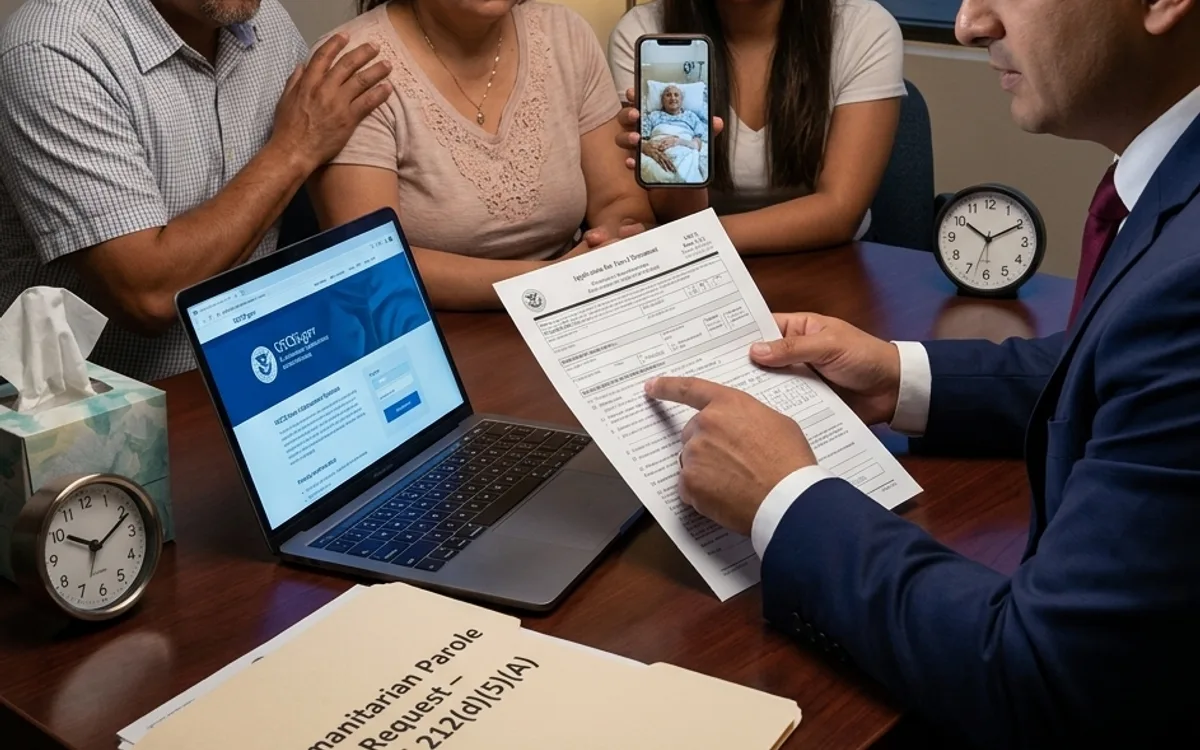
Your phone rings at 2 a.m. with news from across the world. A parent's surgery has been moved up. A sibling is in danger. A spouse's visa application stalled, and the clock on their safety is now measured in days, not months. You search for a flight, a visa, anything that gets them here before it is too late, and every ordinary option takes longer than the emergency allows.
Humanitarian parole exists for this kind of moment. It is a narrow, discretionary path that lets U.S. Citizenship and Immigration Services (USCIS) authorize temporary entry when no ordinary visa category fits and the need cannot wait for normal processing. It will not fix every problem, and it is never a guarantee. If the facts support it, it may be the only route fast enough to matter.
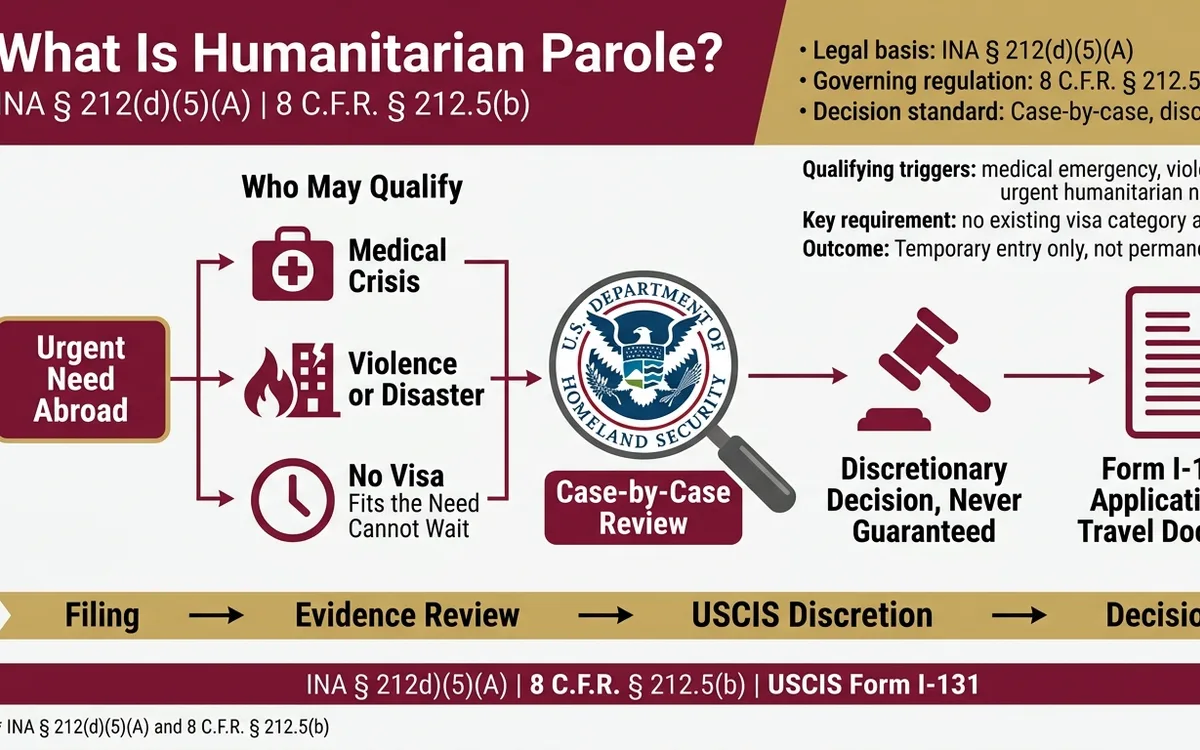
Humanitarian parole lets USCIS grant temporary entry to a noncitizen abroad facing a medical crisis, violence, or another urgent emergency, when no visa category fits and the need cannot wait for normal processing. It is discretionary under INA § 212(d)(5)(A) and 8 C.F.R. § 212.5(b), decided case by case, never guaranteed.
The Hard Truth
Humanitarian parole is not a right. Under INA § 212(d)(5)(A), USCIS has discretion to grant it only for a compelling emergency and significant public benefit, and the Supreme Court confirmed decades ago in Jean v. Nelson, 472 U.S. 846 (1985), that this discretion belongs to the agency, not the applicant.
There is no fixed timeline. USCIS Policy Manual, Vol. 7, Part B, Chapter 2, states each request is adjudicated on its own facts. A complete, urgent, well-documented package can still take weeks to resolve, sometimes longer if the agency requests more evidence.
Family ties alone will not move a request forward. A pending visa petition, a general asylum claim, or sympathy for the family's situation is not enough. What moves a request is a specific emergency with dates, medical records, and a named sponsor who can show real, verifiable support.
What Happens If You Wait
Every day spent deciding whether to file is a day the underlying emergency keeps moving. A parent's surgery date does not wait for paperwork, and a dangerous situation abroad does not pause while you weigh your options.
Evidence also degrades with time. Hospital records are easiest to obtain while the patient is still being treated at that facility. Witnesses to a threat are easiest to locate before they scatter. A thin, late-assembled package is harder to support than a complete one filed early, and USCIS adjudicates the facts as they exist at the time of filing, not as they existed months earlier.
If the person is already in an unstable location, delay can also mean missing a specific window: a scheduled surgery, an evacuation flight, a consular appointment that will not be rescheduled for months. Humanitarian parole does not pause those other clocks, and neither does waiting to file.
Step-by-Step Process
Confirm no faster option exists. Before filing for parole, we check whether an emergency visitor visa, an expedited immigrant visa interview, or another existing process could resolve the situation faster, since parole is meant for cases with no other avenue.
File Form I-131 through a USCIS online account (myUSCIS). USCIS requires most humanitarian or significant public benefit parole requests to be filed online, with a detailed written statement explaining the specific emergency, dates, and why no other option works.
File Form I-134, Declaration of Financial Support. The U.S.-based sponsor documents income, assets, and housing to show the agency the parolee will not become a public charge while in the country.
Assemble emergency evidence. This includes medical records, death or birth certificates, police reports, or sworn statements, all with certified translations if not in English.
Submit an expedite request to the USCIS Humanitarian Affairs Branch. This is a separate step from the base filing, directed specifically at the unit that reviews urgent parole cases, and it must spell out why the timeline itself is part of the emergency.
Attend biometrics and respond to any Request for Evidence. USCIS may ask follow-up questions before deciding; delay in responding restarts the clock.
Receive a decision. If approved, USCIS issues Form I-512L, Authorization for Parole, naming the port of entry and the parole period, generally up to one year under USCIS Policy Manual, Vol. 7, Part B, Chapter 2, and renewable in limited circumstances.
Travel to a U.S. port of entry. For North Carolina-based sponsors, that is often Charlotte Douglas International Airport (CLT) or Raleigh-Durham International Airport (RDU), where Customs and Border Protection processes the parolee on arrival.
If USCIS does not act within a reasonable time, consider a federal mandamus action. This is a lawsuit, filed in a court such as the U.S. District Court for the Western District of North Carolina, asking a judge to compel USCIS to decide under the Administrative Procedure Act, 5 U.S.C. § 706(1), sometimes paired with emergency relief under Federal Rule of Civil Procedure 65.
Plan for what happens during and after parole. A parolee can apply for work authorization on Form I-765, but parole itself is temporary and ends on its stated date; a longer-term plan, such as a family petition or asylum application, needs to start well before parole expires.
A Real-World Example
Consider a composite situation built from the kind of calls our office receives, not a specific client. A lawful permanent resident living in Charlotte learns her father in El Salvador has gone into acute kidney failure and needs a transplant evaluation only available at a specialized hospital in the U.S. No family-based visa petition is pending, and the standard immigrant visa line would take years.
The sponsor gathers the father's hospital discharge summary, lab results, and a letter from his treating physician describing the urgency. She files Form I-131 online with a written statement tying the medical timeline to the request, files Form I-134 with two years of tax returns and pay stubs, and submits a separate expedite request to the USCIS Humanitarian Affairs Branch referencing the physician's letter.
USCIS acknowledges receipt and later issues a Request for Evidence asking for an updated medical letter, since several weeks have passed. The family supplies it within the deadline. At this stage, the case is still pending adjudication, and the family is told, correctly, that the decision could go either way and that there is no set date by which USCIS must rule.
William J. Vasquez is a member of the North Carolina State Bar with federal immigration practice experience that includes humanitarian parole filings, sponsor documentation, and federal district court litigation over agency delay. He has handled parole requests built around medical emergencies, threats of violence, and other time-sensitive family situations, working directly with sponsors on the financial and evidentiary record USCIS expects to see.
His role in these cases is to assess, case by case, whether the facts meet the regulatory standard under 8 C.F.R. § 212.5(b) before a filing goes to USCIS, and to tell a family honestly when the evidence is not yet strong enough. Our team handles the surrounding filings, including Form I-134 sponsor packages and expedite requests to the Humanitarian Affairs Branch, so a single attorney is not managing every document alone under deadline pressure.
Key Terms Explained
Humanitarian Parole: discretionary authority under INA § 212(d)(5)(A) and 8 C.F.R. § 212.5(b) allowing USCIS to permit a noncitizen abroad to enter the U.S. temporarily for an urgent humanitarian reason, without granting a visa or formal admission.
Form I-131: the application used to request parole, now generally required to be filed through a USCIS online account (myUSCIS) for humanitarian and significant public benefit parole cases.
Form I-134: Declaration of Financial Support, filed by the U.S.-based sponsor to show the ability to house and financially support the parolee.
Significant Public Benefit Parole: a related but separate parole category, typically used for witnesses or informants assisting law enforcement, distinct from humanitarian parole for family or medical emergencies.
Advance Parole: a different document used by someone already in the U.S. with a pending application to travel abroad and return; it does not apply to a person who is currently outside the country seeking entry.
Form I-512L: the authorization document USCIS issues when a parole request is approved, naming the port of entry and the length of the parole period.
Humanitarian Affairs Branch: the USCIS unit that reviews expedite requests and urgent parole filings.
Mandamus Action: a federal lawsuit asking a court to compel a government agency to act on a request it has unreasonably delayed, authorized under the Administrative Procedure Act, 5 U.S.C. § 706(1).
Port of Entry: the location where Customs and Border Protection processes an arriving traveler, such as Charlotte Douglas International Airport (CLT) or Raleigh-Durham International Airport (RDU).
Frequently Asked Questions
Q: How fast can humanitarian parole be approved for a medical emergency? A: There is no guaranteed timeline. USCIS adjudicates each request on its own facts (USCIS Policy Manual, Vol. 7, Part B, Chapter 2), and a well-documented expedite request sent to the Humanitarian Affairs Branch can shorten review, but even urgent cases can take weeks.
Q: Can I appeal or ask USCIS to reconsider a denied humanitarian parole request? A: There is no formal appeal process. You can file a new request with additional evidence addressing the denial, or ask USCIS to reconsider if circumstances have changed since the original filing.
Q: Does humanitarian parole lead to a green card or permanent status? A: No. Parole is temporary permission to enter, generally up to one year under USCIS Policy Manual, Vol. 7, Part B, Chapter 2, and it does not by itself create eligibility for a green card; the parolee still needs a separate underlying basis, such as a family petition or asylum application, to stay longer.
Q: What if USCIS takes too long and the emergency cannot wait? A: In genuinely unreasonable-delay situations, it may be possible to file a mandamus action in federal district court, such as the U.S. District Court for the Western District of North Carolina, asking a judge to compel USCIS to act under the Administrative Procedure Act, 5 U.S.C. § 706(1).
Q: Who has to sponsor a humanitarian parole applicant financially? A: A U.S.-based sponsor, often a relative or friend, files Form I-134 to show they can support the person financially while on parole, with proof of income, assets, and a place for the parolee to stay.
Families who come to us for humanitarian parole are usually in the middle of the worst week of their lives, and what they tell other clients afterward tends to focus on communication: whether we returned calls quickly, explained each USCIS step honestly, and were direct about what the evidence could and could not support. That feedback shows up consistently in the firm's Google Business Profile reviews.
We do not cite outcome statistics for humanitarian parole, because USCIS decisions are individualized and discretionary, and a number would not describe any single family's case accurately.
If you are weighing whether to file now or wait for more information, the honest answer is usually to start gathering documents today, even before you decide on a lawyer. Hospital records, sponsor financial documents, and a clear written timeline of the emergency are useful regardless of who ends up filing the case.
If someone you love is facing a medical crisis, violence, or another emergency abroad and no ordinary visa will arrive in time, schedule a case review with our immigration team to find out whether humanitarian parole fits your facts and what to gather first. We will tell you plainly if the evidence does not yet support a filing, and what would need to change before it does.