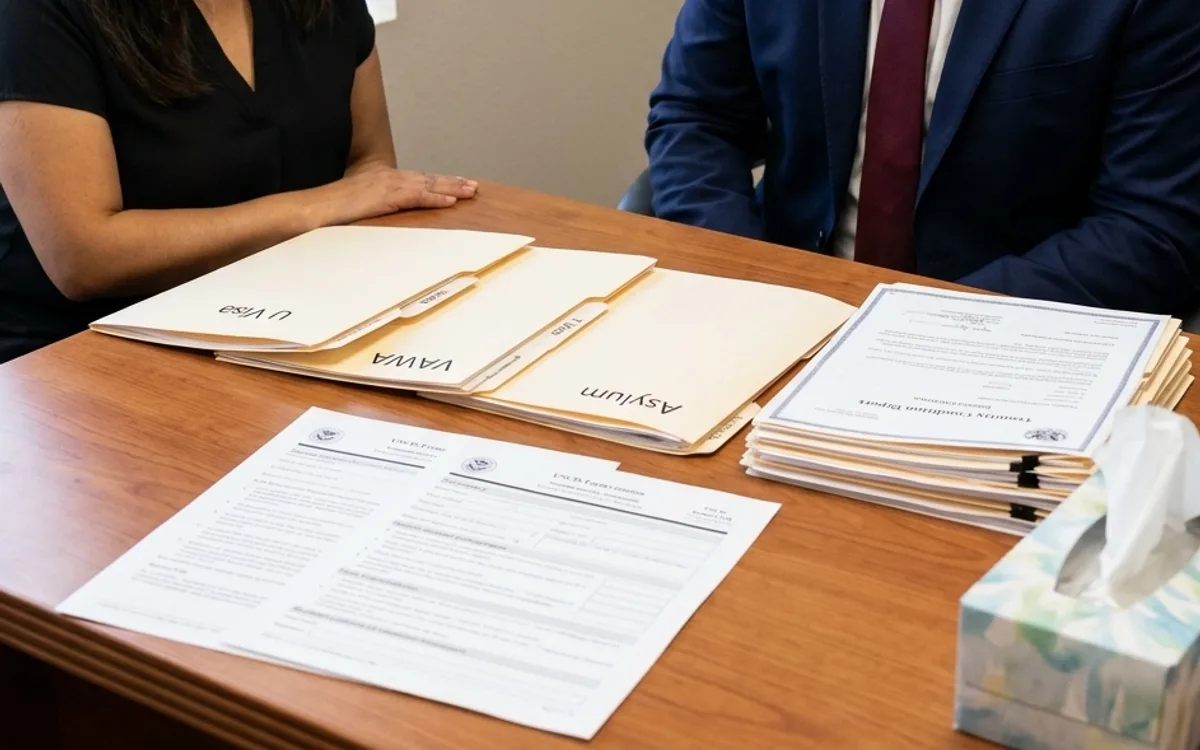
A knock from immigration enforcement. A child who crossed alone and doesn't know where her parents are. A marriage that turned violent, but no police report because calling the police felt more dangerous than staying. A trafficker who threatened your family back home if you ever talked. Humanitarian relief exists for people in exactly these situations, built into federal immigration law for decades, but it is not automatic and it is not fast. If you're reading this at midnight because someone told you there might be a path to stay, you're not wrong to look. You're also not finished with the hard part yet.
Humanitarian immigration relief covers several federal protections for crime victims, trafficking survivors, abused spouses and children, and people fleeing persecution: U visas, T visas, VAWA self-petitions, Special Immigrant Juvenile Status, asylum, and Temporary Protected Status. Each has its own form, agency, evidence standard, and timeline, filed with USCIS or in Immigration Court depending on the category.
The Hard Truth
The honest starting point: most humanitarian categories involve a wait measured in years, not months. The U visa program is capped at 10,000 principal petitions per fiscal year by statute (8 U.S.C. § 1184(p)(2)), and demand has exceeded that cap for more than a decade. USCIS now places qualifying petitioners on a waiting list, with deferred action and work authorization while they wait, but the wait itself can run past a decade before a visa number opens up, per USCIS's own published processing data. Asylum law has also narrowed in ways that matter if your claim rests on domestic violence. Matter of A-B-, 28 I&N Dec. 307 (A.G. 2021), restored a demanding standard for showing a private actor's abuse counts as persecution the home government was unwilling or unable to control. A case that would have been approved under earlier precedent is not guaranteed today. None of this means these categories don't work. It means the timeline and the evidence burden are the two things most people underestimate when they first ask about humanitarian relief.
What Happens If You Wait
Delay carries a different cost depending on which form you need. Asylum applicants generally must file within one year of their last arrival in the United States, under 8 U.S.C. § 1158(a)(2)(B); miss that window without a qualifying exception and the claim can be barred before anyone reviews the facts. Special Immigrant Juvenile Status requires the petitioner to be under 21 and unmarried when Form I-360 is filed, under 8 U.S.C. § 1101(a)(27)(J); a birthday can close that door permanently. TPS carries its own clock. Each designated country's redesignation and re-registration window is published in the Federal Register and closes on a fixed date; miss it and you wait for the next designation period, if one comes at all. And if you're already in removal proceedings while a humanitarian petition sits pending, the Charlotte Immigration Court docket does not pause on its own. Deadlines set at a master calendar hearing keep running whether or not your I-918 or I-360 has been decided.
Step-by-Step Process
The exact sequence depends on which relief fits your facts, but most humanitarian cases handled out of North Carolina move through a similar structure. 1. Screening. We review the facts against each humanitarian category: crime-victim cooperation for a U visa, trafficking indicators for a T visa, a qualifying family relationship and abuse for VAWA, abandonment or abuse for SIJS, or a fear of return for asylum or withholding of removal. 2. Evidence and certification. A U visa petition needs Form I-918 Supplement B, a certification signed by a North Carolina law enforcement agency, prosecutor, or judge confirming the victim was helpful in investigating or prosecuting the crime (8 C.F.R. § 214.14(c)(2)(i)). A VAWA self-petition does not require a police report or the abuser's knowledge (8 U.S.C. § 1154(a)(1)(A)(iii)) and instead relies on affidavits, medical records, and other proof of the relationship and abuse. SIJS requires a North Carolina district court order addressing custody, reunification, and the child's best interest before Form I-360 can be filed. 3. Filing. U visas, T visas, and VAWA self-petitions all file with USCIS's Vermont Service Center, the sole center that adjudicates Forms I-918, I-914, and I-360. Asylum applicants already in removal proceedings file instead with the Charlotte Immigration Court through EOIR's electronic case access and filing system, ECAS. 4. Interim relief. While a petition is pending, USCIS may place a U visa petitioner on the waiting list with deferred action and work authorization. T visa and VAWA applicants can also seek work authorization once a petition is deemed bona fide. 5. Decision and next steps. A grant of U or T status, an approved VAWA self-petition, or an SIJS-based green card application each opens a separate path toward adjustment of status. A denial, in most categories, can be appealed or, in removal proceedings, renewed before the immigration judge.
A Real-World Example
Consider a composite built from the kind of cases our team handles, not a real client: a woman we'll call Ana came to North Carolina on a work visa and married a U.S. citizen. The marriage turned violent, but she never called the police, afraid a report would end with her own deportation. Her case began with documenting the abuse without a police report: a declaration, medical records from a visit to a Mecklenburg County clinic, and messages from her husband. We prepared a VAWA self-petition on Form I-360, filed with the Vermont Service Center, laying out the marriage, the abuse, and her good moral character. USCIS first reviews the filing for completeness, then screens it for a prima facie case, then moves to a full merits review, a sequence that commonly runs well over a year from filing to decision, per USCIS's published processing times for Form I-360. While the petition sat pending, Ana applied separately for work authorization. This composite is built to show what that first year actually looks like: the paperwork, the waiting, the questions about whether a request for additional evidence will arrive. It is not a prediction about how any individual case will be decided.
William J. Vasquez has spent years of his practice on federal immigration matters, including humanitarian relief filings before USCIS and removal defense before the Charlotte Immigration Court. His work covers U and T visa petitions, VAWA self-petitions, SIJS cases built on North Carolina state court orders, and asylum, withholding of removal, and CAT claims. He focuses on building the factual record, the police report or its absence, the medical documentation, the state court order, before a single form is filed, because the evidence standard is where most humanitarian petitions succeed or fail. That focus reflects years of handling these filings, not a certification claim.
Key Terms Explained
U visa: Nonimmigrant status for victims of certain crimes who assist law enforcement, created by 8 U.S.C. § 1101(a)(15)(U). T visa: Nonimmigrant status for survivors of human trafficking, filed on Form I-914. VAWA self-petition: A Form I-360 petition filed by an abused spouse, child, or parent of a U.S. citizen or lawful permanent resident, filed without the abuser's knowledge or participation. Special Immigrant Juvenile Status (SIJS): Status for a child under 21 with a state court order finding reunification with one or both parents is not viable and return to the home country is not in the child's best interest. Asylum: Protection for a person who meets the refugee definition and applies within one year of arrival, absent a recognized exception, under 8 U.S.C. § 1158. Withholding of removal: A form of protection from deportation requiring a higher burden, a 'clear probability' of persecution, than asylum's 'well-founded fear' standard, under 8 U.S.C. § 1231(b)(3). CAT protection: Protection under the Convention Against Torture requiring proof it is more likely than not the applicant would be tortured if returned, under 8 C.F.R. § 1208.16(c). Temporary Protected Status (TPS): A designation allowing nationals of specific countries to remain and work temporarily due to conditions in that country, subject to periodic redesignation. Form I-918 Supplement B: The law enforcement certification required for a U visa petition, confirming the victim's helpfulness in a criminal investigation or prosecution. EOIR / ECAS: The Executive Office for Immigration Review, which oversees immigration courts, and its electronic case access and filing system. Vermont Service Center: The USCIS office that adjudicates all Form I-918, I-914, and I-360 filings nationwide.
Frequently Asked Questions
Q: Can I file a VAWA self-petition without a police report? A: Yes. VAWA self-petitions rely on affidavits, medical records, counseling records, and other proof of abuse, and the law does not require the abuser to know about the filing, under 8 U.S.C. § 1154(a)(1)(A)(iii). Q: What happens if a North Carolina police department refuses to sign Form I-918 Supplement B? A: A refusal does not end a U visa case outright. The certifying agency has discretion, and in North Carolina a petitioner can sometimes seek certification from a prosecutor's office or a judge instead, or ask the original agency to reconsider with additional documentation of cooperation. Q: Does Special Immigrant Juvenile Status require a North Carolina custody case first? A: Yes. SIJS requires a state court order, typically from a North Carolina district court, addressing custody or guardianship and making specific findings about reunification and best interest, before Form I-360 can be filed. Q: How long does the U visa waiting list take? A: Processing varies by case, but USCIS's published data for Form I-918 shows a multi-year wait for a visa number after the annual statutory cap of 10,000 is reached, per 8 U.S.C. § 1184(p)(2). Petitioners on the waiting list can request work authorization and deferred action while they wait.
Clients who come to us for humanitarian relief are usually carrying two fears at once: fear of the abuser, trafficker, or home country, and fear of immigration enforcement itself. What they describe afterward, in reviews and in conversations with our team, is less about a single result and more about finally understanding the process, what was filed, when, and what happens next. We do not publish outcome statistics. Case results in humanitarian relief depend on individual facts, agency adjudication, and law that changes from year to year.
If you're not sure which category applies to you, or whether you qualify at all, that uncertainty is normal. Most people who call us have already searched online and found five different forms with five different deadlines. A consultation starts with your specific facts, the relationship, the harm, the paperwork you already have, not with a form number picked off a website.
Humanitarian relief cases are decided on the evidence filed in the first petition, not on an appeal years later. If you are a crime victim, a trafficking survivor, an abused spouse or child, or someone facing return to danger, schedule a consultation with our immigration team to review your eligibility for a U visa, T visa, VAWA self-petition, SIJS, asylum, or TPS, and to map out the filing and documents your case needs.
- U Visa Lawyer North Carolina
- VAWA Self-Petition Attorney Charlotte
- Special Immigrant Juvenile Status (SIJS) Attorney
- Asylum and Withholding of Removal Attorney Charlotte
- Temporary Protected Status (TPS) Filing Help
- Removal Defense Attorney Charlotte Immigration Court
- Contact Our Immigration Team