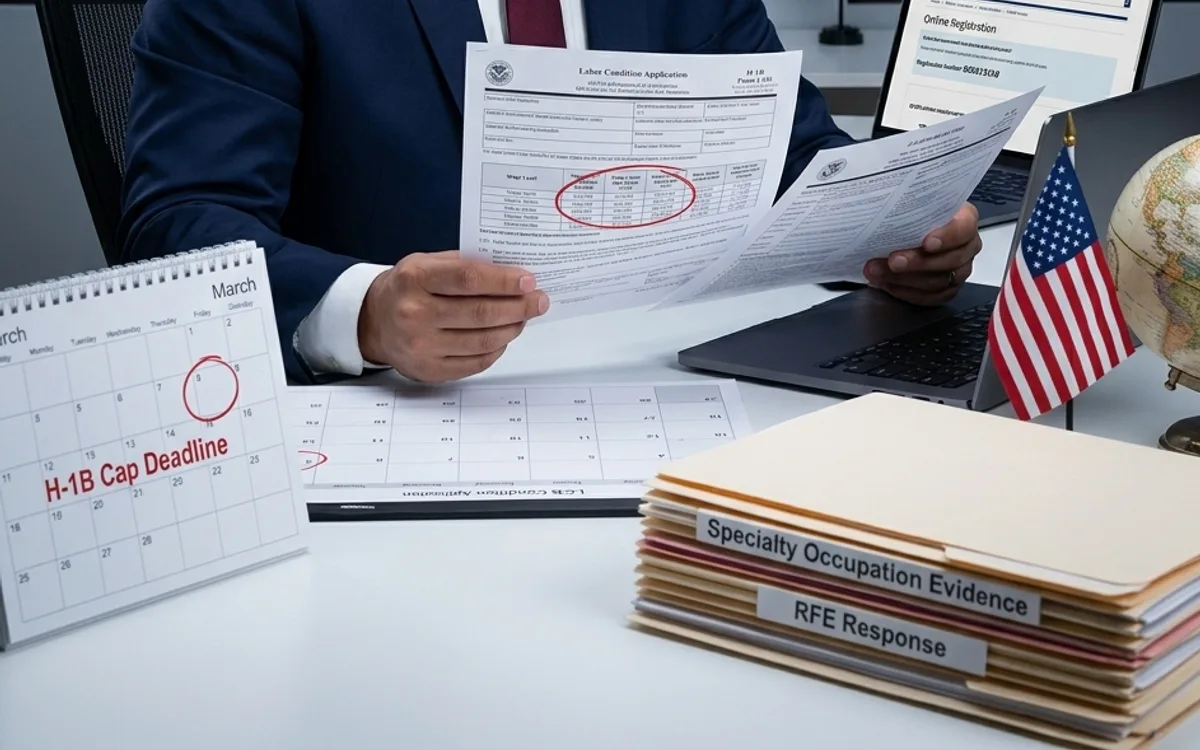
Your H-1B registration went into a pool of names, and a computer picked who gets a petition filed this year. That is the entire selection process. No ranking, no weight given to your degree, your employer's size, or how many years you have worked in the United States.
If your number was not drawn, your current work authorization still depends on whatever status you already hold, and that status does not pause because the lottery did not go your way. If you were selected, a different anxiety starts. Your employer controls the petition, your job controls your status, and a layoff can start a 60-day grace period you did not choose and cannot extend on your own.
You are not powerless in this, even though the lottery itself is out of your hands. The parts you can control, the LCA wage level your employer files, the specialty-occupation evidence in the petition, the timing of a job change, the paperwork after a layoff, are the parts a lawyer can help you get right the first time.
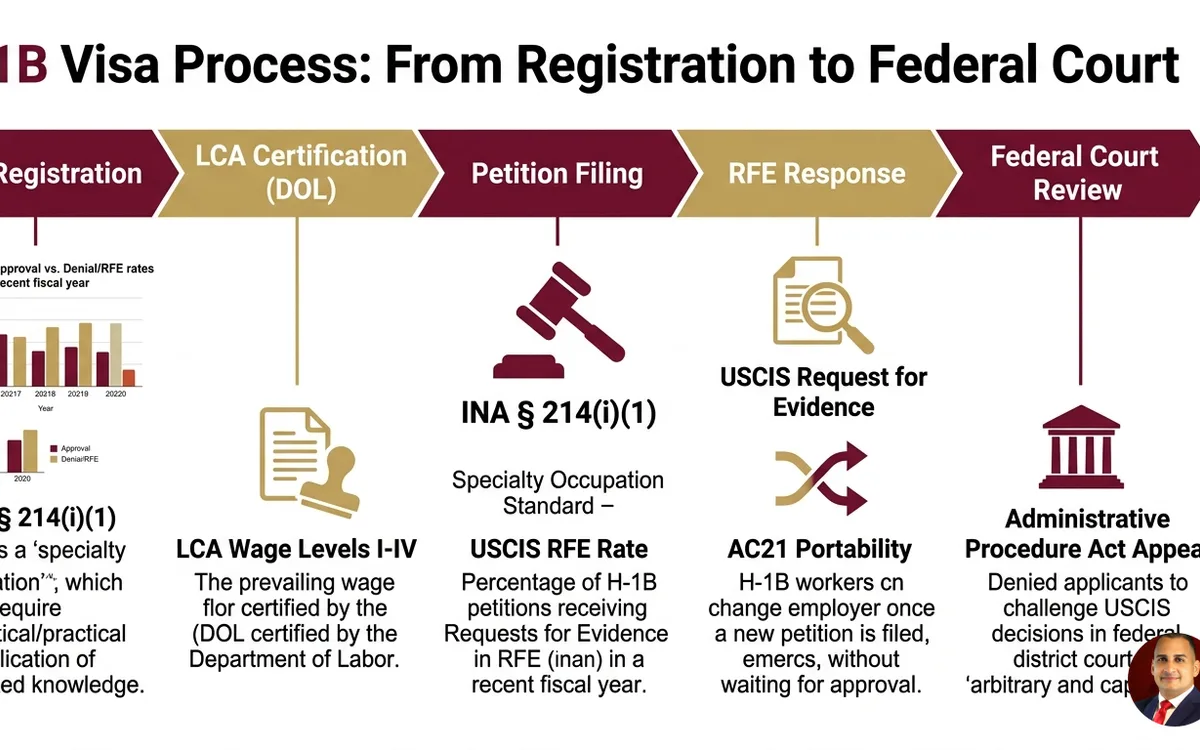
An H-1B visa attorney prepares cap-registration filings, specialty-occupation evidence under INA § 214(i)(1), and LCA wage-level documentation with the Department of Labor. They respond to USCIS Requests for Evidence, advise on AC21 portability when changing employers, and represent denied applicants in federal district court under the Administrative Procedure Act.
The Hard Truth
The lottery decides who gets considered, not who gets approved. A selection notice means USCIS will accept a petition for filing. It is not a visa grant. INA § 214(g)(1) caps the regular category at 65,000 visas a year, with another 20,000 reserved for applicants holding a U.S. master's degree or higher, and most years both numbers are gone within the registration window.
Once a petition is filed, USCIS reviews it against the specialty-occupation standard in INA § 214(i)(1) and the evidentiary criteria at 8 C.F.R. § 214.2(h)(4)(iii)(A). A generic job title, or an LCA wage level that does not match the duties described in the petition, is a common reason USCIS issues a Request for Evidence. An RFE is not a denial, but it is also not a formality.
Some petitions do not survive the RFE stage. We tell clients this before we file, not after, because the specialty-occupation standard turns on how the job and the degree are described, and that description has to hold up under agency scrutiny, not just sound reasonable to the employer who wrote it.
What Happens If You Wait
A layoff starts a 60-day grace period under 8 C.F.R. § 214.1(l)(2). That is 60 calendar days, not 60 business days. If you spend three weeks deciding whether to call a lawyer, you have already used half the window to find a new sponsoring employer, file a change of status, or arrange your departure before falling out of status.
An RFE deadline works the same way. USCIS sets a fixed response date printed on the notice itself, and a late or incomplete response usually ends in denial rather than in a request for more time. There is no second deadline to fall back on.
Waiting to start a green card process while comfortable on H-1B status creates a separate, slower-moving risk. Extending H-1B status past the standard six-year limit under AC21 § 106 depends on having an I-140 petition or labor certification on file for 365 days before the limit hits. A reader who waits until year five to start that process may run out of runway before year six arrives, with no extension available to buy more time.
Step-by-Step Process
Step one is employer registration, filed electronically by the sponsoring employer during the USCIS registration period, typically in March, for a per-registrant fee set on USCIS's published fee schedule. Step two is the lottery itself. USCIS notifies selected registrants, usually by early April, and selection opens a 90-day window to file the full petition.
Step three is the Labor Condition Application. The employer files Form ETA-9035 with the Department of Labor's Office of Foreign Labor Certification, attesting to the wage level, worksite, and prevailing wage for the position; DOL certification is required before the H-1B petition itself can be filed. Step four is the Form I-129 petition, filed with evidence addressing the specialty-occupation criteria at 8 C.F.R. § 214.2(h)(4)(iii)(A), including the degree requirement, job duties, and the LCA.
Premium processing, where requested, puts USCIS on a 15-calendar-day adjudication clock for an additional government fee; confirm the current fee directly with USCIS before filing, since it is adjusted periodically. If USCIS issues an RFE, the response is due by the date on the notice and should address the specific regulatory criteria USCIS cited, not just restate the original petition.
Once approved, work can begin on October 1 of the fiscal year, or immediately if the worker is already in valid H-1B status with a different employer. From there, AC21 § 105 portability lets a worker start a new H-1B job once a new employer's petition is filed, without waiting for approval, as long as the worker's current status is valid at the time of filing. If a petition is denied, options include a motion to reopen with USCIS or a federal lawsuit under the Administrative Procedure Act, filed in U.S. district court, not state court, since immigration adjudication is entirely federal.
A Real-World Example
Consider a composite, non-client scenario built from common fact patterns we see in this area. A biomedical engineer working for a device manufacturer in Research Triangle Park registers in the March lottery and is selected in April. The employer's HR team files Form ETA-9035 with the Department of Labor, listing the position at LCA wage level II based on the engineer's years of specialized experience.
Form I-129 is filed within the 90-day window, with premium processing requested because a project start date is approaching. Six weeks later, USCIS issues a Request for Evidence questioning whether a biomedical engineering degree is specific enough to the duties listed, citing 8 C.F.R. § 214.2(h)(4)(iii)(A) and referencing the specialty-occupation reasoning courts have applied in cases like Defensor v. Meissner, 201 F.3d 384 (5th Cir. 2000).
The response package includes a detailed job-duties letter from the employer, university course descriptions, and a credential evaluation letter connecting the specific coursework to the specific duties. This sequence, registration, selection, LCA, filing, possible RFE, response, is the realistic shape of most H-1B cases. It is not a representation about how any individual case resolves.
William J. Vasquez is a member of the North Carolina State Bar. Immigration practice before USCIS and the Executive Office for Immigration Review is federal, so representation in these matters is not limited by state bar lines; an attorney licensed in any state may appear before USCIS and the immigration courts nationwide under 8 C.F.R. § 1292.1.
His practice includes employment-based petitions such as H-1B specialty-occupation filings, RFE responses, and AC21 portability matters for workers changing employers mid-process. Our immigration team tracks current USCIS RFE patterns on the specialty-occupation standard and Department of Labor wage-level determinations as part of ongoing casework, not as a one-time review before filing.
We describe what we handle and how we handle it. We do not quote approval statistics for H-1B cases, because individual case outcomes are not something a law firm can verify or guarantee in advance.
Key Terms Explained
Specialty occupation: under INA § 214(i)(1), a position requiring theoretical and practical application of a body of specialized knowledge and at least a bachelor's degree or its equivalent in a specific field related to the duties.
LCA (Labor Condition Application): Form ETA-9035, filed by the employer with the Department of Labor's Office of Foreign Labor Certification, attesting to the wage level, work location, and working conditions for the H-1B position before the petition is filed.
RFE (Request for Evidence): a USCIS notice asking for additional documentation on a specific issue in a pending petition, issued with a fixed response deadline printed on the notice.
AC21 portability: provisions in the American Competitiveness in the Twenty-First Century Act, including § 105 and § 106, that let an H-1B worker begin work for a new sponsoring employer once that employer's petition is filed, and that allow extensions beyond the standard six-year limit under specified conditions.
Cap-exempt employer: under INA § 214(g)(5), a university, a nonprofit entity affiliated with a university, or certain nonprofit or government research organizations, whose H-1B petitions are not counted against the annual numerical cap and can be filed year-round.
Premium processing: an optional USCIS service that commits the agency to adjudicate a petition, or issue an RFE, within 15 calendar days of receipt, for an additional filing fee set on USCIS's published fee schedule.
60-day grace period: the window under 8 C.F.R. § 214.1(l)(2) during which an H-1B worker whose employment ends may remain in the United States to find new sponsorship, change status, or depart, without immediately falling out of status.
Frequently Asked Questions
Q: What happens if I am not selected in the H-1B cap lottery? A: Your underlying status does not change because of the lottery result. If you are on OPT, your work authorization runs on its own clock and any STEM OPT extension deadlines still apply regardless of the lottery outcome, so check your I-20 and OPT dates directly with your school's international office.
Q: Can I change employers while my H-1B petition is pending or already approved? A: Yes. Under AC21 § 105, a new employer can file an H-1B petition on your behalf, and you can start working for them once that petition is filed, called portability, as long as your current H-1B status is valid at the time of filing and the new petition is non-frivolous.
Q: What happens to my H-1B status if I am laid off? A: You enter a 60-day grace period under 8 C.F.R. § 214.1(l)(2), during which you can find a new sponsoring employer who files a transfer petition, change to another status, or depart the country, and the grace period ends at 60 days or your authorized stay, whichever comes first.
Q: Can I challenge an H-1B denial in federal court? A: Yes, through a lawsuit under the Administrative Procedure Act filed in U.S. district court, arguing the denial was arbitrary, capricious, or contrary to law; courts reviewing specialty-occupation denials have applied reasoning from cases such as Defensor v. Meissner, 201 F.3d 384 (5th Cir. 2000), though outcomes depend on the specific record USCIS built in your case.
Q: What is the difference between LCA wage level 1 and wage level 2? A: Wage levels, set by Department of Labor prevailing wage guidance, reflect the experience, judgment, and supervisory responsibility the position requires, with level 2 generally corresponding to positions above entry level; a mismatch between the wage level and the job duties described in the petition is a documented basis for USCIS to question whether the position genuinely qualifies as a specialty occupation.
Clients who have worked with our immigration team describe straightforward explanations of RFE deadlines, LCA wage-level questions, and portability timing in reviews posted to Google and other public platforms. We encourage you to read those reviews directly rather than rely on a summary here. We do not cite outcome statistics or approval rates as a basis for trust; our process is the part we can describe accurately, and the part worth checking before you decide.
If you are waiting on a registration result, holding an RFE notice you do not fully understand, or weighing a job offer that would require a new H-1B filing, the next useful step is a direct conversation about your specific dates and documents, not another general article about the process.
Schedule a consultation with our immigration team to review your H-1B registration status, RFE notice, layoff timeline, or employer-change plan against your actual filing dates. We handle H-1B petitions, RFE responses, AC21 portability filings, and the transition toward employment-based green card categories as part of our broader immigration practice. Call our North Carolina office or request a consultation online to go over what applies to your specific situation.
- Employment-Based Immigration Overview
- L-1 Visa Attorney
- PERM Labor Certification Guidance
- EB-2 National Interest Waiver
- Immigration Appeals and Federal Court Litigation
- Schedule a Consultation