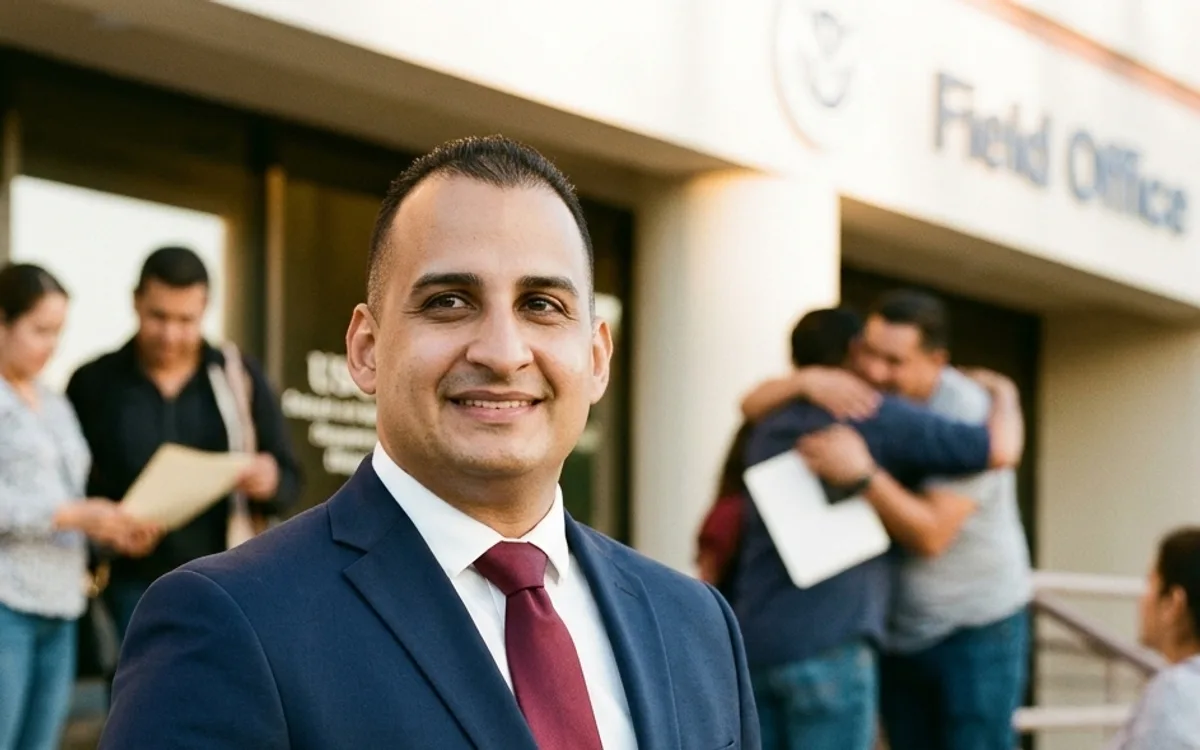
You check the Visa Bulletin the same day every month. Maybe your spouse's category finally moved, or maybe it sat still again while your parent or sibling waits somewhere else, and you are the one carrying the paperwork forward. Years into this, the fear is not abstract: one income line miscalculated on the I-864, one document the National Visa Center says is missing, or one birthday your child crosses before the case catches up, and progress that took years to build can stall or reset. Family-based immigration cases are not fast, and no attorney can move the Visa Bulletin. What an attorney can do is make sure nothing on your side of the file is the reason your family waits longer than the law already requires.
A family-based immigration attorney files Form I-130 to establish a qualifying relationship, then tracks your priority date against the State Department's monthly Visa Bulletin. Spouses and minor children of U.S. citizens face no annual cap under INA § 201(b). Siblings and adult children wait in preference categories that can take over a decade.
The Hard Truth
Some family petitions move in months. Others take longer than a decade, and that is not a failure of process, it is how the numerical caps in INA § 201 work. F4 sibling petitions, in particular, sit behind every other family and employment category, and the Department of State's Visa Bulletin Final Action Dates chart has shown F4 waits well past ten years for petitioners' siblings from high-demand countries. A priority date can also retrogress after it becomes current, meaning the cutoff date moves backward in a later bulletin and your case is no longer current even though it was last month. No attorney, however experienced, can change your place in that queue. What we can control is whether the I-130, the I-864 affidavit of support, and every NVC document arrives complete and on time, so government processing is the only thing slowing your case down, not an avoidable error.
What Happens If You Wait
A Request for Evidence on an I-130 spousal petition typically gives you a fixed window, often around 87 days per USCIS's own processing guidance, to respond or the case is denied on the record as it stands. The National Visa Center terminates a registration under 22 C.F.R. § 42.83 if required documents are not submitted within one year of the initial document request, which means a family that goes quiet for twelve months can lose its place and have to start the immigrant visa process over. For a child approaching 21 in the F2B or F3 category, the Child Status Protection Act freezes their age only if specific filing steps happen inside a defined window after the priority date becomes current; miss that window and the child ages out of the petition entirely, a result the Supreme Court addressed directly in Cuellar de Osorio v. Mayorkas, 573 U.S. 41 (2014). None of these are hypothetical risks. They are recurring, correctable failure points that show up in real family petitions every year.
Step-by-Step Process
Step one is filing Form I-130, Petition for Alien Relative, under 8 U.S.C. § 1154(a)(1)(A)(i), with evidence of the qualifying relationship that satisfies 8 C.F.R. § 204.2, marriage certificates, birth certificates, or proof of the stepparent or stepchild relationship where applicable. USCIS issues a receipt notice, and processing runs from months to over a year depending on the service center and category. Once approved, an immediate relative petition (spouse, parent, or minor child of a U.S. citizen) moves straight to visa processing since there is no annual cap under INA § 201(b); a preference-category petition (F1, F2A, F2B, F3, or F4) instead waits for its priority date to become current on the monthly Visa Bulletin. For a beneficiary abroad, the approved petition transfers to the National Visa Center in Portsmouth, New Hampshire, which collects the DS-260 immigrant visa application through the CEAC portal, the I-864 affidavit of support, and civil documents before scheduling a consular interview. For a beneficiary already lawfully in the United States, the alternative is adjustment of status, filed with USCIS instead of processed through a consulate, with interviews for Charlotte-area cases typically held at the USCIS Charlotte Field Office, 6130 Tyvola Centre Drive, Charlotte, NC 28217, and biometrics frequently taken at the Application Support Center in Raleigh.
A Real-World Example
Consider a composite case built from patterns we see regularly, not any real client. A U.S. citizen in Mecklenburg County files an I-130 for a sibling abroad, an F4 petition. USCIS approves the petition within about a year, but the case then sits with the National Visa Center for years while the F4 priority date slowly advances on the monthly bulletin. When the date finally approaches current, NVC requests the DS-260 and civil documents, and the petitioner's income, checked against the 125% federal poverty guideline required under INA § 213A, falls short for the household size once the sibling's own dependents are counted. That requires a joint sponsor, someone willing to file a separate I-864 or an I-864A contract, with their own tax returns and proof of income. Once the joint sponsor's documents are submitted and NVC completes its document review, the case is placed in line for interview scheduling at the appropriate U.S. consulate, at which point the priority date, the sponsor's finances, and the underlying relationship all remain subject to review by a consular officer.
William J. Vasquez focuses his practice on family-based immigration matters, including I-130 petitions, NVC document processing, adjustment of status, and affidavit of support disputes, working with petitioners across the family preference categories from spouses and minor children to siblings waiting in the F4 backlog. His work centers on catching the errors, income shortfalls, and CSPA timing issues that cause avoidable delay before they reach USCIS or the National Visa Center. Our broader immigration team supports that work across intake, document preparation, and NVC follow-up, so a case does not depend on any single person's calendar.
Key Terms Explained
I-130 (Petition for Alien Relative): the form a U.S. citizen or lawful permanent resident files with USCIS to establish a qualifying family relationship under 8 U.S.C. § 1154(a)(1)(A)(i).
Priority date: the date USCIS receives a properly filed I-130, which fixes the beneficiary's place in line for a preference category.
Visa Bulletin: the U.S. Department of State's monthly publication of Final Action Dates, which shows which priority dates are currently eligible to move forward for each family preference category.
Retrogression: when a category's cutoff date in a later Visa Bulletin moves backward, making a previously current priority date no longer current.
National Visa Center (NVC): the federal office in Portsmouth, New Hampshire that manages document collection and interview scheduling for approved petitions headed to a U.S. consulate abroad.
DS-260: the online Immigrant Visa Electronic Application, submitted through the CEAC portal once NVC begins processing a consular case.
I-864 (Affidavit of Support): the sponsor's legally binding promise, required under INA § 213A, to financially support the immigrating relative, backed by income at or above 125% of the federal poverty guideline.
Joint sponsor: a second person who signs a separate I-864 when the original petitioner's income does not meet the threshold alone.
CSPA (Child Status Protection Act): the federal law that can freeze a child's age for immigration purposes past their 21st birthday under specific timing rules, as interpreted in Cuellar de Osorio v. Mayorkas.
Adjustment of status: the process of applying for a green card from inside the United States, filed with USCIS, as opposed to consular processing abroad.
Frequently Asked Questions
Q: How long does the F2A category take for a green card holder's spouse in 2025? A: F2A has historically been current or very close to current on the Visa Bulletin for most countries, making it one of the faster preference categories, though it is still slower than immediate relative processing for a U.S. citizen's spouse and can shift month to month.
Q: What happens if my sponsor's income is below the 125% poverty guideline on the I-864? A: You need a joint sponsor, a separate person who meets the income threshold and signs their own I-864, or you can combine household income using Form I-864A if the joint sponsor lives with you; NVC will not proceed without a qualifying affidavit.
Q: My priority date became current, then the next Visa Bulletin moved it back. What now? A: That is retrogression. Your case pauses until the date becomes current again in a future bulletin; check whether NVC has already begun document review, since a retrogressed date does not remove you from that queue.
Q: How does a child avoid aging out of the F2B category? A: The Child Status Protection Act can lock in a younger age if the parent files the required step (such as the I-824 or DS-260) within one year of the priority date becoming current, per the calculation the Supreme Court addressed in Cuellar de Osorio v. Mayorkas; missing that window risks the case reverting to a slower category or the child losing eligibility.
Q: Can I convert my case from F2B to a faster category? A: If the petitioner naturalizes as a U.S. citizen while the F2A or F2B petition is pending, an unmarried child under 21 can convert to immediate relative status, removing the annual cap; a child over 21 generally converts to the F1 category instead.
Families come to us at every stage, some filing a first I-130, others stuck at NVC for years, others responding to an RFE they do not understand. What they consistently tell us afterward is that someone finally explained their specific priority date, their specific category, and their specific timeline, instead of a general answer. That is the standard we hold the team to on every family case, regardless of size or category.
If you are staring at this month's Visa Bulletin trying to figure out what your category's movement actually means for your case, you do not have to work through the I-864 math or the NVC checklist alone.
Schedule a consultation with our immigration team to have your specific petition, priority date, and affidavit of support reviewed before the next Visa Bulletin comes out. We will tell you exactly where your case stands and what, if anything, needs to be fixed before it moves forward.
- Family-Based Immigration Overview
- I-130 Petition Filing Assistance
- Adjustment of Status Services
- Consular Processing and NVC Support
- Affidavit of Support (I-864) Review
- Schedule a Family Petition Consultation