Your OPT clock keeps running no matter what's happening around you: a slow HR department, a missed E-Verify enrollment, a lottery result that comes back empty. You came here on an F-1 visa to study, and now you are trying to turn that degree into a job, that job into an H-1B, and that H-1B into a future that does not depend on a visa category at all. Every week that passes without a clear plan for your unemployment days, your STEM extension paperwork, or your cap-gap timing is a week closer to a problem you cannot undo after the fact. The stakes are real, and they are measured in days.
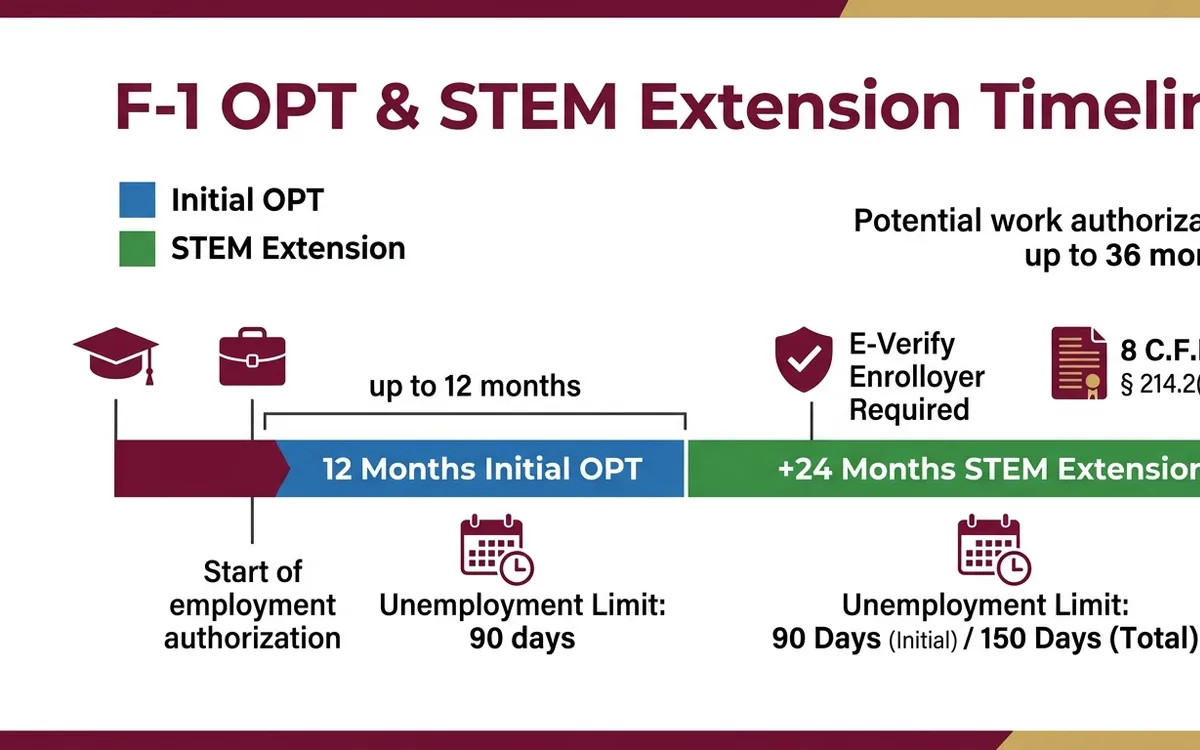
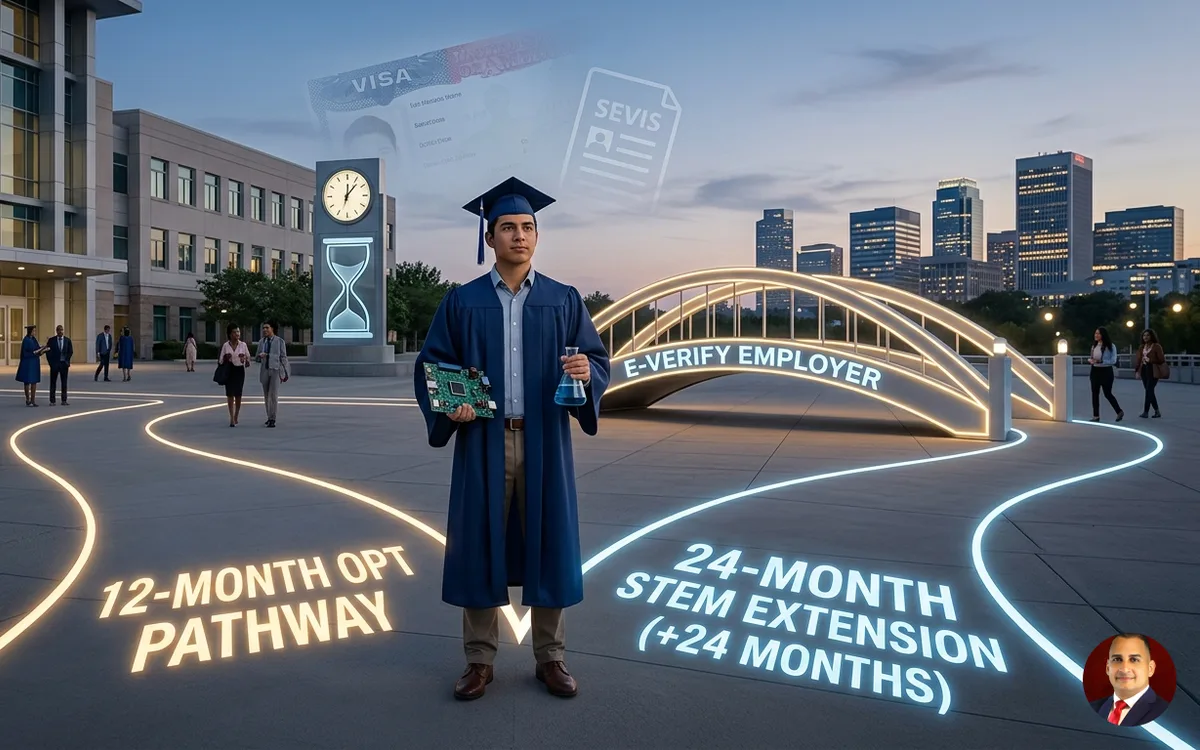
F-1 students can work after graduation under Optional Practical Training (OPT) for up to 12 months. STEM graduates may extend 24 more months under 8 C.F.R. § 214.2(f)(10)(ii), if their employer enrolls in E-Verify. Unemployment is capped at 90 days during initial OPT and 150 days total across both periods.
The Hard Truth
STEM OPT is not a formality. USCIS tracks your unemployment days through SEVIS, and your school's designated school official (DSO) has to report accurate data on a schedule the agency sets, not one you negotiate. If your employer is not enrolled in E-Verify, you are not eligible for the 24-month STEM extension, full stop, no matter how strong your job offer looks on paper. Cap-gap only extends your work authorization while your H-1B case is pending selection and adjudication. If your H-1B is not selected in the lottery, or USCIS denies the change of status, that extension ends on the date of the rejection or denial notice. September 30 has nothing to do with it, and neither does whatever later date you may have assumed you had.
What Happens If You Wait
Miss the 90-day unemployment limit on initial OPT, or the combined 150-day limit once you add the STEM extension, and your DSO is required to terminate your SEVIS record for a status violation (8 C.F.R. § 214.2(f)(10)(ii)(E)). A terminated SEVIS record does not just end your work authorization. It can cut off your ability to file a timely change of status, force you to leave the country to preserve any future immigration options, and create a record USCIS will ask about on every filing that follows. If your STEM employer quietly lets its E-Verify enrollment lapse, or never had it, your extension can be invalidated retroactively, and the clock you thought you had left disappears. Waiting to find out whether these problems apply to you is how students lose months they cannot get back.
Step-by-Step Process
Start before your 90-day initial OPT unemployment clock is a concern: confirm your Form I-20 recommendation and Form I-765 approval dates with your school's international office, whether that is NC State University's Office of International Services, UNC-Chapel Hill's International Student and Scholar Services, or Duke's Visa Services Office. Second, if you plan to pursue the STEM extension, confirm in writing, before you accept an offer, that the employer is currently enrolled in E-Verify under 8 C.F.R. § 214.2(f)(10)(ii); a staffing agency can sponsor the extension only if the agency itself, not a client site alone, holds the E-Verify enrollment tied to your worksite. Third, file your STEM extension application, including the new Form I-20 from your DSO and the signed Form I-983 training plan, before your initial OPT authorization expires; USCIS does not require a new I-20 for a job change alone, but it does require an amended I-983 within 10 days of any change in employer or supervisor. Fourth, track unemployment days across both periods using the SEVP Portal, not a personal spreadsheet your DSO cannot see. Fifth, if your employer intends to file an H-1B petition, confirm the Form I-129 is filed before your OPT or STEM OPT authorization expires and requests a change of status effective October 1, which triggers the automatic cap-gap extension under 8 C.F.R. § 214.2(f)(5)(vi). Sixth, if the H-1B is not selected in the registration process, or USCIS issues a denial, your cap-gap extension ends on that notice date; at that point you need a plan ready the same day, covering a different status, a grace period departure, or another visa category. Interviews and biometrics tied to a later change-of-status filing, if one is needed, are generally scheduled through the Charlotte USCIS Field Office for North Carolina-based applicants.
A Real-World Example
Consider a composite example drawn from the kind of filing our office sees often in the Research Triangle Park STEM-employer corridor: a computer science graduate on initial OPT accepts a software engineering role at a mid-sized employer that has never used E-Verify. Before accepting, the student and the firm's attorneys review the employer's E-Verify status and confirm enrollment is possible but not yet completed. The firm coordinates with the student's DSO at NC State to time the STEM extension filing around the enrollment date, drafts the initial Form I-983 training plan with the employer's HR team, and sets a calendar for the 10-day amendment window in case the student later changes supervisors. When the employer's H-1B petition is filed the following spring, the firm tracks the registration and change-of-status filing dates against the OPT expiration date to confirm cap-gap eligibility applies. The remainder of the case, including the lottery result and any adjudication, proceeds through USCIS on its own timeline, outside the firm's control, which is why the planning happens months before any of those steps.
William J. Vasquez is admitted to the North Carolina State Bar and focuses his federal immigration practice on matters before USCIS and the Executive Office for Immigration Review (EOIR), including student status, employment-based work authorization, and related filings. Federal immigration practice before USCIS and EOIR does not require a state-specific bar admission matched to the client's location; under 8 C.F.R. § 1292.1, any attorney licensed and in good standing in a single U.S. state may represent clients nationwide in matters before the agency and the Board of Immigration Appeals. Our team works directly with university international offices, including NC State's OIS, UNC-Chapel Hill's ISSS, and Duke's Visa Services Office, to resolve SEVIS reporting issues before they threaten a student's work authorization.
Key Terms Explained
OPT (Optional Practical Training): temporary employment authorization for F-1 students tied to their field of study, available for up to 12 months after completing a degree, under 8 U.S.C. § 1101(a)(15)(F) and 8 C.F.R. § 214.2(f). STEM OPT Extension: an additional 24 months of work authorization for graduates of designated STEM fields, requiring employer E-Verify enrollment and a signed Form I-983 training plan, per 8 C.F.R. § 214.2(f)(10)(ii). Cap-gap: an automatic, temporary extension of F-1 status and OPT or STEM OPT work authorization for students whose employer has filed a timely H-1B petition requesting an October 1 start date, lasting until the petition is adjudicated or, if not selected or denied, ending immediately on that notice. E-Verify: a federal employment-eligibility verification system administered by USCIS and DHS; enrollment is mandatory for any employer sponsoring a STEM OPT extension. Form I-983: the DHS-required training plan document, signed by the student, the DSO, and the employer, that must be amended within 10 days of a change in employer, worksite, or supervisor. SEVIS: the Student and Exchange Visitor Information System, the federal database that tracks F-1 student status, employment authorization, and unemployment days. DSO: a school's designated school official, authorized to recommend OPT and STEM OPT applications and report status changes in SEVIS. EAD: Employment Authorization Document, the physical card issued by USCIS confirming OPT or STEM OPT work authorization.
Frequently Asked Questions
Q: How many unemployment days am I allowed during the STEM OPT 24-month extension? A: You get 60 additional days during the STEM extension period, combined with the 90 days from initial OPT, for a total of 150 days across the entire post-completion OPT period, per 8 C.F.R. § 214.2(f)(10)(ii)(E).
Q: Can I change jobs during STEM OPT without violating the E-Verify requirement? A: Yes, but your new employer must also be enrolled in E-Verify, and you must submit an amended Form I-983 training plan through your DSO within 10 days of the change, including a new supervisor if one applies.
Q: What happens if my H-1B is not selected before my cap-gap period ends? A: Your cap-gap work authorization and F-1 status extension end on the date of the non-selection or denial notice, not on September 30, so you need to have a status, departure, or alternative visa plan ready before that notice arrives.
Q: Do I need a new Form I-20 for the STEM OPT extension, or just a new EAD card? A: You need both: a new Form I-20 recommending the STEM extension from your DSO, filed alongside Form I-765, and a new EAD card issued by USCIS once that application is approved.
Q: Can a staffing agency sponsor my STEM OPT E-Verify enrollment? A: Yes, if the staffing agency itself holds the E-Verify enrollment covering your actual worksite, not just its headquarters; a client site using a different, unenrolled entity will not satisfy the requirement.
Clients come to our office after searching for straightforward answers about unemployment-day tracking, E-Verify enrollment, and cap-gap timing, often after a university international office has pointed them toward outside counsel for an employer-side compliance question. Our attorneys have handled F-1, OPT, and STEM OPT matters for students and sponsoring employers across North Carolina, coordinating directly with DSOs at NC State, UNC-Chapel Hill, and Duke. We do not publish outcome statistics for immigration filings, because USCIS adjudication and H-1B lottery results are outside any firm's control; what we can describe is the work itself, reviewing employer E-Verify status, drafting and amending Form I-983 plans, and tracking filing deadlines against SEVIS data.
If you are three months from your OPT expiration, mid-way through a STEM extension, or waiting on an H-1B result with cap-gap running, the next right step is a timeline review built on your actual filing dates, not a guess. A short consultation can tell you exactly which deadlines apply to your specific filing dates and employer status.
Schedule a consultation with our immigration team to map your OPT-to-H-1B timeline, confirm your employer's E-Verify status, and put your unemployment-day count and cap-gap deadlines in writing before they become a problem.