You are not worried about immigration paperwork. You are worried about whether the regional center holding your subscription agreement will still have its federal designation by the time USCIS reaches your file. That worry is earned. Regional centers have lost their I-956 designation mid-petition. Project sponsors have defaulted on construction loans after investors signed. Indirect job-creation models built on outdated economic multipliers have collapsed under agency scrutiny. None of that has to happen to your capital, and a lawyer who reviews the project before you sign can catch most of it before your money moves.
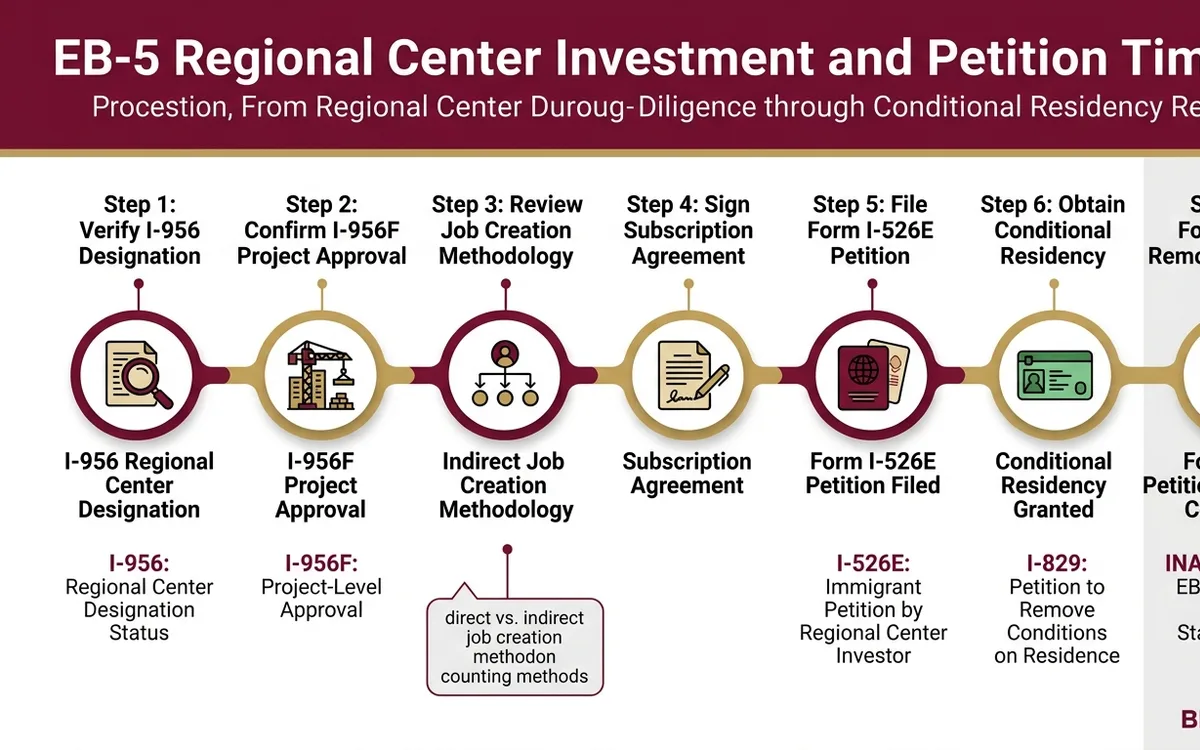
An EB-5 regional center investor visa attorney reviews a regional center's current I-956 designation, its Form I-956F project-level approval status, and its indirect job-creation methodology before you sign a subscription agreement, then files your Form I-526E petition under INA § 203(b)(5) and tracks your conditional residency through Form I-829.
The Hard Truth
Here is the hard part: a regional center's current good standing does not guarantee it stays that way for the three to five years your I-526E and I-829 petitions are pending. USCIS's Immigrant Investor Program Office (IPO) can terminate a regional center's I-956 designation for noncompliance, and under the EB-5 Reform and Integrity Act of 2022 (RIA), a terminated regional center cannot sponsor new indirect job creation, even for investors who already filed. The RIA reauthorized the Regional Center Program through 2027; if Congress does not renew it again, new regional center filings could stop, though pending petitions have generally continued under grandfathering treatment USCIS applied during prior lapses. Most troubled EB-5 projects were not frauds from day one. They were real developments that ran short of construction capital, fell behind on Integrity Fund compliance filings, or relied on an indirect job-creation methodology, RIMS II or IMPLAN, that an IPO economist later rejected.
What Happens If You Wait
Skipping project due diligence does not just risk your capital. It risks the conditional residency timeline sitting underneath it. If the regional center sponsoring your investment loses its I-956 designation after you file Form I-526E but before approval, USCIS can deny the petition or request amended evidence, adding delay on top of the 28-to-55-month I-526E processing range USCIS's own processing-time data currently reports for the Texas Service Center. If you already hold conditional residency and the project fails its job-creation count by the time you file Form I-829, due in the 90 days before your conditional residency's two-year anniversary under 8 C.F.R. § 216.6, you can lose status with no project left to fix the shortfall. Checking a regional center's Form I-956F project-level approval only after your capital has been wired leaves you with far fewer options, mostly a civil claim against the project sponsor, not an immigration remedy.
Step-by-Step Process
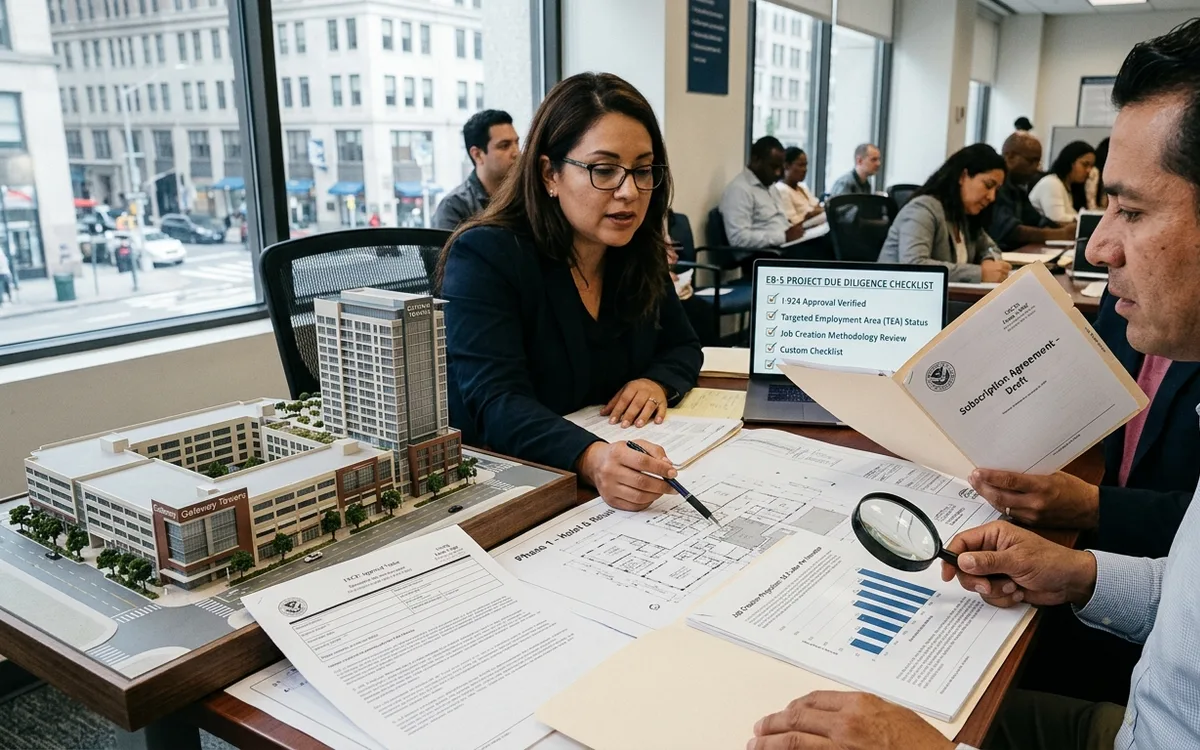
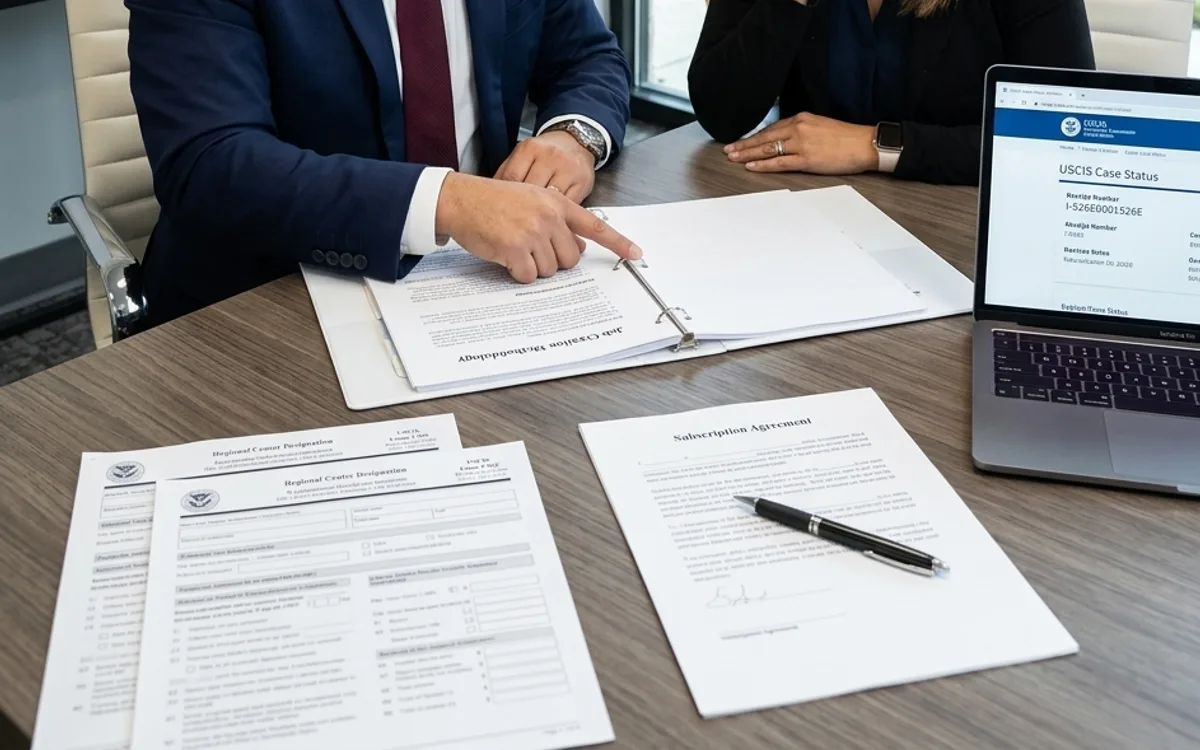
Due diligence comes first, before any subscription agreement is signed. We verify the regional center's current I-956 designation against USCIS's public list, request the project's Form I-956F approval notice rather than accepting a pending receipt, confirm the targeted employment area (TEA) documentation, and review the indirect job-creation study's RIMS II or IMPLAN inputs against the at-risk investment standard set in Matter of Izummi, 22 I&N Dec. 169 (BIA 1998). Next comes the subscription and escrow review: confirming the minimum investment, $800,000 in a TEA or $1,050,000 outside one under INA § 203(b)(5)(C) as adjusted by the RIA, and confirming escrow releases on USCIS filing, not merely on closing. We then file Form I-526E at the USCIS Texas Service Center, citing the already-approved I-956F project rather than one still pending its own agency review. From there, NC-based investors typically complete adjustment-of-status interviews and biometrics at the USCIS Charlotte Field Office; conditional residency begins on approval and runs two years. During that window we track the project's ongoing Integrity Fund compliance and annual certifications, then file Form I-829 in the 90-day window before the two-year anniversary, documenting the indirect jobs the project actually created. If processing stalls well beyond posted times, a mandamus or Administrative Procedure Act action can be filed in the U.S. District Court for the Eastern District of North Carolina, Raleigh Division, under that court's Local Civil Rule 7.1 motions practice.
A Real-World Example
Consider a composite investor, call him Mr. R, a software executive in Cary, North Carolina choosing between two Research Triangle Park regional center offerings with similar minimum investments. Pulling USCIS's regional center list showed both sponsors held current I-956 designation, but only one had an approved Form I-956F for the specific project; the other's project-level filing was still pending with no decision date. The approved project's TEA documentation matched current census-tract data, and its job-creation study used IMPLAN inputs with assumptions our team could trace line by line; the pending project's study relied on an older multiplier set that an IPO economist had flagged in an unrelated filing. Mr. R chose the project with the approved I-956F and documented methodology, and we filed his Form I-526E at the Texas Service Center citing that approval. His petition is now pending, his conditional residency clock has not yet started, and the project's compliance filings are reviewed on an ongoing basis through his conditional period. No stage of that process guarantees an outcome; it only narrows the risks within his control before USCIS adjudicates the rest.
William J. Vasquez has spent years focused on federal immigration matters, including employment-based and investor-category filings, and reviews project-level documentation, TEA studies, and job-creation methodologies as part of EB-5 regional center matters before any investor signs. His practice is federal; EOIR, USCIS, and BIA matters fall under federal jurisdiction regardless of state bar lines, and his work on investor petitions centers on reading the project file the way USCIS's Immigrant Investor Program Office will read it, not on general investment advice. Our team coordinates with investors' financial and tax advisors on the business side while handling the immigration filings directly.
Key Terms Explained
Form I-526E: the immigrant petition a regional center investor files with USCIS to classify their investment under INA § 203(b)(5); it must cite an already-approved project. Form I-956F: the project-level filing a regional center must get approved before its investors' I-526E petitions can rely on that project's job creation, required under the EB-5 Reform and Integrity Act of 2022. Form I-829: the petition filed near the end of the two-year conditional residency period to remove conditions, requiring proof the investment created the required jobs. TEA (targeted employment area): a high-unemployment or rural area where the minimum EB-5 investment drops to $800,000 instead of $1,050,000. At-risk investment: the Matter of Izummi, 22 I&N Dec. 169 (BIA 1998) standard requiring real risk of loss, not a guaranteed-return arrangement. EB-5 Integrity Fund: the annual fee and audit mechanism the RIA created for regional centers to fund fraud prevention and compliance oversight. Immigrant Investor Program Office (IPO): the USCIS unit that designates regional centers, approves I-956F project filings, and adjudicates I-526E and I-829 petitions. Mandamus action: a federal lawsuit asking a court to compel an agency to act on an unreasonably delayed petition.
Frequently Asked Questions
Q: How do I check whether a regional center still holds its I-956 designation before I invest? A: USCIS publishes a current list of designated regional centers on its website; confirm the sponsor's name matches exactly, since a terminated regional center is removed from that list, and ask the sponsor directly for their most recent USCIS designation notice.
Q: What happens to my I-526E if the regional center loses its designation after I file? A: USCIS generally requires the petition to be amended to a different qualifying project or regional center, which adds processing time; it does not automatically mean denial, but it does mean your original job-creation basis no longer applies.
Q: Is a pending Form I-956F project approval the same as an approved one? A: No. A pending I-956F means USCIS has not yet confirmed the project's job-creation methodology or TEA eligibility, and an I-526E filed citing that project carries more adjudication risk than one citing an already-approved I-956F.
Q: Can I switch from a direct EB-5 investment to a regional center project, or the reverse, after filing? A: It requires filing an amended or new I-526E citing the new enterprise or project, since the original petition is tied to the specific investment and job-creation method you first filed under INA § 203(b)(5).
Q: What if my I-526E has been pending far longer than USCIS's posted processing time? A: After exhausting USCIS inquiry channels, a mandamus or Administrative Procedure Act lawsuit can be filed in federal district court to compel a decision; our team evaluates timing and venue, including the U.S. District Court for the Eastern District of North Carolina, before recommending that step.
EB-5 investors who work with our team describe a process built on document review before investment, not after. Clients return for the annual compliance check-ins we build into the conditional residency period, and several have referred other investors evaluating the same regional center offerings. We report that as volume of work handled over years of practice, not as any statistic about results, because EB-5 adjudications are USCIS's decisions to make, not ours to promise.
If you already have a subscription agreement in hand, the review is faster with the offering documents, the I-956F notice (or confirmation one does not yet exist), and the project's TEA study in front of us. If you are still comparing two or three regional center projects, that is the better time to call.
Schedule a consultation with our immigration team to have a specific regional center project and its I-956F status, job-creation methodology, and TEA documentation reviewed before you sign, or to get your pending I-526E or I-829 evaluated if it has already been filed. Call our North Carolina office or request a consultation through our site to start that review.