You have the publications, the awards, the press clips, the citations. People in your field recognize your name without being told who you are. What you do not know is whether a USCIS officer reading your file at the Texas Service Center will see the same thing your peers see, or whether your evidence will read as solid work dressed up as extraordinary. That gap, between how your field sees you and how an immigration officer is required to read your file under 8 C.F.R. § 204.5(h)(3), is where EB-1A self-petitions either hold up or come apart.
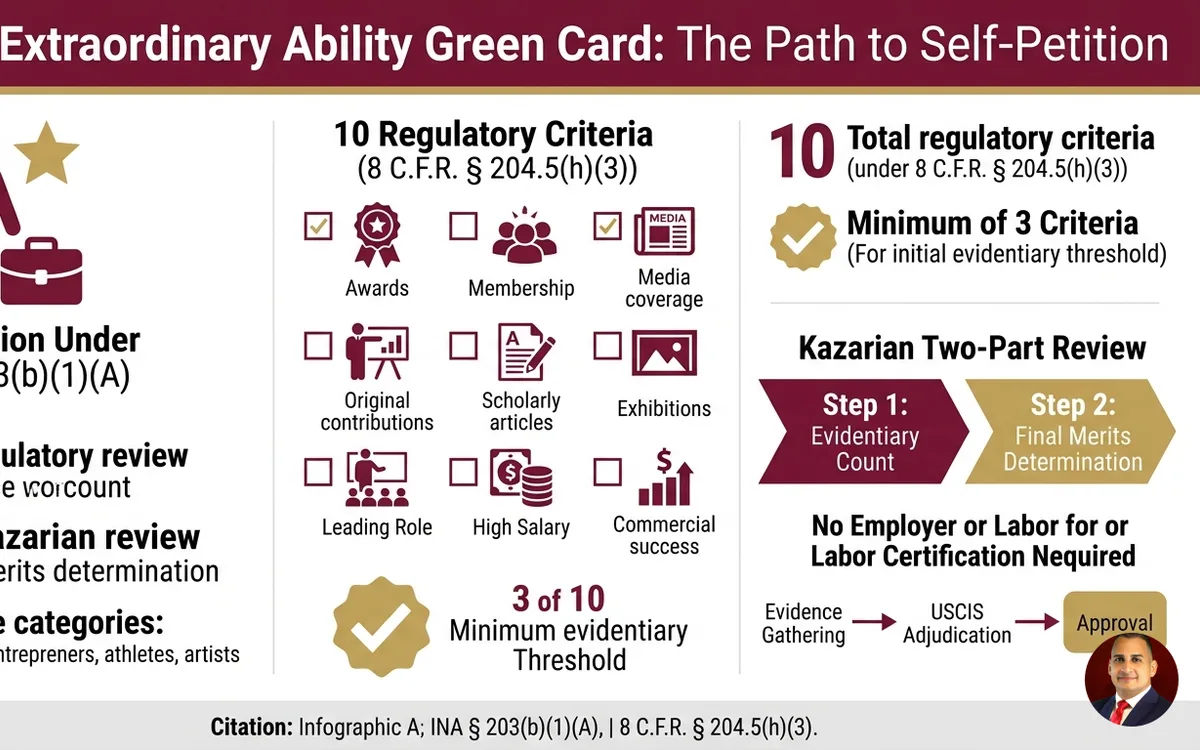
An EB-1A extraordinary ability green card lets researchers, entrepreneurs, athletes, and artists self-petition under INA § 203(b)(1)(A) without an employer or labor certification. USCIS requires evidence meeting at least 3 of 10 regulatory criteria under 8 C.F.R. § 204.5(h)(3), then applies the Kazarian two-part evidentiary and final merits review to every petition.
The Hard Truth
Meeting three of the ten criteria under 8 C.F.R. § 204.5(h)(3) does not mean USCIS will approve your petition. The framework from Kazarian v. USCIS, 596 F.3d 1115 (9th Cir. 2010), which USCIS now applies nationwide, splits review into two separate steps: first, a checklist pass asking whether your evidence technically satisfies at least three criteria, and second, a final merits determination asking whether your record, taken as a whole, shows you have actually risen to the top of your field. A petitioner can clear the first step and still be denied at the second, because quantity of evidence is not the same as evidence of sustained national or international acclaim. Citation counts, judging invitations, and press mentions that genuinely impressed your field can still read as the normal markers of a strong career rather than proof you sit at the top of it. USCIS officers who review EB-1A files apply that same two-step test to every petition, regardless of how your record is regarded inside your field.
What Happens If You Wait
Waiting to file carries its own cost, separate from whether your case is strong enough today. If you hold F-1 Optional Practical Training, that work authorization expires on a fixed date set by your I-20, typically 12 months plus up to 24 months under a STEM OPT extension per 8 C.F.R. § 214.2(f)(10)(ii). If you are on H-1B, your six-year limit under INA § 214(g)(4) keeps running while you wait to self-petition. EB-1 is current for most countries but has retrogressed for applicants born in China and India in recent cycles of the Department of State Visa Bulletin, so a delayed filing can land you behind a longer line than the one you would join today. Evidence also ages. A citation count that looked strong two years ago can look thin against your field's current output, and awards, judging roles, or press coverage that stopped after your strongest year can work against the sustained acclaim standard the regulation requires.
Step-by-Step Process
Step one is a criterion-by-criterion gap analysis against the ten categories in 8 C.F.R. § 204.5(h)(3), or the comparable-evidence provision in 8 C.F.R. § 204.5(h)(4) if the standard categories do not fit your field. Step two is evidence assembly: documentation for each criterion you plausibly meet, plus recommendation letters that explain your specific contribution rather than restating your CV. Step three is a legal brief that ties each piece of evidence to the Kazarian two-part structure before it ever reaches an officer's desk. Step four is filing Form I-140 with USCIS, which routes EB-1A self-petitions to the National Benefits Center or Texas Service Center, with no labor certification and no employer sponsor required. Step five is an optional premium processing upgrade, which commits USCIS to action within 15 calendar days of receipt under its current service terms, for an added fee. Step six, if USCIS issues a Request for Evidence, is a written response addressing the specific criterion in question, due by the deadline stated on the notice. Step seven is the decision; if denied, you can appeal to the USCIS Administrative Appeals Office on Form I-290B within 33 days under 8 C.F.R. § 103.3. Step eight, once the I-140 is approved and your priority date is current, is filing Form I-485 to adjust status if you are already in the U.S., or Form DS-260 for consular processing abroad.
A Real-World Example
Consider a composite example built from the kind of record this firm's immigration team commonly evaluates: a postdoctoral researcher at a Research Triangle Park institution with roughly a dozen peer-reviewed publications, a mid-range citation count, and two conference awards. In the initial gap analysis, her CV was mapped against each of the ten criteria in 8 C.F.R. § 204.5(h)(3), and three looked plausible: original contributions of major significance, authorship of scholarly articles, and judging the work of others through peer review for two journals. That addressed the first Kazarian step on paper. The harder work came next, drafting recommendation letters that explained, in a reviewer's own words, how her method changed practice in other labs rather than simply listing her credentials. The petition was filed with USCIS at the National Benefits Center. Several months later, a Request for Evidence arrived challenging the authorship criterion and asking for more detail on her role relative to co-authors on multi-author papers. Responding meant going back to those co-authors for individual contribution statements, a step that took longer than either she or the legal team had planned for. That stage, not the initial filing, is usually where an academic EB-1A record is actually tested.
William J. Vasquez leads the firm's employment-based self-petition work, including EB-1A filings for researchers, entrepreneurs, athletes, and artists who want to petition on their own record rather than through an employer. He focuses a substantial part of his federal immigration practice on evidentiary strategy under 8 C.F.R. § 204.5(h)(3) and the Kazarian two-part framework USCIS applies to every EB-1A petition. Rather than a general eligibility consultation, he works through each of the ten regulatory criteria individually with a prospective petitioner, identifying which ones the existing record actually supports and which would need more documentation before filing. Our broader immigration team supports that work with research, brief drafting, and RFE response preparation.
Key Terms Explained
INA § 203(b)(1)(A): the statutory section creating the extraordinary ability immigrant classification, one of three employment-based first-preference categories. 8 C.F.R. § 204.5(h)(3): the regulation listing ten evidentiary categories, such as major awards, published material about you, original contributions, and high salary, of which a petitioner must satisfy at least three unless relying on a one-time major achievement. Kazarian two-part test: the review framework from Kazarian v. USCIS, 596 F.3d 1115 (9th Cir. 2010), under which USCIS first checks whether evidence technically meets the regulatory criteria, then conducts a final merits determination on the record as a whole. Form I-140: the Immigrant Petition for Alien Worker, the form used to file an EB-1A self-petition without a labor certification or employer. Request for Evidence (RFE): a USCIS notice asking for additional documentation before it decides a petition, with a deadline set on the notice itself. National Benefits Center / Texas Service Center: the USCIS facilities with filing jurisdiction over EB-1A I-140 petitions. Administrative Appeals Office (AAO): the USCIS body that reviews denied petitions on appeal and issues decisions interpreting the regulatory criteria. Priority date: the date USCIS receives your I-140, which marks your place in line for a green card once annual visa numbers become limited.
Frequently Asked Questions
Q: How many of the ten EB-1A criteria do I need to meet? A: At minimum, three of the ten criteria listed in 8 C.F.R. § 204.5(h)(3), unless you qualify instead through a one-time major achievement such as a Nobel Prize or Pulitzer under the same regulation. Meeting three criteria only clears the first Kazarian step; it does not guarantee a final merits determination in your favor.
Q: Should I file EB-1A or an EB-2 National Interest Waiver instead? A: It depends on your specific evidence. EB-2 NIW generally asks for a lower evidentiary threshold under Matter of Dhanasar while still requiring no labor certification or job offer, and a tenure-track researcher with strong publications but limited awards or media coverage sometimes fits that standard more comfortably than EB-1A's sustained-acclaim bar.
Q: Can a startup founder with no job offer letter qualify for EB-1A? A: Yes. EB-1A has no job offer or labor certification requirement under INA § 203(b)(1)(A), so a founder can self-petition on evidence such as original business contributions, media coverage of the company, or a leading or critical role in a distinguished organization, as long as the evidence ties to the founder's own ability rather than the company's results alone.
Q: What happens if USCIS challenges a specific criterion in a Request for Evidence? A: You respond with documentation addressing the exact criterion USCIS questioned, by the deadline printed on the notice. If the petition is still denied, you can appeal to the USCIS Administrative Appeals Office on Form I-290B within 33 days of the denial under 8 C.F.R. § 103.3.
Q: How long does premium processing take for an EB-1A self-petition? A: Premium processing commits USCIS to taking action, an approval, denial, or RFE, within 15 calendar days of receipt, per current USCIS premium processing service terms. Without it, standard I-140 processing times vary by service center and are posted on uscis.gov.
Clients who come to us for EB-1A self-petitions are typically mid-career professionals who have never worked with an immigration attorney before and are comparing more than one firm's read on their record. Reviewers consistently describe a first meeting where our attorneys walked through specific gaps in their evidence rather than offering a blanket assurance that they qualify. That directness, including being told which criteria do not look strong yet, is the pattern mentioned most often by past clients.
Your publication list, award history, or press coverage already exists. What changes how USCIS reads it is how that record gets organized and argued against the specific regulatory language in 8 C.F.R. § 204.5(h)(3), not how impressive it sounds to colleagues inside your own field.
If you are weighing an EB-1A self-petition against an EB-2 National Interest Waiver, or want a criterion-by-criterion read on your record before spending months building a case, schedule a consultation with our immigration team to go through your evidence against 8 C.F.R. § 204.5(h)(3) in detail.