
A treaty between the United States and your country of nationality is what makes this visa possible. The E-2 classification is built for investors who put real capital at risk in an operating business, with safeguards meant to screen out anyone simply trying to buy a visa.
Officers at USCIS and U.S. consulates scrutinize business plans, trace the source of invested funds, and ask one blunt question: does this enterprise do more than support your family? Get that wrong and your capital is at risk along with your status.
This page walks through what 'substantial' and 'not marginal' mean under current law, what consular processing and change of status cost in time and government fees, and where a treaty-enterprise owner needs a documented record before filing, not after a denial. Last updated June 2025, reflecting USCIS and Department of State adjudication practice for fiscal year 2025.
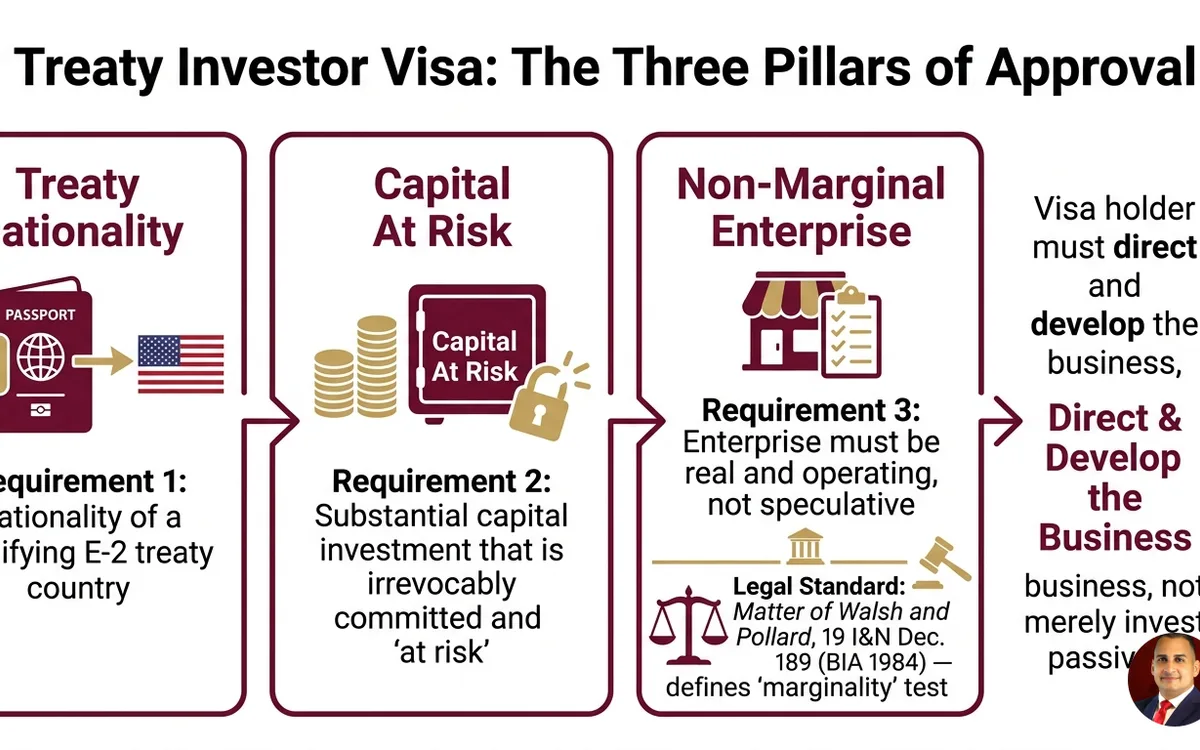
An E-2 treaty investor visa lets a national of a qualifying treaty country direct and develop a business after investing a substantial amount of capital in a real, operating U.S. enterprise. Approval requires treaty-country nationality, an irrevocable investment at risk, and proof the enterprise is not marginal under Matter of Walsh and Pollard, 19 I&N Dec. 189 (BIA 1984).
The Hard Truth
What Really Determines Whether Your E-2 Petition Succeeds?
Most E-2 denials have nothing to do with how much money you have. They come from two failures: a business plan that cannot show the enterprise will employ others and generate more than a living for your household, and a source-of-funds trail with gaps a consular officer or USCIS adjudicator can see immediately.
The marginality standard from Matter of Walsh and Pollard, 19 I&N Dec. 189 (BIA 1984), is not a dollar-amount test. A $60,000 investment in a well-documented franchise with a hiring plan can satisfy it; a $400,000 investment in a business with no realistic path to hiring past year one can fail it. Officers weigh proportionality, the nature of the business, and job-creation projections together, under 8 CFR § 214.2(e)(15) and the USCIS Policy Manual, Volume 2, Part E.
Rough proportionality bands that have held up in practice, not official brackets written into any regulation:
- Under $100,000: typically service or franchise businesses with low startup costs; the investment should sit at or near 100% of total business cost.
- $100,000 to $300,000: retail, food service, or small manufacturing, where the investment often covers equipment, lease buildout, and roughly 12 months of operating capital.
- $300,000 and above: larger or multi-location operations, where the proportionality ratio can be lower but the absolute dollar amount and job-creation showing still have to be real.
The Department of State's treaty country list currently runs to nearly 80 countries and territories under 9 FAM 402.9, and that list changes over time. If your country of nationality is not on it, no amount of capital changes the answer. The Department also publishes nonimmigrant visa issuance data by classification at travel.state.gov's visa statistics page; this firm does not cite an approval or success rate drawn from that data, because case-by-case outcomes are not a statistic worth repeating as a sales claim.
Capital that is a loan secured only by the business itself, or a gift with no documented transfer history, routinely draws a request for evidence before an officer ever reaches the marginality question.
What Happens If You Wait
What Happens If You Wait to Prepare Your E-2 Filing?
Delay has a cost that shows up before any denial letter arrives. Commercial lease agreements often carry a 60- to 90-day contingency window; if your E-2 petition is still being drafted when that window closes, you may lose the location you negotiated or have to renegotiate from a weaker position.
If you are already in the United States on a different status, such as F-1 or B-1/B-2, your authorized stay has an expiration date printed on Form I-94. Every week spent assembling documentation after that date passes is a week spent out of status, and USCIS does not pause the clock while a business plan gets written.
Wiring investment capital into a U.S. business account before the enterprise's structure, source-of-funds documentation, and transfer terms are settled creates a separate problem. Capital placed too early, without the paper trail an officer will ask for, is often capital you cannot later prove was genuinely 'at risk' as INA § 101(a)(15)(E)(ii) requires. Fixing that documentation after the fact is far harder than building it as you go.
Step-by-Step Process
How Does the E-2 Process Actually Work?
Step 1: Confirm treaty-country nationality and entity ownership. At least 50% of the enterprise must be owned by nationals of the treaty country, under 8 CFR § 214.2(e)(1). For a North Carolina LLC or corporation, that means tracing the full cap table, not just the founder's passport.
Step 2: Build the business plan and investment record. This is where most cases are decided before they are ever filed. You need a five-year financial projection, a hiring timeline, and documentation of every dollar's path into the business: bank wires, loan agreements, gift letters, asset sales.
Step 3: Register and license the enterprise in North Carolina. This includes filing Articles of Organization or Incorporation with the North Carolina Secretary of State's business registration division in Raleigh, obtaining a Certificate of Existence, securing an EIN from the IRS, and getting any local or state license the specific industry requires. Investors in the Research Triangle Park corridor can also draw on the North Carolina Department of Commerce's International Trade Division as a resource while structuring a new enterprise.
Step 4: Choose your filing path. If you are abroad, you file Form DS-160 and schedule an E-2 interview at the consulate or embassy with jurisdiction over your residence. If you already hold valid status in the U.S., you may instead file Form I-129 with the E-2 Classification Supplement for a change of status, adjudicated by USCIS rather than a consular post. The comparison table below lays out how these two paths differ on timeline, fees, and risk.
Step 5: Attend the interview or await the service center decision. Consular wait times vary by post, from a few weeks to several months, and the Department of State publishes current wait times by post. USCIS change-of-status processing commonly runs several months at standard speed; Form I-907 premium processing, where available for the underlying I-129, provides a decision within 45 calendar days for an additional government fee.
Step 6: Plan for renewal from day one. E-2 status can be renewed indefinitely as long as the enterprise continues to meet the substantiality and non-marginality standards, under 8 CFR § 214.2(e)(5) and (20). The recordkeeping you start at filing, financial statements, payroll records, tax filings, has to continue for the life of the business, not just the first petition.
Step 7: Bring in your team. Once the enterprise is operating, executives, supervisors, or employees whose skills are essential to the business can be sponsored under the E-2 essential employee visa. If your enterprise is growing past where the E-2 category fits, our EB-5 immigrant investor visa and L-1 intracompany transfer visa pages cover the paths investors use as the business matures.
A Real-World Example
What Does a Real E-2 Filing Look Like, Step by Step?
Consider a composite scenario based on patterns common among treaty investors, not a real client. A national of a treaty country living in North Carolina wants to open a specialty import business in Charlotte.
Personal savings and a documented bank loan secured by assets outside the business got her to $150,000. Working with an accountant, she built a five-year plan projecting two hires in year one and four by year three, a plan built to answer the non-marginality question head-on. Before moving any investment capital, she registered the LLC with the North Carolina Secretary of State, obtained an EIN, and opened a dedicated business bank account.
Because she held valid B-1 status at filing, she filed Form I-129 with the E-2 Classification Supplement from inside the U.S. USCIS issued a request for evidence six weeks later, asking for additional proof that the loan funds were unconditionally committed to the business rather than a personal obligation she could walk away from. She responded with the original loan agreement, a letter from the lender confirming the funds were secured by her personal real estate and not the business itself, and an updated financial projection.
That is the shape of a real E-2 case: documentation, a plan, a filing, often a follow-up request, and a wait that depends on the service center's current caseload. The decision itself rests with USCIS or the consular officer, not with any attorney.
Who Handles Your E-2 Case?
William J. Vasquez leads the firm's business and investor immigration work. Federal immigration-bar standing allows him to represent clients before USCIS and the Board of Immigration Appeals nationwide, regardless of state bar jurisdiction, consistent with 8 C.F.R. § 1292.1.
Membership in the American Immigration Lawyers Association (AILA), the national bar association for attorneys practicing business and family immigration law, runs alongside a caseload that has included business-plan review, source-of-funds documentation, and E-2 filings for treaty investors and treaty enterprises across industries ranging from franchise retail to professional services.
The approach centers on the paperwork problem before it becomes a legal one: tracing where investment capital actually came from, documenting it the way an adjudicator will expect to see it, and building the hiring and growth plan that answers the marginality question directly, rather than leaving it for a request for evidence to surface later.
Read more about William J. Vasquez's background and practice areas.
Key Terms Explained
Key E-2 Terms Explained
Treaty investor (E-2). A classification under INA § 101(a)(15)(E)(ii) and 8 CFR § 214.2(e) for nationals of a country with a qualifying treaty of commerce and navigation with the United States who direct and develop a real business they have invested in.
Substantial investment. An amount of capital proportional to the total cost of establishing or purchasing the specific enterprise, weighed against that enterprise's actual needs, not a fixed dollar figure.
Marginality. The standard from Matter of Walsh and Pollard, 19 I&N Dec. 189 (BIA 1984), requiring the enterprise to generate more than enough income to provide a minimal living for the investor and family, usually shown through a credible hiring and revenue plan.
Change of status. A petition filed with USCIS on Form I-129 with the E-2 Classification Supplement, by someone already lawfully present in the U.S., requesting a new status without leaving the country.
Consular processing. The path for applicants abroad, or those who choose to process this way, involving Form DS-160 and an in-person interview at a U.S. embassy or consulate with jurisdiction over the applicant's residence, under 9 FAM 402.9.
Request for Evidence (RFE). A formal USCIS notice asking an applicant or petitioner for additional documentation before an officer will decide the case.
Essential employee. A worker with skills, knowledge, or experience essential to the treaty enterprise's operation, eligible for the E-2 essential employee visa once the enterprise itself holds E-2 status.
214(b) refusal. A consular denial under INA § 214(b), based on a finding that the applicant did not overcome the presumption of immigrant intent or did not establish eligibility for the classification sought.
Frequently Asked Questions
Frequently Asked Questions About E-2 Treaty Investor Visas
Q: How much money do I need to invest to qualify for an E-2 visa? A: There is no fixed minimum. USCIS and consular officers apply a proportionality test comparing your investment to the total cost of establishing that specific type of business, under 8 CFR § 214.2(e)(15). A $60,000 investment in a low-cost service business can qualify, while a larger investment in a capital-intensive business can still fall short if it is not proportional to what that business requires.
Q: Can my spouse work in the United States on an E-2 dependent visa? A: Yes. E-2 dependent spouses are authorized to work incident to status without filing a separate Form I-765, a policy USCIS implemented in 2022 for E and L dependent spouses whose Form I-94 reflects the correct dependent classification. Confirm your I-94 annotation before starting work.
Q: What does it cost to file an E-2 petition or application? A: Government fees include the Form I-129 filing fee for change-of-status petitions (set at $1,015 for E classification under the USCIS fee schedule effective April 1, 2024, 8 CFR § 106.2; confirm the current amount on USCIS's fee schedule before filing) or the $315 E-visa application fee for consular processing, per the Department of State's reciprocity fee schedule. Attorney fees vary with the complexity of the business plan and source-of-funds documentation and are discussed directly in a consultation.
Q: How long does E-2 processing take? A: Consular interview wait times vary by post and are published by the Department of State at travel.state.gov, ranging from a few weeks to several months. USCIS change-of-status adjudication at standard speed commonly runs several months, while Form I-907 premium processing, where available, provides a decision within 45 calendar days for an additional $2,805 fee.
Q: What happens if my E-2 application is denied? A: A consular denial under INA § 214(b) is not appealable, but you can reapply with additional evidence addressing the specific ground cited in the refusal. A USCIS denial on a change-of-status petition can sometimes be addressed through a motion to reopen or reconsider, or by refiling, depending on the stated reason for denial.
Q: Can an E-2 investor eventually get a green card? A: E-2 status does not lead directly to a green card. It is a nonimmigrant, renewable category with no set limit on the number of renewals. Investors who want permanent residence typically look at separate paths, such as EB-5 immigrant investor status or an employment-based petition tied to the enterprise's growth.
Q: How many employees can one treaty enterprise sponsor? A: There is no statutory cap on the number of E-2 essential employees one enterprise can sponsor, but each individual must independently meet the essential-skills or executive/supervisory standard under 8 CFR § 214.2(e)(17)-(18). Sponsoring many employees without a business large enough to support them can itself raise a marginality question about the enterprise.
Q: Does an e-commerce or remote-first business qualify for E-2 status? A: It can, but marginality review tends to be sharper for asset-light businesses. Officers look for a documented hiring plan and revenue projections showing the business will do more than support the owner, since a passive online holding with minimal staffing is close to the fact pattern Matter of Walsh and Pollard was written to screen out.
What Clients Say About Working With This Firm
Clients who come to this firm for E-2 matters are often meeting with an immigration attorney for the first time as a business owner rather than as someone facing a removal case. Reviewers describe direct communication about what the business plan needs to show, clear explanation of the source-of-funds documentation an officer will expect, and responsiveness during the wait for a consular interview or USCIS decision. This firm does not publish outcome statistics or success rates; it describes, and clients describe, the process itself.
If you are still deciding whether your business and your capital fit the E-2 framework, start with a conversation about your specific investment, industry, and treaty country. That conversation, not a filing, is usually where marginality risk and source-of-funds gaps surface first.
Schedule a consultation with our immigration team to review your business plan, your investment documentation, and whether change of status or consular processing fits your situation and your treaty country. Call our North Carolina office or request a consultation through our E-2 treaty investor visa services page to get a specific assessment of your enterprise before you file.

- E-2 Treaty Investor Visa Overview
- EB-5 Immigrant Investor Visa
- E-1 Treaty Trader Visa
- L-1 Intracompany Transfer Visa
- E-2 Essential Employee Visa
- Attorney William J. Vasquez
- Schedule a Consultation