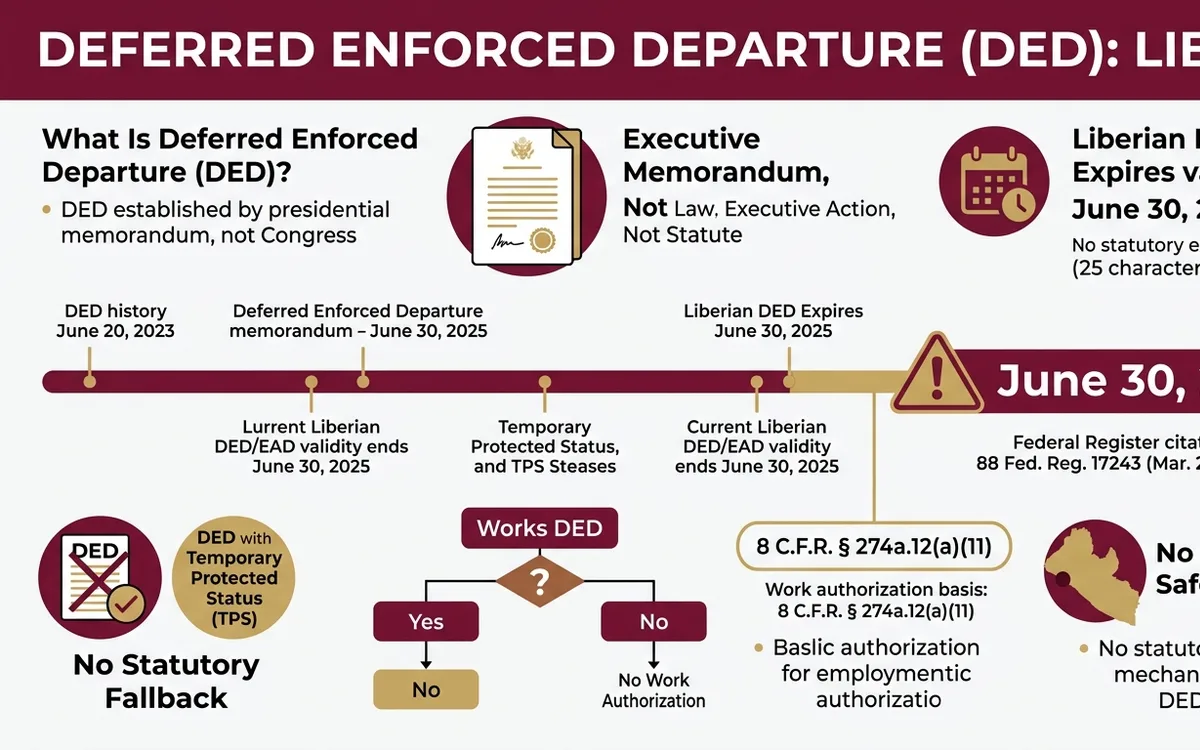
Your work permit says you can stay and work here, but it is tied to a memorandum a president signed, not a law Congress passed. That distinction keeps people awake at night. If you are a Liberian national under Deferred Enforced Departure (DED), your protection and your Employment Authorization Document (EAD) both run through June 30, 2025, unless the current administration acts again before then. DED was never put to a vote in Congress, and if the next memorandum doesn't arrive, there's no appeal to file. This page was last reviewed in June 2025, while that deadline is still live. You do not have to wait for the directive to lapse to find out whether you qualify for something more permanent.
Deferred Enforced Departure (DED) is a temporary, country-specific protection from removal created by presidential memorandum, not statute, with work authorization under 8 C.F.R. § 274a.12(a)(11). The current Liberian DED and related EAD validity run through June 30, 2025, per 88 Fed. Reg. 17243 (Mar. 22, 2023). No statutory fallback exists if it lapses.
The Hard Truth
The Hard Truth About DED's Legal Foundation
DED rests on the president's inherent authority over foreign affairs - the same discretion the Supreme Court recognized in Reno v. American-Arab Anti-Discrimination Committee, 525 U.S. 471 (1999), which held that decisions about whom to deport, and when, rest largely outside judicial review. No statute created it. A new administration can shorten, decline to renew, or revoke a DED designation with far less process than Congress would need to end a statutory program like Temporary Protected Status (TPS).
Liberia's DED has been extended by memorandum repeatedly since the 1990s, most recently through June 30, 2025. Each extension exists because a sitting president decided to sign one, not because any law requires it. If the memorandum isn't renewed, there's no appeal process and no administrative hearing available. Courts have made clear they won't step in to order an extension of a program resting on executive discretion rather than statute. The 2021 termination of DED for certain Venezuelan and Hong Kong nationals shows how quickly a designation can end when a new administration reassesses the underlying foreign-policy judgment.
Treating the next memorandum as your entire plan for staying in the United States means carrying a risk you have never actually sized up.
What Happens If You Wait
What Happens If You Wait
An EAD tied to DED does not renew itself. If your card expires before you file Form I-765 and before any automatic extension published in the Federal Register covers you, your work authorization lapses the day the card does. An employer that re-runs E-Verify or requests I-9 reverification at that point has no legal basis to keep you on payroll.
If DED ends while your renewal is still pending at the USCIS Vermont Service Center, USCIS can deny the case outright, because C11 eligibility under Form I-765 depends on an active DED designation existing at the time of adjudication. At that point you are out of status with no pending application protecting you, and ICE can initiate removal proceedings.
Once removal proceedings start, the clock changes entirely. A petition for review of a final Board of Immigration Appeals order must be filed within 30 days under Federal Rule of Appellate Procedure 15, and that deadline is jurisdictional, meaning a federal circuit court will not accept a late filing for almost any reason. Not knowing the deadline existed is not a basis for an extension.
Step-by-Step Process
How to Renew Your DED-Based EAD
Track the Federal Register. DHS publishes a new notice each time DED is extended or a designation nears expiration. For Liberia, the operative notice is 88 Fed. Reg. 17243 (Mar. 22, 2023), implementing the March 2023 presidential memorandum that runs through June 30, 2025. Check federalregister.gov directly, searching for the Liberia DED notice by date, rather than relying on secondhand summaries.
File Form I-765 early. USCIS processes DED-based work permits under category C11 through the USCIS Vermont Service Center. File your renewal as soon as a new Federal Register notice opens a filing window, typically 60 to 180 days before your current card expires, so there is no gap between cards.
Watch for an automatic extension notice. When DED is renewed close to a prior expiration date, DHS sometimes publishes an automatic extension of existing EADs for a stated period while new cards are produced. That extension only covers people whose prior card and DED grant already existed; it does not create new eligibility.
Attend biometrics if scheduled. Some DED renewals require biometrics capture. USCIS will send a notice with the date and Application Support Center location. In North Carolina, interviews or biometrics tied to DED filings are generally handled through the USCIS Charlotte Field Office.
Do not travel without advance parole. DED alone does not authorize re-entry after international travel. Departing without an approved Form I-131 advance parole document can jeopardize your ability to return and any pending application you have filed.
Screen for a permanent path before the directive lapses. This is the step most people skip. Certain Liberians may apply for lawful permanent residence under the Liberian Refugee Immigration Fairness (LRIF) provision, Section 7611 of the 2020 NDAA, independent of DED's survival. Other DED holders may qualify through adjustment of status based on a family or employment petition, or for asylum if conditions in their home country have changed. These paths often have their own deadlines separate from DED's calendar.
If removal proceedings begin anyway. A case that reaches the Charlotte Immigration Court (EOIR) after DED lapses needs a defense built on whatever independent relief you may have, since DED itself is not a form of relief a judge can grant. Our removal defense team handles these matters before the Charlotte Immigration Court and, where needed, petitions for review before the Fourth Circuit Court of Appeals.
A Real-World Example
A Composite Example: What the Process Actually Looks Like
Consider a composite, not a real client: a Liberian home health aide living in the Research Triangle area, working under a DED-based EAD set to expire in five months. She comes in after seeing a Federal Register notice referenced in a community group, unsure what it means for her card.
The first step is pulling her full immigration history: date of entry, every prior filing, any contact with immigration court, and any family members who are U.S. citizens or lawful permanent residents. That review takes one full appointment, not one phone call, because LRIF eligibility and family-based adjustment both depend on facts that are easy to get wrong from memory.
Next, her attorney files the I-765 renewal through the Vermont Service Center well before her current card expires, so there is no gap in work authorization. In parallel, the attorney evaluates whether she meets LRIF's continuous-presence and other statutory requirements under Section 7611 of the 2020 NDAA. If she does, that application moves on a track separate from DED, meaning it continues even if a future administration declines to extend the memorandum again.
The case then sits where most immigration filings sit for months: pending, with USCIS adjudicating in the order it receives filings. LRIF and adjustment cases commonly take well over a year. DED renewals move faster, but not instantly. What she has, at the end of this process, is a filed, pending application for a form of status that does not depend on a memorandum being renewed, plus a current work permit while she waits.
Who Handles DED Cases at This Firm
William J. Vasquez has spent over 20 years practicing immigration law, with his federal appellate work concentrated in removal defense and petitions for review arising from the Fourth Circuit, which covers North Carolina. He is admitted to practice before the Fourth Circuit Court of Appeals, which matters directly for DED holders here, since a Board of Immigration Appeals decision following a DED lapse would be reviewed by that circuit if removal proceedings reach the Charlotte Immigration Court.
His approach to DED cases is procedural: track the Federal Register notice for a specific country, calendar every renewal window, and screen for LRIF, asylum, or family and employment-based relief before a directive's expiration date becomes an emergency instead of a plan. See his full attorney profile for his background in humanitarian-protection and removal-defense matters.
Key Terms Explained
Deferred Enforced Departure (DED): A temporary protection from removal that a president authorizes for nationals of a specific country, created through a presidential memorandum rather than a federal statute, and implemented by DHS through a Federal Register notice.
Employment Authorization Document (EAD): The physical work permit, Form I-766, issued by USCIS. DED-based EADs are authorized under 8 C.F.R. § 274a.12(a)(11) and filed under category code C11 on Form I-765.
Temporary Protected Status (TPS): A separate, statutory humanitarian protection created by 8 U.S.C. § 1254a. Unlike DED, TPS is established by the Secretary of Homeland Security under a law Congress passed, with its own registration and re-registration process. See our TPS page for how the two programs differ in practice.
Liberian Refugee Immigration Fairness (LRIF): A statutory adjustment-of-status path for certain Liberian nationals and qualifying family members, enacted as Section 7611 of the National Defense Authorization Act for Fiscal Year 2020. It exists independently of DED and does not end when a DED memorandum expires.
Advance Parole (Form I-131): Permission to travel outside the United States and be allowed back in without abandoning a pending application. DED status alone does not include this; it must be requested and approved separately before departure.
Federal Rule of Appellate Procedure 15: The rule setting the 30-day deadline to file a petition for review of a final Board of Immigration Appeals order in the applicable U.S. Court of Appeals.
Vermont Service Center: The USCIS service center that adjudicates DED-based Form I-765 filings nationally, regardless of where the applicant lives.
Frequently Asked Questions
Q: What happens to my EAD if Deferred Enforced Departure for Liberia is not renewed by June 30, 2025? A: Your work authorization expires with the directive unless DHS publishes a Federal Register notice extending it or providing an automatic extension before that date. Without a new memorandum or a separate form of status already pending, you would have no independent legal basis to keep working.
Q: Can DED be revoked overnight, the way it was for some Venezuelan and Hong Kong nationals in 2021? A: Yes. Because DED rests on presidential discretion rather than statute, a new administration can decline to extend it, or shorten a prior extension, with far less process than ending TPS would require. There is no requirement of advance notice beyond whatever the administration chooses to give.
Q: Is there a green card path for Liberian DED holders? A: Yes, through the Liberian Refugee Immigration Fairness (LRIF) provision, Section 7611 of the 2020 NDAA, for Liberians and certain family members who meet its continuous-presence and other eligibility requirements. LRIF is a statutory path and does not depend on DED continuing.
Q: Can I travel abroad on DED status without an advance parole document? A: No. DED alone does not authorize reentry after international travel, so leaving the country without an approved Form I-131 advance parole document can jeopardize your ability to return and any pending application you have filed.
Q: What if my country's DED memorandum expires while my Form I-765 renewal is still pending at USCIS? A: USCIS generally cannot approve a DED-based work permit once the underlying designation has ended, because C11 eligibility depends on an active DED grant at the time of adjudication. This is why filing early and tracking the Federal Register notice matters more than waiting until your card is close to expiring.
Clients who come to our office for DED and other humanitarian-protection matters consistently describe the same two concerns before their first appointment: confusion about whether their work permit is still valid, and uncertainty about whether anything permanent exists beyond the current directive. Our team has handled DED, TPS, and related humanitarian-protection filings for clients across North Carolina's Liberian and other DED-eligible communities for years. We do not publish outcome statistics for immigration matters, because an EAD renewal, an LRIF application, or an asylum claim turns on facts specific to each person's history, not on a track record reduced to a percentage.
A directive that can change with an election is not something to manage passively. If you have not had your full immigration history reviewed against LRIF, asylum, or family and employment-based options, the best time to do it is while your current DED status and EAD are both still valid, not after a new Federal Register notice forces the question.
Schedule a consultation with our immigration team to have your DED case reviewed: your EAD renewal timeline, your eligibility for LRIF or another permanent path, and what to do if the directive is not extended. Call our office or request a consultation online, and bring your current EAD, your I-94 or entry records, and any prior immigration filings so we can map your options in one appointment. Learn more about our broader humanitarian protection and removal defense services before your directive's expiration date arrives.